17

I am trying to solve the following problem: Consider $n\geq 2$ and the polynomial $$P(x)=x^n+a_{n-1}x^{n-1}+a_{n-2}x^{n-2}+\ldots+a_1x+a_0$$ with $a_{n-1}, a_{n-2},\ldots,a_1, a_0\in[0,1]$. Prove that if $P(z)=0$, then $\Re(z)<\dfrac{1+\sqrt{5}}{2}$. ($\Re(z)$ denotes the real part of the complex number $z$).

I can't seem to find a meaningful way to use the condition $a_i\in[0,1]$. I managed to prove that if $P(z)=0$, then $|z|<2$: $$|z|^n=|a_{n-1}z^{n-1}+a_{n-2}z^{n-2}+\ldots+a_1z+a_0|\leq\sum_{k=1}^{n-1}|z|^k$$ hence, if $|z|>1$, $$|z|^n\leq\frac{|z|^n-1}{|z|-1}\Rightarrow |z|^{n+1}\leq 2|z|^n-1\Rightarrow |z|<2-\frac{1}{|z|^n}$$ and so, $|z|<2$.

Also, we see here another bound for $|z|$ in terms of the positive coefficients, but, nonetheless, I couldn't find anything about $\Re(z)$.

WimC
  • 33,414
  • 2
  • 52
  • 98
John WK
  • 1,073
  • What was $-1$? Can you clarify this because I'm trying to write an answer. – Sarvesh Ravichandran Iyer Apr 10 '22 at 06:33
  • The inequality we obtain is $|z|^{n+1}\leq 2|z|^n-1$ instead of $|z|^{n+1}\leq 2|z|^n+1$ – John WK Apr 10 '22 at 11:45
  • Is there any background on this inequality that you have? Where did you find it? I can't believe that the bound $\mathfrak{R}(z)<\frac{1+\sqrt 5}{2}$ is actually independent of $n$ : I've found bounds that are dependent on $n$ (which go to infinity with the constraints as $n \to \infty$, but are fixed for fixed $n$). – Sarvesh Ravichandran Iyer Apr 10 '22 at 12:19
  • Unfortunately, I don't have any background on this. The problem was sent to me. I don't think a bound that goes to infinity as $n\to\infty$ is well suited for the problem as we always have the bound $\Re(z)<2$. – John WK Apr 10 '22 at 13:50
  • I've also tried using Rouche Theorem based on this question, but it doesn't seem to work here https://math.stackexchange.com/questions/55889/justification-for-applying-rouch%c3%a9s-theorem-for-an-unbounded-domain – John WK Apr 10 '22 at 13:51
  • Thanks for the information. Yes, clearly a bound that goes to infinity is useless, but thankfully it seems that there are other good bounds around that are pretty useful. – Sarvesh Ravichandran Iyer Apr 10 '22 at 14:19
  • @JohnWK: For $1+\alpha=|z|$, $\alpha>0$, we have $$|p(z)-z^n|\leq\frac{|z|^n-1}{|z|-1}<\frac{|z|^n}{|z|-1}=\frac{|z|^n}{\alpha}$$ For $\frac{1}{\alpha}\leq1$, by Rouché's theorem all roots of $p$ are in the Ball $B(0;1+\alpha)$. The best ball from this argument being $B(0;2)$. That shows the conclusion of your last argument. – Mittens Apr 10 '22 at 15:00
  • @OliverDiaz If $\lvert z \rvert \leq 1$ then also $\lvert z \rvert < 2$. So OP’s argument misses a part, but calling it just wrong two times is a bit much. – WimC Apr 10 '22 at 20:08
  • 1
    I edited the answer. Sorry for the confusion. – John WK Apr 10 '22 at 21:00
  • (+1) @JohnWK: n ice question. Also, thanks for correcting the pesky oversight. – Mittens Apr 10 '22 at 21:03
  • This bound seems not to be sharp. The highest real part of a root of such a polynomial I've been able to find is $\approx 1.1367$, the polynomial being $x^{18} + x^{10} + x^9 + x^8 + x^7 + x^6 + x^5 + x^4 + x^3 + x^2 + x + 1$. Can anyone do better? – Jair Taylor Apr 10 '22 at 23:18

2 Answers2

10

Let $g=\frac{1+\sqrt 5}{2}$ be the golden ratio. Note that for $n \ge 2$ one has $g^n (g-1)=g^{n-1}>g^{n-1}-1$ so $g^n >1+g+\ldots +g^{n-2}$

But now assume by contradiction that the equation above has a root $\Re z \ge g$; dividing by $z^{n-1}$ one has:

$$ |z+a_{n-1}|=|-a_{n-2}/z-\ldots-a_0/z^{n-1}| \le 1/|z|+\ldots +1/|z^{n-1}|$$

But now $\Re(z+a_{n-1}) \ge \Re z >0$ and the imaginary parts are same so $|z| \le |z+a_{n-1}|$ so by substituting and simplifying we get

$$|z|^n \le 1+|z|+\ldots+|z|^{n-2}$$

But now the equation $x^n=1+\ldots+x^{n-2}$ has only one positive root $r_n$ (division by $x^n$ shows that clearly as rhs decreases then strictly), and from the left one has $0<x<r_n$ implies $x^n <1+x+\ldots +x^{n-2}$ (while from the right we have the opposite inequality). So, $r_n <g \le |z|$ on one hand by the first paragraph, and $|z| \le r_n$ by the inequality above which is a contradiction, and we are done!

Mittens
  • 46,352
Conrad
  • 31,769
  • (+1). Just two observations: the equation $x^n-x^{n-2}-\ldots -x-1=0$ has only one change of sign amongst its coefficients. This there is exactly one positive solution (by Descartes criteria) and (2) the argument used by the OP to show that solutions of $P$ are within the ball $B(0;2)$ is wrong (although it is indeed the case). An application of Rouche's shows that fact. – Mittens Apr 10 '22 at 19:22
  • @Oliver Yes that works of course - note that here we use the one starting at $-x^{n-2}$ but agree that one can use that argument too – Conrad Apr 10 '22 at 19:24
  • @Oliver - one can easily show directly (pretty much as above but starting from the original equation) that without any hypothesis about the real part, all the roots are bounded in absolute value by $x_n$ the unique positive root of $x^n=1+..+x^{n-1}$ and those are strictly less than $2$ But converge to $2$ – Conrad Apr 10 '22 at 21:09
  • @Oliver all good - that's a very good point about Descartes rules of change and I get what you are saying about thinking that way - I tend to think in terms of analytic bounds like the cauchy bound and its many cousins and here one notices that the golden ratio is the limiting cauchy bound for the equations that skips the $n-1$ power from the geometric series $1/g^2+...1/g^n+...=1$ and then it kind of becomes clear how to proceed – Conrad Apr 10 '22 at 21:23
  • Very nice. You've actually proven the stronger statement $|z| \leq r_n$. You could write this as a direct proof. – Jair Taylor Apr 10 '22 at 21:23
  • 1
    @Jair well as per comment above, $r_n \to g$ so the uniform bound is $g$ with this method at least – Conrad Apr 10 '22 at 21:24
8

This is inspired by the inequality $g^n > g^{n-2} + \cdots + 1$ in Conrad's excellent answer.

Let $g = \frac{1+\sqrt{5}}{2}$ as in his answer. Consider the polynomial

$$Q(x) = (x-a_{n-1})P(x) = x^{n+1} + \sum_{k=0}^{n-1} b_k x^k $$ where $b_k = \begin{cases} a_{k-1} - a_{n-1} a_k & k > 0\\-a_{n-1}a_0, &k = 0\end{cases}$.

Since all $a_k \in [0,1]$, all $|b_k| \le 1$. For $z \in \mathbb{C}$ with $|z| = g$, we have

$$\left|\sum_{k=0}^{n-1} b_k z^k \right| \le \sum_{k=0}^{n-1} g^k = \frac{g^n - 1}{g-1} < \frac{g^n}{g-1} = g^{n+1} = |z^{n+1}|$$

By Rouché's theorem, all roots of $Q(z)$ and hence all roots of $P(z)$ belongs to the open disc $|z| < g$. As a result, all roots of $P(z)$ have $\Re z < g$.

Update - an improved upper bound $\Re(z) \le u_* \sim 1.214497857615758$.

Let $z$ be any root of $P(x)$ outside unit disc (ie. $|z| > 1$). Let $$c_k = \begin{cases}a_{n-k}, & 1 \le k \le n\\ 0, & k > n\end{cases} \quad\text{ and }\quad \epsilon = 2c_k - 1\quad\text{ for all } k $$ Since all $c_k \in [0,1]$, all $|\epsilon_k| \le 1$. Using the fact $P(z)= 0$, we have

$$0 = \frac{2}{z^n}P(z) = 2 + \sum_{k=1}^\infty \frac{2c_k}{z^k} = 2 + \sum_{k=1}^\infty \frac{1+\epsilon_k}{z^k} = \frac{2z - 1}{z-1} + \sum_{k=1}^\infty \frac{\epsilon_k}{z^k} $$ This leads to $$\left|\frac{2z-1}{z-1} \right| = \left|\sum_{k=1}^\infty \frac{\epsilon_k}{z^k} \right| \le \sum_{k=1}^\infty \frac{1}{|z|^k} = \frac{1}{|z|-1} $$ This implies all roots of $P(x)$ lies inside a region "bounded" by the curve $$|z| = 1 + \left|\frac{z-1}{2z-1}\right|$$

Expand $z$ as $u + iv$ and using a CAS, we find this curve is part of an octic curve (the outer portion of the red curve in the illustration below): $$4v^8+16u^2v^6-8uv^6-8v^6+24u^4v^4-24u^3v^4-20u^2v^4+20uv^4-4v^4+16u^6v^2-24u^5v^2-16u^4v^2+40u^3v^2-20u^2v^2+4uv^2-v^2+4u^8-8u^7- 4u^6+20u^5-16u^4+4u^3 = 0$$
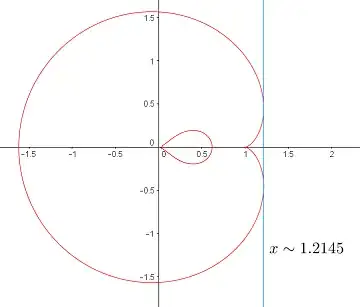
bound of roots of polynomial

As one can see, the $u$ in this curve doesn't reach $g$. Instead, it lies inside a half-plane $\Re z \le u_*$ for some $u_* \sim 1.2$. With help of a CAS again, we find $u_*$ is a root of the heptic polynomial $$2048u^7-19456u^6+52608u^5-62848u^4+36752u^3-10288u^2+1392u-171 = 0$$ with a more accurate estimate $u_* \sim 1.214497857615758$.

achille hui
  • 125,323
  • Very good solution too - this actually shows that the assumption $\Re z>0$ is superfluous and the generic equation of degree $n$ as above (monic and all coefficients in $[0,1]$) has the golden ratio as universal bound on the roots – Conrad Apr 10 '22 at 21:39
  • (+1) Very nice indeed. Your solution gives a more general result. – Mittens Apr 10 '22 at 22:54
  • Very nice. For fun I plotted your curve along with zeros of random polynomials of degree <= 30 satisfying the conditions: https://www.dropbox.com/s/omfoqxa74ltk564/zeros.png – Jair Taylor Apr 13 '22 at 17:13
  • @JairTaylor I believe you will be interested in A.Odlyzko and B. Poonen's paper Zeroes of polynomials with 0,1 coefficients. In particular Fig. 1 in page 319 which show the zeros of polynomials for deg $\le 18$ with $a_k = 0$ or $1$ only. – achille hui Apr 13 '22 at 18:00
  • @achillehui Very interesting! – Jair Taylor Apr 13 '22 at 18:29
  • Hi @achillehui, this is unrelated to your answer, hence I would be deleting this comment soonest. Please could you help out with this question https://math.stackexchange.com/q/4435979/585488 – linker Apr 29 '22 at 08:20