On the picture below, $M$ is the midpoint of $AB$ and so $AM$ is the orthogonal bisector of $BC$. Reflection with respect to $AM$ sends $C$ to $B$ and circle $c_1$ to circle $c_2$, i.e. these are symmetric with respect to $AM$. Under the reflection, the image the circle $c$ is denoted by $c^{*}$ and since $c$ is tangent to both $c_1$ and $c_2$, so is $c^{*}$. Moreover, since $c$ is tangent to $AB$, its symmetric image $c^{*}$ is tangent to $AC$.
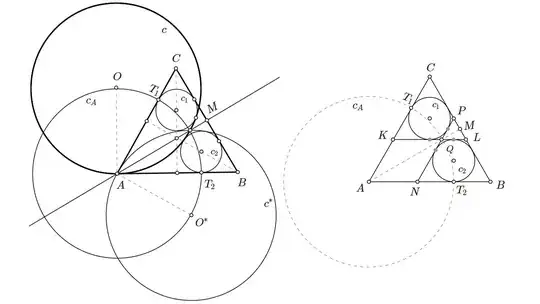
Consider the circle $c_A$ centered at $A$ and with radius $AT_1 = AT_2$, where $T_1$ and $T_2$ are the points of tangency of $c_1$ and $c_2$ with $AC$ and $AB$ respectively. Perform inversion with respect to the circle $c_A$. By construction, circles $c_1$ and $c_2$ are mapped to themselves. By the properties of inversions, the circles $c$ and $c^{*}$ passing through the center $A$, are mapped to straight lines. In addition to that, since $c$ is tangent to $c_1$ and $c_2$, its inverse image is a line, tangent to both $c_1$ and $c_2$, i.e. it is a common inner tangent of the circles $c_1$ and $c_2$. Moreover, since $c$ is tangent to $AB$, and since after inversion $AB$ is mapped to itself, the inverse image of $c$ is a line parallel to $AB$. All of the facts form above combined yield the conclusion that the inverse image of the circle $c$ with respect to the circle $c_A$ is a common inner tangent line of the two circles $c_1$ and $c_2$, which in addition to that, is parallel to $AB$.
Analogously, by symmetry, the inverse image of the circle $c^{*}$ with respect to the circle $c_A$ is the other common inner tangent line of the two circles $c_1$ and $c_2$, which is parallel to $AC$.
So the result of the inversion is depicted on the right, where the inverse images of the circles $c$ and $c^{*}$ are the lines $KL$ and $NP$ which are also the common inner tangents of $c_1$ and $c_2$, parallel to $AB$ and $AC$ respectively. $Q$ is the intersection point of $KL$ and $NP$ and by symmetry, must lie on $AM$. (Remark: $c, \, c^{*}$ and $AM$ are not concurrent and point $Q$ is actually not on $c_A$. It just looks like they are.)
Since $KL \, || \, AB$ and $NP\,||\,AC$ and, the quads $CKQP$ and $BNQL$ are symmetric, congruent, isosceles trapezoids with $60^{\circ}$ and $120^{\circ}$ angles. Furthermore, since the circles $c_1$ and $c_2$ are inscribed in the trapezoids $CKQP$ and $BNQL$ of radius $1$, their diameters are $2$ and since their diameters are also the altitudes of the trapezoids $CKQP$ and $BNQL$. The latter leads to the fact that
$$AN = NQ = BL = AK = KQ = CP = \frac{4}{\sqrt{3}}$$
If we denote $x = AB = BC = CA$, then
$$LQ = PQ = LP = x - BL - CP = x - \frac{8}{\sqrt{3}}$$
and
$$BN = CK = x - AK = x - AN = x - \frac{4}{\sqrt{3}}$$
The property of having $c_2$ as a circle inscribed in $BNQL$ is equivalent to the identity
$$BN + LQ = NQ + BL$$ which leads to the equation
$$x - \frac{4}{\sqrt{3}} \, + \, x - \frac{8}{\sqrt{3}} \, = \, \frac{4}{\sqrt{3}} + \frac{4}{\sqrt{3}}$$
$$2\,x - \frac{12}{\sqrt{3}} \, = \, \frac{8}{\sqrt{3}}$$
$$x - \frac{6}{\sqrt{3}} \, = \, \frac{4}{\sqrt{3}}$$
so
$$AB = BC = CA = x = \frac{10}{\sqrt{3}} = \frac{10}{3}{\sqrt{3}}$$


