2

It is well known that under a certain condition (e.g. the weak convergence), the convergence of norms implying the convergence in norm, that means

Theorem. (see e.g. MSE) In a Hilbert space $\mathcal H$, let $x_n$ be a sequence weakly converging to $x$. If $||x_n|| \rightarrow ||x||$ then $x_n$ converges to $x$ in norm, i.e. $||x_n-x||\rightarrow 0$.

I am wondering that is there a similar result for Minkowski functional? (a.k.a. gauge function, block norm in combinatorics, atomic norm in signal processing). I mean: is there a sufficient condition such that the following statement holds true?

Statement. For $x_n\in \mathcal H$, if $||x_n||_A \rightarrow ||x||_A$, then $||x_n-x||_A\rightarrow 0$.

Here $A$ is a closed convex set (not necessarily bounded) in $\mathcal H$ containing the origin as its interior point and $||\cdot||_A$ is the Minkowski functional corresponding to $A$, i.e. $||x||_A := \inf \{t\geq 0: x\in t A\}$ for all $x\in \mathcal H$.

Of course, this statement is not true even in $\mathcal H=\mathbb R^2$ if we don't impose any condition, indeed, see the counter example given in the following figure.
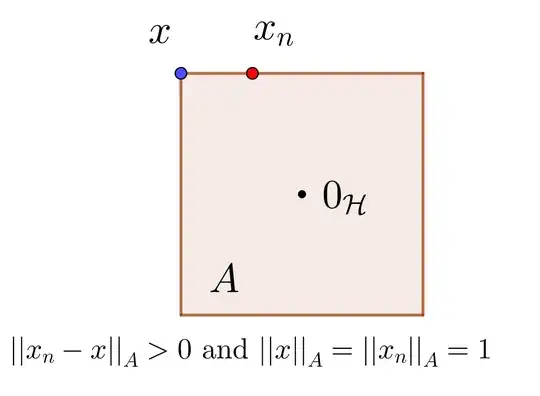
Is there any ideas?

Leonard Neon
  • 1,404
  • As you said, it's not true without imposing a condition. What condition are you imposing? – Robert Israel Dec 21 '21 at 21:46
  • @RobertIsrael, Yeah, the condition is what I am looking for. – Leonard Neon Dec 21 '21 at 21:52
  • Despite the name "weakly convergent to $x$" is still a fairly strong condition. It implies the directions to the $x_i$ converge to the direction for $x$. Then the convergence of the norms assures that the remaining freedom it had to diverge hadn't been exploited. You need the same thing for your functional. If the directions of the $x_i$ converge to the direction of $x$, convergence of the functional values should be sufficient to prove full convergence. – Paul Sinclair Dec 22 '21 at 18:45
  • @Pau Not very clear for me! Do you mean: " If $x_n$ weakly converges to $x$ and $||x_n||_A\rightarrow ||x||_A$, then $||x_n-x||_A\rightarrow 0$? If such case holds true, could you please illustrate your arguments as an answer below?! – Leonard Neon Dec 23 '21 at 14:18
  • 1
    I didn't make an argument. I gave a suggestion on where you could look. $|x_n| \to |x|$ says only two things about $(x_n)$: that it is bounded, and that all of its limit points lie on a sphere of radius $|x|$ in the normed space. But those limit points could be scattered in every direction on that sphere. It is weak convergence that prevents this scattering of directions. You effectively have the same thing going on with a different norm. Even though the norm is not from the inner product, it is likely that weak convergence stills prevent scattering of directions here. – Paul Sinclair Dec 23 '21 at 17:55
  • @PaulSinclair Ah ok thank you so much! I got your idea! Intuitively, I think that your suggestion is applicable when $||\cdot||_A$ being a strictly convex norm. However, in the general case, I think that it is much more difficult. – Leonard Neon Dec 25 '21 at 08:27
  • You might have to modify the concept of weak convergence to provide what you need. Or else look for a different condition that will guarantee convergence of directions. – Paul Sinclair Dec 25 '21 at 13:28
  • I found a useful result: Vincent Roulet, On the geometry of optimization problems and their structure, Prop 4.1.3. e-page 70/190. – Leonard Neon Apr 08 '22 at 09:45

0 Answers0