The square root of $81$ is $9.$
In symbols: $$\sqrt{81}=9.$$ Yes, this is a statement, and it is clearly true (based on the conventional interpretation of the various symbols contained in the statement).
Notice that it contains no logical connective (and, or,
conditional, negation, etc.); this means that it is an atomic statement; we might further symbolise this proposition as $P.$
a statement is true or false but in this case it would always be true. If it is a proposition, would it be a tautology
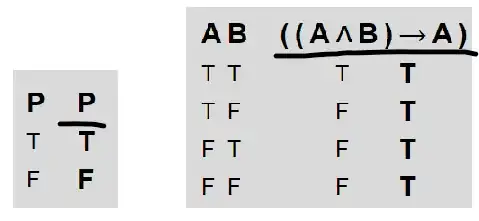
The truth table on the right shows that the compound statement $\;(A\land B)\to A\;$ is true regardless of what the atomic statements $A$ and $B$ stand for. In other words, $\;(A\land B)\to A$'s truth-functional form is always true. This means that $\;(A\land B)\to A\;$ is a tautology.
On the other hand, notice that if $P's$ meaning changes to "pigs can fly", or if we reinterpret the $\sqrt{\quad}$ symbol to output the negative root instead of the conventional positive root (so that $\sqrt{81}=9$ becomes false), then $P$ becomes a false statement (corresponding to the bottom row of $P$'s truth table). Since $P$'s truth table contains at least one 'false' entry, $P$ is patently not a tautology: its truth-functional form is not always true. In fact, no atomic statement can be a tautology.
In propositional logic, a tautology can also be understood as a proposition that is true regardless of its atomic propositions' assigned meanings.
Addendum to address the OP's follow-up questions
- Since the propositional variable $\sqrt{81}=9$ is always be true, is it a tautology?
Your confusion stems from referring to $\sqrt{81}=9$ as “always true”, and conflating this with your impression that tautology means “always true”.
Firstly, ‘$\sqrt{81}=9$’ is not a propositional variable, just as ‘Pigs can fly’ isn't. However, both can be symbolised as the propositional variable $P.$
Secondly, please re-read the third-from-last and last paragraphs of my Answer above. Notice that asking whether a statement is a tautology involves inspecting its truth table, which requires the statement to first be symbolised in terms of propositional variable(s).
(Clearly then, a single propositional variable by itself cannot be a tautology.)
When considering whether $\sqrt{81}=9$ is a tautology, we are ignoring its particular guise, and considering just its abstract logical skeleton $P$ (as $P$'s assigned meaning varies).
The truth-functional form (logical skeleton $P$) of $\sqrt{81}=9$ is not always true; therefore, it is not a tautology. (In fact, $\sqrt{81}=9$ itself can be false, for example when working in base $12.)$ Calling $\sqrt{81}=9$ “always” true is not instructive; better to think of it as just “true”.
In contrast, $$1=1\to\big(1=1\:\lor\:2=3\big)$$ is a tautology.
- Or are tautologies only restricted to formulas?
Do you mean to ask whether tautologies are restricted to only compound propositions? Yes, they are.


