Drake Thomas and I have proposed a sequence A343909 to the On-Line Encyclopedia of Integer Sequences (OEIS), which counts "generalized polyforms": generalizations of free polyominoes (Tetris pieces), but with cells in the tetrahedral-octahedral honeycomb.
That is, take a subset of tetrahedral or octahedral cells in the honeycomb such that each cell is connected to every other cell by a chain of face-to-face connections. Consider two subsets to be the same if there is a rigid transformation that takes one to the other.
The ($0$-indexed) sequence begins:
1, 2, 1, 4, 9, 44, 195, 1186, 7385, 49444, 337504, ...
Which is to say that there is
- 1 polyform with 0 cells (the empty polyform),
- 2 polyforms with 1 cell (the tetrahedron and the octahedron),
- 1 polyform with 2 cells (the tetrahedron attached to the octahedron by a face),
- 4 polyforms with 3 cells, and
- 9 with 4 cells, as shown below:
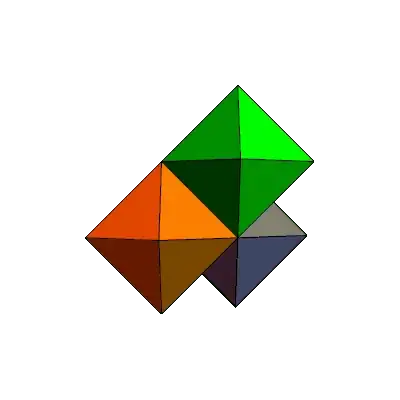
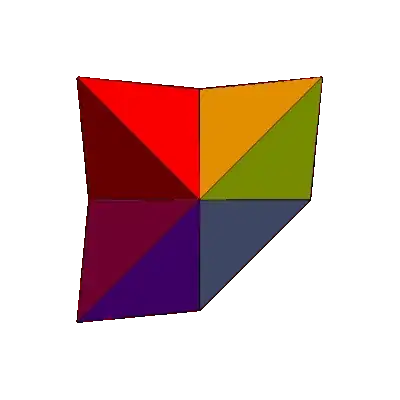
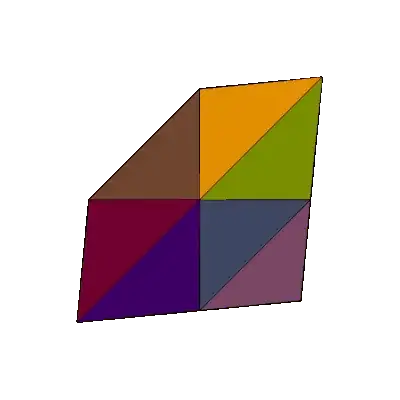
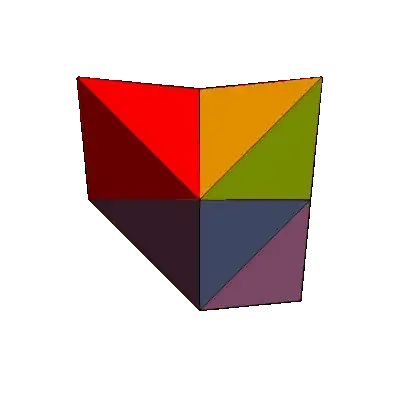
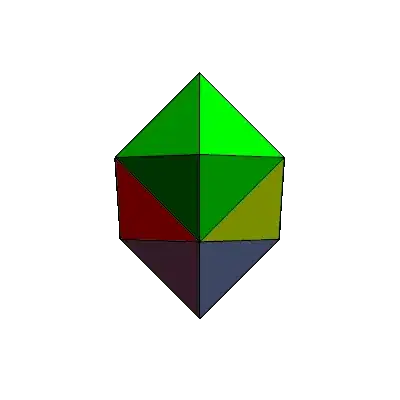
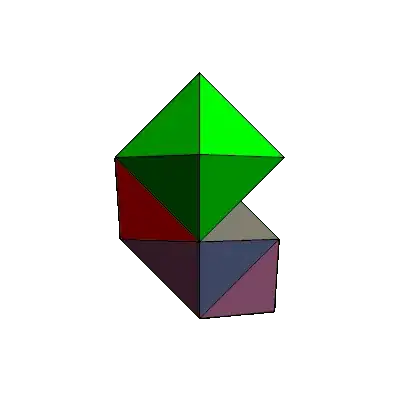
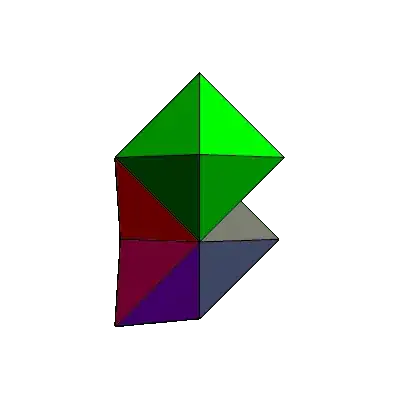
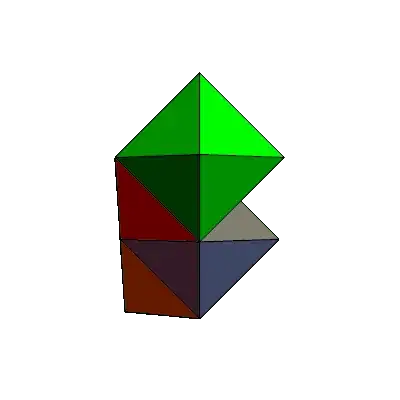
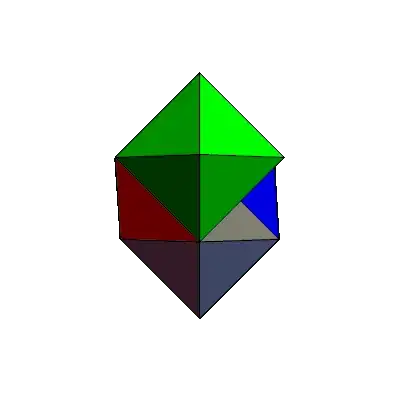
Tetrahedra/octahedra breakdown
It's hard to compute large values of this sequence, but here is the breakdown of the number of octahedra and tetrahedra in $8$- and $9$-cell polyforms.:
$n = 8 \\ A343909(8) = 7385$
- 1 octahedron, 7 tetrahedra: $1$
- 2 octahedra, 6 tetrahedra: $285$
- 3 octahedra, 5 tetrahedra: $3223$
- 4 octahedra, 4 tetrahedra: $3440$
- 5 octahedra, 3 tetrahedra: $432$
- 6 octahedra, 2 tetrahedra: $4$
$n = 9 \\ A343909(9) = 49444$
- 1 octahedron, 8 tetrahedra: $1$
- 2 octahedra, 7 tetrahedra: $356$
- 3 octahedra, 6 tetrahedra: $10853$
- 4 octahedra, 5 tetrahedra: $27632$
- 5 octahedra, 4 tetrahedra: $10141$
- 6 octahedra, 3 tetrahedra: $459$
- 7 octahedra, 2 tetrahedra: $2$
Questions
In these (and smaller) cases, the greatest number of polyforms occurs when the number of octahedra is $\lfloor (n-1)/2 \rfloor$. Based on the fact that the honeycomb is composed of alternating regular octahedra and tetrahedra in a ratio of 1:2, I would have expected the mode to be closer to one-third.
- In the limit, is the mode asymptotic to $n/2$, $n/3$, or something else?
- For a fixed number of cells, does the number of polyforms with $m$ octahedra have a known distribution in $m$?
- What is the minimum number of octahedra than an $n$-cell polyform can have? The maximum number?

