3

I was reading the book "One Two Three...Infinity" by George Gamow, too old book, yes I know but its not my fault if I am born late, nevertheless, he was talking about comparing infinities with nice examples and he successfully convinced me that even infinity is of the same size as of the integer infinity, he explained that by forming pairs like this, [(Why I m not allowed to add picture, anyway.)]

Then he started proving how fractional/rational infinity are also the same size of integer infinity, I will quote from his book, [(I hope you all are able to read it.)]
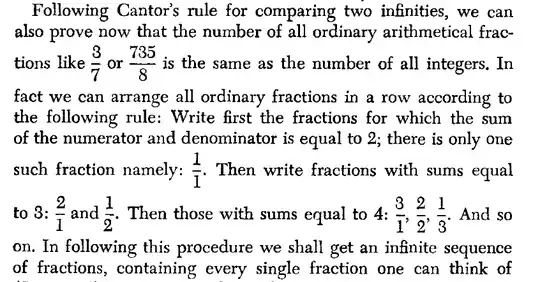
Now this means that the number 2 is associated with 1 fraction and the number 3 is associated with 2 fraction and the number 4 is associated with 3 fractions(so on and so forth), unlike infinities of even and integer here one element of one infinity is associated with one or more than one element of the second infinity(fractional),so that clearly makes rational infinity bigger in size, so if someone can correct the miscommunication between me and Mr.Galow, Thank you.

Saurabh
  • 45
  • 2
    hello! welcome to MSE. Please see if you find this useful: https://math.stackexchange.com/questions/7643/produce-an-explicit-bijection-between-rationals-and-naturals. The idea is that you can find some function that explicitly maps every natural to every rational. In which case just like in the even numbers case, you will have same number of rational numbers as you have natural numbers – Rahul Madhavan Apr 12 '21 at 11:31
  • @RahulMadhavan if they are bijective then it is clear, I think there is something wrong in the book explanation, I should move on I guess, thanks for your time. – Saurabh Apr 12 '21 at 11:36
  • 1
    Please also see https://natureofmathematics.wordpress.com/lecture-notes/cantor/ (under the theorem card(N) = card(Q)) that gives an explicit visualization of the argument in the book. – Rahul Madhavan Apr 12 '21 at 11:37
  • Related: https://math.stackexchange.com/q/7643/ – user3733558 Apr 12 '21 at 11:56
  • Thank you all for all these new insights I will for sure add all this while passing this knowledge to someone else. – Saurabh Apr 12 '21 at 12:36
  • 1
    Just a general remark, you wrote "too old book, yes I know but its not my fault if I am born late", it's your loss for not reading newer books which will usually have a modern perspective on the topic. – Asaf Karagila Apr 12 '21 at 12:55
  • @AsafKaragila thank you for this eye opener actually this book was recommended too much to me, you won't believe, but in our school physics textbook in the last they suggested us to read this book, so I was like ok. It would be very kind of you if you can give some books suggestions, please!! – Saurabh Apr 12 '21 at 13:17

2 Answers2

2

What this means is that there is a bijection between the integers and the rationals (written in lowest terms), by ordering the rationals by (a) the sum of their numerator and denominator and (b) by their denominator.

Here is the beginning of the positive part of this:

$$\begin{array} \, & 1 & 2 & 3 & 4 & 5 & 6 & 7 & 8 & 9 & 10 & 11 & 12 & 13 & 14 & \text{etc.} \\ \, &\updownarrow & \updownarrow & \updownarrow & \updownarrow & \updownarrow & \updownarrow & \updownarrow & \updownarrow & \updownarrow & \updownarrow & \updownarrow & \updownarrow & \updownarrow & \updownarrow & \cdots \\ \, & \frac11 & \frac21 & \frac12 & \frac31 & \frac13 & \frac41 & \frac32 & \frac23 & \frac14 & \frac51 & \frac15 & \frac61 & \frac52 & \frac43 & \text{etc.} \end{array}$$

and the non-positive part could then be $$\begin{array} \, & \text{etc.} & -3 & -2 & -1 & 0 \\ \, & \cdots & \updownarrow & \updownarrow & \updownarrow & \updownarrow \\ \, & \text{etc.} & -\frac12 & -\frac21 & -\frac11 & \frac01 \end{array}$$ enter image description here

Saurabh
  • 45
Henry
  • 169,616
1

Notice that even if associate a set of rational numbers to an integer, this set is finite, so we can redefine the correspondence to make it a 1-1 correspondence $\mbox{natural numbers}\leftrightarrow\mbox{rational numbers}$: Suppose that to $j\in\mathbb N$ we associate the set $$\{q^j_1,\cdots,q^j_{n_j}\}$$of rational numbers, then you can assign to the first $n_j$ natural numbers the rational numbers $q^1_k$ as $$k\mapsto q^1_k$$ then you assign to $n_1+1,\cdots,n_1+n_2$ the rational numbers $q^2_j$ as $$n_1+k\mapsto q^2_k$$ you assign to $n_1+n_2+1,\cdots,n_1+n_2+n_3$ the rationals $q^3_j$ as $$n_1+n_2+k\mapsto q^3_j$$ and so on. At the stage $p$, you assign to the natural numbers $n_1+\cdots+n_{p-1}+1,\cdots, n_1+\cdots+n_{p-1}+n_p$ the rational numbers $q^p_k$ as $$n_1+\cdots+n_{p-1}+k\mapsto q^p_k$$ this way you have your 1-1 correspondence

Alessandro
  • 2,808