4

Two lines $(L_1,L_2)$ intersects the circle $(x-3)^2+(y+2)^2=25$ at the points $(P,Q)$ and $(R,S)$ respectively. The midpoint of the line segment $PQ$ has $x$-coordinate $-\dfrac{3}{5}$, and the midpoint of the line segment $RS$ has $y$-coordinate $-\dfrac{3}{5}$.

If $A$ is the locus of the intersections of the line segments $PQ$ and $RS$, then the area of the region $A$ is:


What I've done:

Consider $L_1: y= ax+b$. The midpoint of the chord $PQ$ is $(-\dfrac{3}{5}, -\dfrac{3a}{5}+b)$. Now, using the property that the midpoint of a chord of a circle and the center of the circle $(3,-2)$ are perpendicular we have: $\dfrac{-\dfrac{3a}{5}+b-(-2)}{-\dfrac{3}{5}-(3)} *a = -1$ $$\implies b= \dfrac{3a^2-10a+18}{5a}$$ This means we can eliminate one variable and write the equation of $L_1: y= ax+ \dfrac{3a^2-10a+18}{5a}$

From this form of $L_1$ we can get the value of the minimum value of the $y$-intercept by differentiating $b$. Let $b= f(a) = \dfrac{3a^2-10a+18}{5a}, f'(a) = \dfrac{3a^2-18}{5a^2}, f'(a)=0 \implies a = \pm \sqrt{6}$. I just found this hoping we will get bounds on the y-intercept of $L_1$.

Now lets do the same process for $L_2$.

Consider $L_2: y= cx+d$. The midpoint of the chord $RS$ is $(\dfrac{-\dfrac{3}{5} -d}{c},-\dfrac{3}{5})$. Now, using the property that the midpoint of a chord of a circle and the center of the circle $(3,-2)$ are perpendicular we have: $\dfrac{-\dfrac{3}{5}+2}{\dfrac{-\dfrac{3}{5} -d}{c}-3} *c = -1$ $$\implies d= \dfrac{7c^2-15c-3}{5}$$ This means we can eliminate one variable and write the equation of $L_2: y= cx+ \dfrac{7c^2-15c-3}{5}$

From this form of $L_2$ we can get the value of the minimum value of the $y$-intercept by differentiating $d$. Let $d= f(c) = \dfrac{7c^2-15c-3}{5}, f'(c) = \dfrac{14c-15}{5}, f'(c)=0 \implies c = \dfrac{15}{14}$. I just found this hoping we will get bounds on the y-intercept of $L_2$.

Along with all this, we can set bounds when the line segment is just about to leave the circle (tangent to the circle).

What I can visualize:

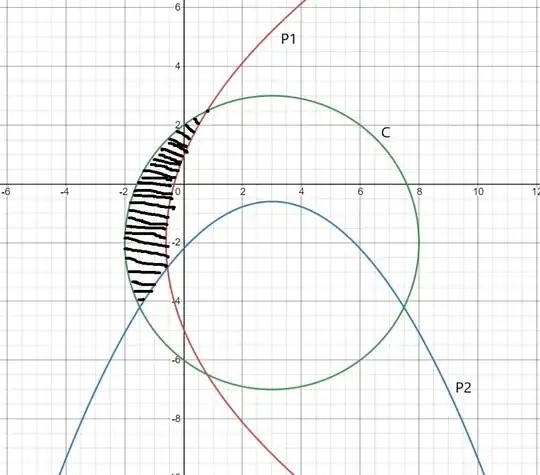
Let $X$ = union of all line segments $PQ$. Let $Y$ = union of all line segments $RS$. Every point in the intersection of $X$ and $Y$ is a candidate intersection point of the lines $L_1$ and $L_2$. So A = $X \cap Y$

Edit 1: I saw the equation of $L_1$ varying as $a$ varies on DESMOS and think the boundry of the union of all line segments PQ might be an outer circle.

Sid
  • 1,290
  • I would just write the intersection point in $(x,y)$ in terms of $(a,c)$ and then try to eliminate the parameters to obtain the locus. You also need $(x-3)^2 +(y+2)^2 \le 25$. – Vishu Mar 31 '21 at 12:13
  • I tried that. U can an equation interms of a,c... Those techiques would work if the locus was a curve... Here clearly the locus is a region cuz we ultimately need to find a shaded area... So I think it's better if find all the line segments PQ and take their union. Same for RS. Intersection of this is the required region – Sid Mar 31 '21 at 12:16
  • In the end, you should get an equation with $x,y$ and either one of $a$ or $c$. Then after some examination of the family of curves, it should probably be possible to reduce the problem to finding the area between the curves for which the free parameter takes its highest and lowest values. – Vishu Mar 31 '21 at 12:20
  • lets say i find the intersection in terms of $a$ and i get $x= f(a)$ and $y= g(a)$. After this I'll have to dump these values into the circle: $(f(a)-3)^2+ (g(a)+2)^2 < 25$ as the segments must intersect inside the circle... but here i don't think this will boil down to a quadratic inequality, so i think its better if we use the other approach. if its promising, please demonstrate your solution. – Sid Mar 31 '21 at 13:02
  • Actually I don’t want to, as it involves too much algebra to be promising. – Vishu Mar 31 '21 at 13:13
  • Why do you want a more cumbersome method, instead of using the envelopes? By the way, even with the envelopes computing the integral to get the area requires a lot of stupid computations: where is this problem taken from? – Intelligenti pauca Apr 03 '21 at 09:29
  • its a high school math problem. there is no partial derivative concept there. or envelope. I think its expected to do it with algebra and high school calculus. – Sid Apr 03 '21 at 09:31
  • @Sid If you want, the envelope can be constructed without calculus at all. – Intelligenti pauca Apr 03 '21 at 13:34
  • But doesn't the derivation of the envolope require calculus? – Sid Apr 03 '21 at 13:36
  • Not necessarily, it just requires the notion that a line tangent to a curve at $P$ is the limiting case of a line passing through two points $P'$ and $P$ of the curve when $P'$ approaches $P$. If you agree, I can show that as an addendum to my answer. – Intelligenti pauca Apr 03 '21 at 14:26
  • Ok add it on. Let me see if i can follow along – Sid Apr 03 '21 at 14:28
  • By the way: I computed the requested area (after a lot of very boring algebra, which fortunately Mathematica did for me) and the result seems to be $$\frac{3004}{75}-4 \sqrt{14 \left(9-4 \sqrt{2}\right)}-\frac{25 \pi }{4}.$$ This doesn't look like a high-school result. – Intelligenti pauca Apr 04 '21 at 20:27
  • We just need the integrand and the limits... rest can be computed using a calculator. – Sid Apr 05 '21 at 03:38

2 Answers2

3

EDIT (Original answer at the end).

I want to show how the envelope of chords $RS$ (or $PQ$) can be obtained without calculus and without coordinates (see figure below).

Let's start with a chord $AB$ of a circle of centre $O$. For any point $M$ on that chord, we can construct a line $RS$ passing through $M$ and perpendicular to $OM$. We want to find the envelope of all those lines, i.e. the curve which is tangent to all the lines $RS$ as $M$ varies on $AB$.

Consider then another point $M'$ on $AB$ and its associated line $R'S'$. Let $P$ be the intersection of $RS$ and $R'S'$, $T$ the tangency point of $RS$ with the envelope, $T'$ the tangency point of $R'S'$ with the envelope. As $M'$ approaches $M$, both $T'$ and $P$ approach $T$.

But the circle through $OMM'$ also passes through $P$ (because $\angle PMO=\angle PM'O=90°$) and this circle, as $M'\to M$, tends to the circle through $O$ tangent to $AB$ at $M$. Hence $T$, which is the limiting position of $P$, is the intersection of that circle with line $RS$. Moreover, $OT$ is a diameter of that circle.

enter image description here

Now that we know how to construct point $T$ on $RS$, let's also construct line $HK$, parallel to $AB$ at a distance from it equal to the distance of $O$ from $AB$. If $J$ is the projection of $T$ on it, then $TJ=TO$, because line $CH$ joining the midpoints of the legs of a trapezoid is the arithmetic mean of bases $OK$ and $TJ$.

It follows that point $T$ has the same distance from $O$ and from line $HK$. Hence its locus (which is the envelope) is a parabola, having $O$ as focus and $HK$ as directrix.

enter image description here

ORIGINAL ANSWER.

What you need is the envelope $\gamma_1$ formed by lines $L_1$ and the envelope $\gamma_2$ formed by lines $L_2$.

As the equation of $L_1$ is $y=\left(x+{3\over5}\right)a-2+{18\over5a}$, differentiating w.r.t. $a$ we get: $x+{3\over5}-{18\over5a^2}=0$, which can be solved for $a$: $$ a^2={18\over 5x+3}. $$ Inserting this into the equation of $L_1$ we get (after some algebra): $$ 25(2+y)^2={72}(5x+3), $$ which is the desired envelope $\gamma_1$ (a parabola).

Repeating the same process for $L_2$ we can find the equation of $\gamma_2$ (another parabola): $$ y=-{5\over28}(3-x)^2-{3\over5}. $$ Lines $L_1$ and $L_2$ are tangent to their envelope, hence the area you want to compute is that external to both parabolas but inside the circle.

enter image description here

To compute the area, one has to find the coordinates of the upper intersection $A$ between $\gamma_1$ and the circle, of the left intersection $C$ between $\gamma_2$ and the circle and of the intersection $B$ between $\gamma_1$ and $\gamma_2$ lying inside the circle: $$ A=\left(\frac{4}{5},\frac{6}{5} \sqrt{14}-2\right),\quad C=\left(3-\frac{6}{5}\sqrt{14},-\frac{21}{5}\right),\quad B=\left(\frac{1}{5} \left(29-12 \sqrt{7}\right),\frac{2}{5} \left(6 \sqrt{7}-23\right)\right). $$

Integrating along $y$ the area can then be computed as: $$ \begin{align} area&=\int_{y_B}^{y_A} \left[\left(\frac{5}{72}(y+2)^2-\frac{3}{5}\right)-\left(3-\sqrt{25-(y+2)^2}\right)\right] \, dy \\ &+\int_{y_C}^{y_B} \left[\left(-\frac{2}{5} \sqrt{-35 y-21}+3\right)-\left(3-\sqrt{25-(y+2)^2}\right)\right] \, dy \\ &=\frac{25 \pi }{4}+4 \sqrt{14 \left(9-4 \sqrt{2}\right)}-\frac{3004}{75}. \end{align} $$

  • It's 18/5a right? You've written 18/a – Sid Mar 31 '21 at 13:44
  • Yes, of course it's a typo, thank you: I'll correct at once. – Intelligenti pauca Mar 31 '21 at 13:46
  • Isn't it $a^2$=18/(5x+3)? Not x+3? – Sid Mar 31 '21 at 13:59
  • You are right, sorry, just corrected. – Intelligenti pauca Mar 31 '21 at 14:02
  • yeah this seems to be right but i can seem to wrap my head around the reason why we can obtaining the envolope by diffrentiating wrt to a – Sid Mar 31 '21 at 14:14
  • You can find an explanation on any good text of Mathematical Analysis, but if you want I could give you some ideas. But perhaps you'd better ask a new question on that topic alone. – Intelligenti pauca Mar 31 '21 at 15:04
  • @Sid I wrote an explanation for that rule as an answer to this old question: https://math.stackexchange.com/questions/3162901/envelopes-in-mathematics/4084577#4084577 – Intelligenti pauca Mar 31 '21 at 18:32
  • I've given you the bounty and marked yours as right. I also found out the method I was looking for and answered my own question. Those three facts I mentioned are something we are supposed to by heart. Thanks for all the insight. – Sid Apr 05 '21 at 12:39
1

Before one attempts to solve this problem one must visualize this:

Let $U$ = union of all lines $L_1$. Let $V$ = union of all lines $L_2$. Every point in the region $U \cap V$ is a candidate intersection point of the lines $L_1$ and $L_2$. Therefore, $L = U \cap V$ such that the intersection point lies inside the circle.

Some Facts: Further information

  1. $y = mx + \dfrac{a}{m}$ is a tangent to the parabola $y^2 = 4ax$, whatever be the value of $m$.

  2. $y = mx -am^2$ is a tangent to the parabola $x^2 = 4ay$, whatever be the value of $m$.

  3. For any point $P$, that is outside a parabola, there is at least one tangent on the parabola passing through $P$.

Study the set of lines $L_1$:

Consider $L_1: y= ax+b$. The midpoint of the chord $PQ$ is $(-\dfrac{3}{5}, -\dfrac{3a}{5}+b)$. Now, using the property that the midpoint of a chord of a circle and the center of the circle $(3,-2)$ are perpendicular we have: $\dfrac{-\dfrac{3a}{5}+b-(-2)}{-\dfrac{3}{5}-(3)} *a = -1$ $$\implies b= \dfrac{3a^2-10a+18}{5a} = \dfrac{3a}{5} -2 + \dfrac{18}{5a}$$ This means we can eliminate one variable and write the equation of $L_1: y= ax+ \dfrac{3a^2-10a+18}{5a}$ for all $a$.

$L_1: y+2= a(x+ \dfrac{3}{5})+\dfrac{18}{5a}$. Let $Y = y+2, X = x+ \dfrac{3}{5} \implies Y = aX + \dfrac{18}{5a}$. Using fact 1, we get that $L_1$ is always tangent to parabola: $Y^2 = \dfrac{72X}{5}$. Upon back substitution, we get: $(y+2)^2 = \dfrac{72(x+ \dfrac{3}{5})}{5} \implies 25(y+2)^2 = 72(5x+3)$. So in conclusion the set of lines $L_1$ are just the set of all tangents to this parabola: ($P_1$). Using fact 3, for any point that is outside $P_1$, a tangent line from $P_1$ can be drawn to that point. Hence union of all tangents is the region outside $P_1$.

Study the set of lines $L_2$:

Consider $L_2: y= cx+d$. The midpoint of the chord $RS$ is $(\dfrac{-\dfrac{3}{5} -d}{c},-\dfrac{3}{5})$. Now, using the property that the midpoint of a chord of a circle and the center of the circle $(3,-2)$ are perpendicular we have: $\dfrac{-\dfrac{3}{5}+2}{\dfrac{-\dfrac{3}{5} -d}{c}-3} *c = -1$ $$\implies d= \dfrac{7c^2-15c-3}{5} = \dfrac{7c^2}{5} - 5c - \dfrac{3}{5} $$ This means we can eliminate one variable and write the equation of $L_2: y= cx+ \dfrac{7c^2-15c-3}{5}$ for all $c$.

$L_2: y+ \dfrac{3}{5}= c(x- 3)+\dfrac{7c^2}{5}$. Let $Y = y+ \dfrac{3}{5}, X = x- 3\implies Y = cX + \dfrac{7c^2}{5}$. Using fact 2, we get that $L_2$ is always tangent to parabola: $X^2 = -\dfrac{28Y}{5}$. Upon back substitution, we get: $(X-3)^2 = -\dfrac{28(y+ \dfrac{3}{5})}{5} \implies y= \dfrac{-5(x-3)^2}{28} - \dfrac{3}{5} (P_2)$.

So overall, for any point outside both $P_1$ and $P_2$ a tangent can be drawn to both $P_1$ and $P_2$ from that point, so the locus of intersection points of $L_1$ and $L_2$ is any point outside both the parabolas. But we must remember that the intersection point must be inside the circle because we are looking for the locus of the intersection of the chords $PQ$ and $RS$, both of which must reside inside the circle, hence their intersection will also be inside the circle. So the region is: $$L: \{(x,y) \in \mathbb{R}: y> \dfrac{-5(x-3)^2}{28} - \dfrac{3}{5}, 25(y+2)^2 > 72(5x+3), (x-3)^2 + (y+2)^2<25 \}$$
To make finding the area simpler lets shift this region (make the circle have center at origin): $X = x+3, Y = y-2$ $$ \implies L: \{(X,Y) \in \mathbb{R}: Y> \dfrac{-5(X)^2}{28} + \dfrac{7}{5}, 25(y)^2 > 72(5x+18), (x)^2 + (y)^2<25 \}$$
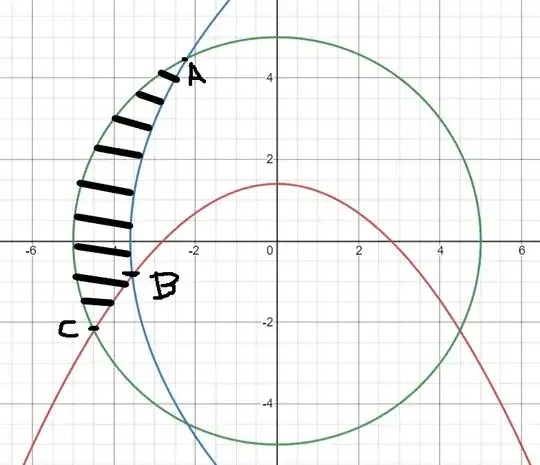
$A: \left(- \dfrac{11}{5}, \dfrac{6\sqrt{14}}{5}\right); B: \left(-\dfrac{2(6\sqrt{7}-7)}{5}, - \dfrac{12(\sqrt{7}-3)}{5}\right); C: \left(-\dfrac{6\sqrt{14}}{5}, - \dfrac{11}{5}\right) $ .

The longest distance $d$ between any two points in the region is obviously AC because A is the point with both maximum x and y coordinates. Any point on $P_2$ (in the shaded region) is closer to A than C because both the x and y coordinates is closer to A. Also any other point along the circle is a chord and C is farthest away as none of the points is the diameter, hence C is the farthest point from A. $d = AC = \sqrt{50} = 5\sqrt{2}$.

Finding the area is a tedious task to do by hand. It can be computed as follows:

Region above the axis: $\int_{-5}^{-\frac{18}{5}}\sqrt{25-x^{2}}dx+\int_{-\frac{18}{5}}^{-\frac{11}{5}}\left(\sqrt{25-x^{2}} - \sqrt{\frac{72\left(5x+18\right)}{25}} \right)dx$

Region below the axis: $\left|\int_{-5}^{-\frac{6\sqrt{14}}{5}}-\sqrt{25-x^{2}}dx+\int_{-\frac{6\sqrt{14}}{5}}^{-\frac{18}{5}}\left(-\frac{5}{28}\left(x\right)^{2}+\frac{7}{5}\right)dx+\int_{-\frac{18}{5}}^{-\frac{2\left(6\sqrt{7}-7\right)}{5}}\left(\left(-\frac{5}{28}\left(x\right)^{2}+\frac{7}{5}\right)-\left(-\sqrt{\frac{72\left(5x+18\right)}{25}}\right)\right)dx\right|$

Adding both these values we get area of region $= 6.94701 \implies \lfloor{1000*6.94701}\rfloor = \lfloor{6947.01...}\rfloor = 6947$

Sid
  • 1,290
  • I see: if you know those rules by heart you can find the envelopes even without knowing what they are. BTW: you can spare some computations by integrating on $y$ instead than on $x$, but I don't know if you are allowed to do that. Glad I've been of help, anyway. – Intelligenti pauca Apr 05 '21 at 13:58
  • Can u please show how. Add it on to your answer. No need to compute. Just show the integrands and the limits. Thanks – Sid Apr 05 '21 at 14:10
  • I added the integral: hope I didn't insert too many misprints. – Intelligenti pauca Apr 05 '21 at 14:56