83

Assume that $f:\mathbb{R}^2\to\mathbb{R}$ a $C^{\infty}$ function that has exactly two minimum global points. Is it true that $f$ has always another critical point?


A standard visualization trick is to imagine a terrain of height $f(x,y)$ at the point $(x,y)$, and then imagine an endless rain pouring with water level rising steadily on the entire plane.

  • Because there are only two global minima, they must both be isolated local minima also. Therefore, initially the water will collect into two small lakes around the minima.
  • Those two points are connected by a compact line segment $K$. As a continuous function, $f$ attains a maximum value $M$ on the set $K$. This means that when the water level has reached $M$, the two lakes will have been merged.
  • The set $S$ of water levels $z$ such that two lakes are connected is thus non-empty and bounded from below. Therefore it has an infimum $m$.
  • It is natural to think that at water height $m$ there should be a critical point. A saddle point is easy to visualize. For example the function (originally suggested in a deleted answer) $f(x,y)=x^2+y^2(1-y)^2$ has a saddle point at the midway point between the two local minima at $(0,0)$ and $(0,1)$. But, can we prove that one always exists?

Follow-ups:

  • Does the answer change, if we replace $\Bbb{R}^2$ with a compact domain? What if $f$ is a $C^\infty$ function on a torus ($S^1\times S^1$) or the surface of a sphere ($S^2$). Ok, on a compact domain the function will have a maximum, but if we assume only isolated critical points, what else is implied by the presence of two global minima?
  • Similarly, what if we have local minima instead of global?
  • If it makes a difference you are also welcome to introduce an extra condition (like when the domain is not compact you could still assume the derivatives to be bounded - not sure that would be at all relevant, but who knows).
C.F.G
  • 8,789
Jyrki Lahtonen
  • 140,891
  • 1
    Am I being slow? This seems like a direct application of Poincare-Hopf to the gradient of $f$. – Eric Towers Feb 13 '21 at 20:56
  • 1
    Probably not @EricTowers. May be Poincaré-Hopf is not that well known among all and sundry :-) A number of us discussed the question without reaching a conclusion! – Jyrki Lahtonen Feb 13 '21 at 20:58
  • @EricTowers Do you think [tag:differential-topology] would be an appropriate tag? – Jyrki Lahtonen Feb 13 '21 at 21:09
  • 2
    Wait! Don't we also have a maximum on a compact manifold? I am open to suggestions for better variants :-) – Jyrki Lahtonen Feb 13 '21 at 21:23
  • @JyrkiLahtonen: ... which made me realize that my “counterexample” on $S^2$ must be wrong. – Martin R Feb 13 '21 at 21:31
  • @MartinR The counterexample does show a way of avoiding saddle points. May be a variant like: Compact domain + only isolated critical points (yours had "a ring of critical points along the equator") + two global minima => a saddle point? – Jyrki Lahtonen Feb 14 '21 at 05:16
  • @JyrkiLahtonen: Maybe, I have no idea right now. – Martin R Feb 14 '21 at 15:31
  • A few of us already discussed this question in the Pearl Dive. I don't usually get this involved in anything resembling calculus, but I want to diversify the Pearl Dive a bit (or at least the role I have there). – Jyrki Lahtonen Feb 16 '21 at 19:42
  • @EricTowers It could be interesting to see how the argument using Poincaré-Hopf you had in mind relates to Martin's counterexample. And also whether it leads to an affirmative results (which?) on another manifold (other than the uninteresting observation that on a compact manifold we also achieve a maximum). – Jyrki Lahtonen Feb 17 '21 at 05:53
  • 2
    I finally remembered yesterday why this problem felt familiar---it is something which is addressed by Morse theory. In particular, this seems to be related to Reeb's Theorem: roughly, a compact smooth manifold with exactly two nondegenerate critical points is homeomorphic to a sphere. There are some issues here---$\mathbb{R}^2$ is not compact, and user21820's observation that the result holds for functions which diverge to infinity suggests that this is a result about manifolds with boundaries. – Xander Henderson Feb 20 '21 at 15:57
  • In any event, that might be a productive direction to look for a more analytic proof. – Xander Henderson Feb 20 '21 at 15:57
  • @JyrkiLahtonen: I don't understand something. all continuous functions on a compact domain attaint a max an a min at least. So what is the wrong with sphere or torus? – C.F.G Mar 01 '21 at 09:47
  • @C.F.G Yes, that is clear. Right now the question is Under what circumstances will the presence of two global minima imply the existence of a saddle point? (at the level the two lakes merge) Feel free to add extra assumptions (only isolated criticial points, compact domain or function tending to infinity or...) – Jyrki Lahtonen Mar 01 '21 at 09:53
  • @C.F.G I believe you. The history of this question is complicated, and we didn't remember Morse theory at the beginning (and apparently it is not as widely known as it deserves to be). An explanation along those lines is a welcome answer! – Jyrki Lahtonen Mar 01 '21 at 09:57

6 Answers6

88

With respect to the first part of your question: No, a function with two global minima does not necessarily have an additional critical point. A counterexample is $$ f(x, y) = (x^2-1)^2 + (e^y - x^2)^2 \, . $$ $f$ is non-negative, with global minima at $(1, 0)$ and $(-1, 0)$.

If the gradient $$ \nabla f(x, y) = \bigl( 4x(x^2-1) - 4x(e^y - x^2) \, , \, 2e^y(e^y-x^2) \bigr) $$ is zero then $e^y =x^2$ and $x(x^2-1) = 0$. $x= 0 $ is not possible, so that the gradient is zero only if $x=\pm1$ and $y=0$, that is only at the global minima.

The construction is inspired by Does $f$ have a critical point if $f(x, y) \to +\infty$ on all horizontal lines and $f(x, y) \to -\infty$ on all vertical lines?. We have $f(x, y) = g(\phi(x, y))$ where:

  • $g(u, v) = (u^2-1)^2 + v^2$ has two global minima, but also an additional critical point at $(0, 0)$, and
  • $ \phi(x, y) = ( x , e^y-x^2)$ is a diffeomorphism from the plane onto the set $\{ (u, v) \mid v > -u^2 \}$. The image is chosen such that it contains the minima of the function $g$, but not its critical point.

With respect to the “connected lakes” approach: The level sets $$ L(z) = \{ (x, y) \mid f(x, y) \le z \} $$ connect the minima $(-1, 0)$ and $(1, 0)$ exactly if $z > 1$. The infimum of such levels is therefore $m=1$, but $L(1)$ does not connect the minima (it does not contain the y-axis). Therefore this approach does not lead to a candidate for a critical point.

enter image description here


The above approach can also be used to construct a counterexample with bounded derivatives. Set $f(x, y) = g(\phi(x, y))$ with

  • $g(u, v) = \frac{(u^2-1)^2}{1+u^4} + \frac{v^2}{1+v^2}$, which has two global minima at $(\pm 1, 0)$, one critical point at $(0, 0)$, and bounded derivatives.
  • $\phi(x, y) = (x, \log(1+e^y) +1 -\sqrt{1+x^2} )$, which is a diffeomorphism from $\Bbb R^2$ with bounded derivatives onto the set $\{ (u, v) \mid v > 1- \sqrt{1+v^2} \}$, which contains the points $(\pm 1, 0)$ but not the point $(0, 0)$.
Jyrki Lahtonen
  • 140,891
Martin R
  • 128,226
  • 4
    Thanks. I was curious about how the lakes fail to connect in your example, so I plotted it to see how it fails. Thanks for explaining it. I took the liberty of adding (a part of) the plot. – Jyrki Lahtonen Feb 13 '21 at 21:20
  • 3
    @JyrkiLahtonen: Thanks for adding the plot. I don't have Mathematica. I tried to produce a contour plot with Maxima, but that did not look well. – Martin R Feb 13 '21 at 21:25
  • 3
    @JyrkiLahtonen: Yea it's much clearer now! =) – user21820 Feb 14 '21 at 07:24
32

$ \def\norm#1{\lVert#1\rVert} $The answer to the question as stated is no as Martin showed, but is yes if we add the condition that $f(x)→∞$ as $\norm{x}→∞$. Martin's example pushes the saddle point 'to infinity', which would be blocked by this condition. And we do not need global minima, nor even continuous derivatives!

Theorem. Take any differentiable $f : ℝ^2→ℝ$ such that $f$ has at least two local minima and $f(x)→∞$ as $\norm{x}→∞$. Then $f$ has a third stationary point.

Proof. Let $a,b$ be two (distinct) local minima of $f$. Let $L$ be the straight line segment from $a$ to $b$, and let $m$ be the maximum value of $f$ on $L$ by EVT (extreme value theorem). For each $k∈ℕ$ let $T(k)$ be a regular tiling of $ℝ^2$ by (closed) hexagons each with diameter $2^{-k}$ such that $a,b$ are respectively in the interior of some hexagonal tile $A,B$. Define the height of each tile $H$ in $T(k)$ to be the minimum value of $f$ on $H$, which exists by EVT. Note that if any tile $H$ has height no greater than that of all its neighbouring tiles, then $f$ has a local minimum on $H$, so we can assume that every tile besides $A$ or $B$ has height greater than that of some neighbour. Impose an enumeration on the tiles in $T(k)$ (say in hexagonal rings outward from $A$). For any tiles $G,H$, we say that $G$ is higher than $H$ (and that $H$ is lower than $G$) iff either ( $G$ has height higher than $H$ ) or ( $G,H$ have the same height but $G$ is after $H$ in the enumeration ). Note that for each tile $H$ there are only finitely many tiles lower than $H$ (since $f(x)→∞$ as $\norm{x}→∞$).

Then from any tile $H$ we can reach $A$ or $B$ via a downhill path, defined as a connected sequence of tiles each of which is higher than the next, because iteratively moving to a lower tile must terminate eventually. Thus there is a good tile, defined to be a tile of height at most $m$ from which we can reach both $A$ and $B$ each via a downhill path, because $L$ passes through a finite connected sequence of tiles from $A$ to $B$, and that sequence has consecutive tiles $I,J$ such that there is a downhill path from $I$ to $A$ and a downhill path from $J$ to $B$, so either $I$ or $J$ is a good tile. Let $M(k)$ be the lowest good tile, and let $O(k)$ be the centre of $M(k)$. Note that the second tiles of any downhill paths $P,Q$ from $M(k)$ cannot be adjacent, otherwise the higher one of those tiles would be a good tile lower than $M(k)$.

Observe that $O$ is a bounded sequence because each term is within distance $1$ from some point in $\{ x : x∈ℝ^2 ∧ f(x) ≤ m \}$, and the latter is bounded. Thus by BZ (Bolzano-Weierstrass) there is some strictly increasing sequence $i : ℕ→ℕ$ and point $c∈ℝ^2$ such that $\lim_{k→∞} O(i(k)) = c$.

From now let us assume that $f$ has only two local minima. By the local minimum of $f$ at $a$, there is some closed annulus $D$ around $a$ with inner radius $r$ and outer radius $s$ with $0<r<s<|L|$ such that $f{↾}D ≥ f(a)$. Let $u = \min_{x∈D} f(x)$. Then $u > f(a)$, otherwise $f$ has a local minimum in $D$ different from $a$ and $b$. And for all sufficiently large $k$ every downhill path from a good tile in $T(k)$ must pass through some tile contained within $D$, and so $M(k)$ has height at least $u$. Symmetrically, there is some $v > f(b)$ such that $M(k)$ has height at least $v$ for all sufficiently large $k$. Since $i$ is strictly increasing, we thus have $f(c) = \lim_{k→∞} f(O(i(k))) ≥ \max(u,v)$ and hence $c∉\{a,b\}$.

If $f$ is stationary at $c$, then we are done. Otherwise, there is some nonzero linear $g : ℝ^2→ℝ$ such that $f(c+t) ∈ f(c)+g(t)+o(\norm{t})$ as $t→⟨0,0⟩$, and hence for some sufficiently large $k$ we have that $M(k)$ and its neighbours are sufficiently close to $c$ that those neighbours lower than $M(k)$ are consecutive around $M(k)$ and number at most four. [1]

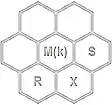
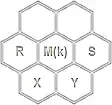
Let $P$ be a downhill path from $M(k)$ to $A$ and $Q$ be a downhill path from $M(k)$ to $B$, and let $R,S$ be the second tiles of $P,Q$ respectively. We now have two cases (up to symmetry):

(Case 1) enter image description here
There is only one neighbour $X$ of $M(k)$ between $R$ and $S$:
$X$ must be lower than $M(k)$. If $X$ is higher than $R$ or $S$, then the combined path $P{+}Q$ can be altered to pass through $X$ instead of $M(k)$, so one of $X,R,S$ would be a good tile. If $X$ is lower than both $R$ and $S$, then since $X$ has a downhill path to $A$ or $B$, respectively $S$ or $R$ would be a good tile.

(Case 2) enter image description here
There are two lower neighbours $X,Y$ of $M(k)$ between $R$ and $S$:
If $X$ is higher than $R$ or $Y$ is higher than $S$, then we can insert $X$ or $Y$ respectively into $P{+}Q$, which yields an instance of Case 1. If $X$ is lower than $R$ and $Y$ is lower than $S$, then by symmetry we can assume that $X$ is lower than $Y$, and so since $X$ has a downhill path to $A$ or $B$, respectively $S$ or $R$ would be a good tile.

In both cases, this contradicts minimality of $M(k)$. Therefore $c$ is indeed the point we are looking for.

−−−−−−−

[1] This part is kind of painful to prove rigorously, but it should be clear from a diagram.

user21820
  • 60,745
14

In 2019, I posted an answer to a relevant question. See: Can a multivariate function only have local minimum?, and Can a smooth function with compact sublevel sets only admit local minimizers?

In [1], some examples are given.

The function $f(x, y) = (x^2-1)^2 + (x^2y-x-1)^2$ has exactly two stationary points $(-1, 0), \ (1, 2)$ which are both strictly local minima (also are both global minima). There is no another stationary point.

The function $f(x,y) = -\mathrm{e}^{-x} (x\mathrm{e}^{-x} + \cos y)$ has infinitely many strictly local minima. There is no another stationary point.

Reference

[1] Alan Durfee, Nathan Kronefeld, Heidi Munson, Jeff Roy and Ina Westby, “Counting Critical Points of Real Polynomials in Two Variables,”, The American Mathematical Monthly, Vol. 100, No. 3 (Mar., 1993), pp. 255-271.

River Li
  • 49,125
  • 1
    Interestingly, the first example is also of the form $f(x, y) = g(\phi(x, y))$ where $g(u, v) = (u^2-1)^2 + v^2$ and $\phi$ avoids the critical point of $g$. – Martin R Feb 20 '21 at 10:07
  • 2
    @MartinR Your result is very nice. In 2019, I search the material about this problem including https://math.stackexchange.com/questions/1036762/an-example-of-a-continuous-function-on-mathbb-r2-with-two-critical-points-b – River Li Feb 20 '21 at 11:53
11

Morse theory says that every Morse function $f$ (that is all critical points were non-degenerate and distinct critical points take distinct critical values) satisfies $$\#\min+\#\max-\#\mathrm{saddle}=\chi(M).$$ So, in the case of torus (that its Euler char is $0$), the functions must have $\#\mathrm{saddle}=\#\max+2$. By the fact that all continuous functions on a compact domain attaint at least a max and a min therefore we should have at least a max point then at least 3 saddle point for torus. in the case of sphere is similar. $\#\min+\#\max-\#\mathrm{saddle}=\chi(\Bbb S^2)=2$ so having two global minima we must have $\#\max=\#\mathrm{saddle}\neq 0$. In any case we have at least a saddle point.

Note that these are non-degenerate critical points (that means Hessian is nonsingular at that points) and there is a function on torus with 3 critical points i.e. a min, a max and a degenerated saddle point.

C.F.G
  • 8,789
  • Thanks. So we should see @user21820's answer as handling a 1-point-compactification of the plane (so a sphere) with a maximum at infinity? – Jyrki Lahtonen Mar 01 '21 at 15:53
  • Since you say that this version for Morse functions relies on critical points being non-degenerate, am I correct to guess that your answer does not give an easy proof of the version in my answer that does not require a continuous derivative? Also, I'm curious how you would classify the critical points if f has global minima at exactly the points on an entire straight line segment but no maximum or saddle point (i.e. stationary point but not local extremum). – user21820 Mar 01 '21 at 16:34
  • @JyrkiLahtonen: it depends on degeneracy of critical points and I don't read long answers. sorry. – C.F.G Mar 01 '21 at 16:52
  • 1
    Some books requires "compactness orientedness and boundarylessness" assumptions to the theorem. So I am not sure about non compact case. – C.F.G Mar 01 '21 at 16:58
5

Suppose we have a compact orientable manifold $M$ with boundary $\partial M$. Suppose that we have a Morse function $f$ whose gradient flow is transverse to the boundary $\partial M$. Then the boundary splits into two components (which are themselves not necessarily connected) $\partial M=\partial_- M^{}+\partial_+M$ where $-\nabla f$ points outward on $\partial_-M$ and inward along $\partial_+M$. Then we have relative Morse inequalities. Define $b_k=\mathrm{rank} H_k(M,\partial M)$ and $c_k$ the number of critical points of $f$ of index $k$. Define the relative Poincare Polynomial and Morse polynomial $$ P_t(M,\partial_- M)=\sum_{k=0}^n b_k \qquad M_t(f)=\sum_{k=0}^n c_k. $$ The Morse relations state that there exists a polynomial $Q_t$ with non-negative coefficients $Q_t$ such that $$ M_t(f)=P_t(M,\partial_- M)+(1+t)Q_t $$ An immediate consequence is that the number of critical points of index $k$ must be larger than the $k$-th Betti number of $(M,\partial_-M)$. And that the alternating sum of the number of critical points of index $k$ must equal the relative euler characteristic of $(M,\partial_-M)$ (evauate the expression above at $t=-1$). In general the Morse relations are stronger than the corollaries I just outlined.

For non-compact manifolds the relation is a bit more complicated, and growth conditions on $f$ should be given. (But the statement for compact manifolds with boundary should give you an idea what to expect). But there are weaker conditions available than demanding that $\lim_{|x|\rightarrow \infty}f(x)=\infty$ (A keyword is isolation or Palais-Smale). You can also make sense of this for non-Morse functions, or even more general vector fields (beyond the gradient of function). This is known as Conley theory. You can have a look at my phd thesis where I discuss some of these matters.

Thomas Rot
  • 10,399
4

We want to explain the intuition in the OP : at the level where the lakes join, there exists a critical point.

Let $M$ be a topological space that is normal, locally path connected and path-connected (like a connected manifold).

Let $f$ be a continuous proper map $f\colon M \to \mathbb{R}$. Moreover, let $b$ a point of local minimum of $f$, and $a\ne b$ such that $f(a) \le f(b)$. Then there exists $c\ne a,b$ that is critial point of $f$.

Definition 1.: $c\in M$ is a critical point of $f$ if $c$ is a local minimum of $f$, or for every $D$ neighborhood of $c$ the set $D \cap M_{< f(c)}$ is not connected (think of a saddle point).

Definition 2. The points $a$, $b$ of a topological space $X$ are separated in $X$ if there exists a partition of $X$ into open (close) subsets $U$, $V$, with $a \in U$, $b\in V$.

On to the proof. First, some easy things: consider $U$ an open subset $b$ not containing $a$, such that $f(b) \le f(x)$ for all $x \in U$. Let $b \in V$ open such that $\overline V \subset U$. If for some point $y \in \partial V$ we have $f(y) = f(b)$, then $y$ is again a local minimum. Let's not allow this possibility. Therefore, we have $f(x) > f(b)$, for all $x \in \partial V$. Note that $a \in M \backslash \overline V$, and $b \in V$. Therefore, we get $a$, $b$ separated in $M_{\le f(b)}$.

Now let us show : if $a$, $b$ are separated in $M_{\le t}$, then there exists $\delta> 0$ such that $a$, $b$ separated in $M_{\le t+\delta}$. Indeed, let $C\ni a$, $D\ni b$ closed, disjoint, with union $M_{\le t}$. Consider $U$, $V$ disjoint open subsets, $C\subset U$, $D\subset V$. Note that $f^{-1}(t) \subset U \cup V$. Since $f$ is proper, there exists $\delta> 0$ such that $f^{-1}([t, t+\delta]\subset U\cup V$. We conclude that $M_{\le t+\delta} \subset U\cup V$. We get a separation of $a$, $b$ in $M_{\le t+\delta}$.

Since $M$ is path-connected, there exists $\gamma$ a path from $a$ to $b$. Let $s= \sup_{\gamma} f$. We conclude that $a$, $b$ are in the same component of $M_{\le s}$, so they are not separated in $M_{\le s}$.

Consider the set $$\{ t \in [f(b), \infty) \ | \ a, b \textrm{ separated in } M_{\le t} \}$$

Since the $s$ above in not in the set, we conclude that the set is bounded, so it has a supremum $t^*$. Now, $t^*$ is not in the set, by the above.

Now, we have $a$, $b$ in the open subset $M_{< t^*}$. Can $a$, $b$ in the same component? If they were, we would have ( locally path-connectedness!) a path $\eta$ from $a$ to $b$ in $M_{< t^*}$. But that would mean that $a$, $b$ are not separated in some $M_{\le t^*-\epsilon}$, contradiction.

Therefore, we have $U$, $V$ disjoint open subsets, $a\in U$, $b\in V$, $U\cup V = M_{< t^*}$.

Now, consider $\overline M_{< t^*} \subset M_{\le t^*}$. If the inclusion were strict, we would have $c \in M_{= t^*}$ that is a local minimum, done.

Let's assume now that $\overline M_{< t^*} = M_{\le t^*}$, and so $\overline U \cup \overline V = M_{\le t^*}$. The sets $\overline U$, $\overline V$ cannot be disjoint, since then we woud have a separation of $a$, $b$ in $M_{\le t^*}$. Let then $c \in \overline U \cap \overline V$. We have $f(c) = t^{*}$, and for every $D$ neighborhood of $c$, we have $D\cap M_{< f(c)} = (D\cap U) \cup (D\cap V)$. Hence, $D\cap M_{< f(c)}$ is not connected. We conclude that $c$ is a critical point.

$\bf{Note:}$ In the example of @Martin R: $f(x,y) = (x^2-1)^2 + (e^y-x^2)^2$, the level set $f^{-1}(t)$ looks like OO for $t \in (0, \frac{1}{2})$, like $\cap \cap$ for $t\in [\frac{1}{2},1]$ and like M for $t > 1$. Worth understanding.

orangeskid
  • 56,630