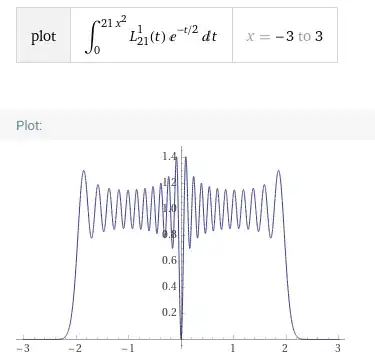
Here is an additional remark.
Let us denote by
$$
g_N(x) := \sum_{n=0}^N (-1)^n L_n(x)
$$
1) When $x≤0$. First, since $L_n(x) = \sum_{k=0}^n \binom{n}{k} \frac{(-x)^k}{k!}$, we immediately have for $x≤0$
$$
g_N(x) = \sum_{n=0}^N \sum_{k=0}^n \binom{n}{k} \frac{|x|^k}{k!} ≥ 0
$$
2) When $x≥0$.
- When $m = 2N+1$ is odd, by the answer of @mathreadler, one has
$$
g_{2N+1}(x) = \sum_{n=0}^N L_{2n}(x)-L_{2n+1}(x) = \int_0^x \sum_{n=0}^{N} L_{2n}(x)\,\mathrm d x
$$
Now, recall the formula $\sum_{n=0}^{m} L_{n} = L_m^{(1)} = -L'_{n+1}$ (see e.g. wikipedia). Thus since $\frac{1+(-1)^n}{2} = \mathbf{1}_\text{n even}$,
$$
2\,g_m(x) = \int_0^x \sum_{n=0}^{m} (1+(-1)^n)\, L_{n}(x)\,\mathrm d x = \int_0^x g_{m}(x) + L^{(1)}_{m}(x)\,\mathrm d x
$$
and so since $L_{2N+2}(0)=1$, for $m=2N+1$ any odd positive number, one has
$$
2\,g_{m}(x) = \int_0^x g_{m}(t) \,\mathrm d t - L_{m+1}(x) + 1
$$
Taking the derivative, it tells that
$$
g_m' = \frac{1}{2} \,g_m + \frac{1}{2} L^{(1)}_{m}.
$$
Since $g_m(0)=0$, we can then solve this differential equation to get
$$
2\,e^{-x/2}\,g_m(x) = \int_0^x L^{(1)}_{m}(t) \,e^{-t/2}\,\mathrm d t
$$
$\bullet$ Similarly, when $n=2N$ is even, removing the first term $L_0(x) =1$ of the sum,
$$
g_{2N}(x) = 1- \sum_{k=1}^N L_{2k-1}(x)-L_{2k}(x) = 1-\int_0^x \sum_{k=1}^{N} L_{2k-1}(x)\,\mathrm d x
\\
= 1-\int_0^x \sum_{k=0}^{2N} \frac{1-(-1)^k}{2}\,L_{k}(x)\,\mathrm d x
$$
so
$$
g_n(x) = 1 + \frac{1}{2}\int_0^x (g_n - L_{n}^{(1)})
$$
and so
$$
g_n' = \frac{1}{2} (g_n - L_{n}^{(1)})
$$
and so since $g_n(0)=1$,
$$
2\,e^{-x/2}\,g_n(x) = 2 - \int_0^x L^{(1)}_{n}(t) \,e^{-t/2}\,\mathrm d t
$$
which is positive if $\int_0^x L^{(1)}_{n}(t) \,e^{-t/2}\,\mathrm d t < 2$.
3) Conjecture.
When $N\to\infty$, $2\,e^{-N|x|^2/2}\,g_N(N|x|^2)$ approaches $\mathbb 1_{[-2,2]}$.