1

Suppose that a discrete group $G$ acts freely on a topological space $X$ such that each orbit is discrete for the subspace topology. Here $X$ is not necessarily Hausdorff.

Are there any easy examples such that the quotient map $X \to X/G$ is not a covering map?

I believe a counterexample is given without proof here, but I don't see why the quotient map fails to be a covering map in that case. Maybe there are easier counterexamples?

Jens Hemelaer
  • 644
  • 4
  • 14
  • 1
    In the example given on mathoverflow, you can think of the space $X/G$ as the set whose elements are orbits of the action of $G$ on $X$. These orbits look like parabolas and there is a discontinuity when the parabola approaches the axes: it splits in two halves. This space $X/G$ is a bit like the line with two origins. – Dabouliplop Jan 15 '21 at 14:50
  • Thanks @Idéophage! Do you know how the discontinuity results in $X \to X/G$ not being a covering map? I agree that the quotient space is not Hausdorff, but this doesn't in itself give a contradiction, since a covering map can have Hausdorff domain and non-Hausdorff codomain (see https://math.stackexchange.com/q/2851938/). – Jens Hemelaer Jan 15 '21 at 15:18
  • 1
    I'm sorry, indeed I don't understand either why the map $F→F/G$ in the post you linked is claimed to not be a covering map! I built an example but it's too convoluted and not based on something like $\mathbb{R}^2$ but more on a space with copies of ${0}∪{1/n,|,n>0}$... I'll post it later if I don't find any mistake meanwhile. – Dabouliplop Jan 15 '21 at 17:49
  • The action in the example actually is a covering projection. It is only necessary to show that the translation map associated to the action is continuous, and this isn't too hard. The example appears in Hatcher's Algebraic Topology as exercise 25 on pg. 81. – Tyrone Jan 15 '21 at 18:29
  • 1
    A statement I am looking now at is Pr.14.1.12 on pg. 333 of tom Dieck's book Algebraic topology. It gives condition for a free action of a discrete group to be locally trivial. Maybe it is useful to you. – Tyrone Jan 15 '21 at 18:34
  • 1
    @Tyrone Actually the example in the mathoverflow link which is claimed to not be a covering map is not the same as the one in Hatcher. It's the second one that is supposed to not be a covering, not the first one. But still, I believe this one is too. – Dabouliplop Jan 15 '21 at 19:30
  • @Idéophage I see my confusion. Unless you think its confusing, I'll leave my previous comment for anyone who reads this post... So I guess I'll just keep quiet and look forwards to your example ;). – Tyrone Jan 15 '21 at 19:42
  • @Tyrone No problem. I posted the example if you are interested. – Dabouliplop Jan 16 '21 at 11:40
  • 2
    See my answer here, Proposition 4. Let me know if you find it unclear. The key thing to understand is that each point $p\in A$ (the equivalence class of $(x,0)$) has basis of neighborhoods $W$ in $A$ such that each $W$ is the projection to $A$ of the union a neighborhood $U$ of $(x,0)$ and a neighborhood $V$ of $(0, 1/x)$. Now, observe that for infinitely many $g\in G$, $gU\cap V\ne \emptyset$. Thus the action of $G$ on $A$ is not covering. – Moishe Kohan Jan 16 '21 at 14:31
  • Thanks @MoisheKohan! If I understand correctly, as $g \in G$ goes to $-\infty$, $gU$ becomes very close to the x-axis and also extremely stretched out horizontally. So there is an $N < 0$ such that $gU \cap V \neq \varnothing$ for all $g < N$. Thanks for the additional explanation. – Jens Hemelaer Jan 16 '21 at 17:11
  • @MoisheKohan I add my thanks to Jens'. On mathoverflow, the post was speaking about the complement of $Q$ if I understand correctly. I agree that the action on $Q$ itself (quotiented) doesn't give a covering. Actually it's an easier way to describe the example I posted below! Maybe that's what Misha meant to say on mathoverflow. – Dabouliplop Jan 16 '21 at 17:20
  • @JensHemelaer Absolutely right! – Moishe Kohan Jan 16 '21 at 17:37

1 Answers1

3

I think both of the examples given at mathoverflow are actually covering maps.

I claimed in the comments that I had a somewhat discrete example but I transformed it to a manifold-based example. The space $X$ is the Möbius strip and $G = ℤ$. I haven't found a really nice way of describing the action but I'll do what I can.

We start by describing a free action of $ℝ$ on $X$. The quotient is $[0,1[$ and the fibers of the quotient $X↠[0,1[$ are shown on the drawing below.
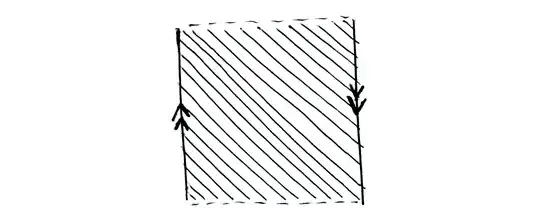
Notice that the "cut" chosen above to draw the Möbius strip above is special. If we displace the cut, we see an angle appear in the fibers. Below are other drawings of two of the fibers. The one in red is the fiber above $0 ∈ [0,1[$.
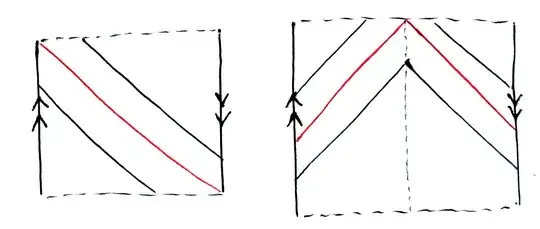
The action of $ℝ$ is done by "following the fibers" in a chosen direction, but you need to slow down more and more as you approach the angle of the red line. Maybe it's a bit hard to see that it works on the drawings I gave. Here is a different way of drawing the Möbius strip and the two fibers. Imagine it has an infinite height.
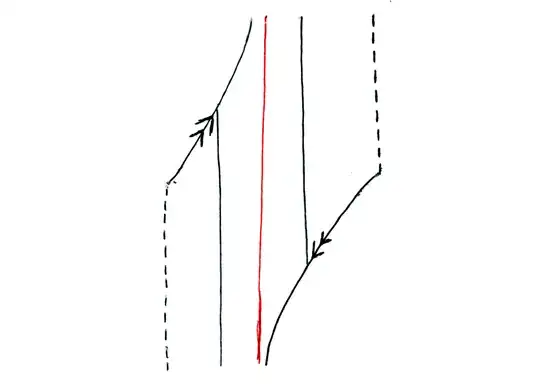
On this drawing, the action of $ℝ$ is isometric on the fibers and easier to see (translate along the $y$ direction and teleport to the other side of the red line when you end up out of the drawing).

To get an action of a discrete group and discrete orbits, we restrict the above action to $ℤ⊆ℝ$. The quotient becomes $[0,1[ × S^1$ and the quotient map is not a covering above $(0,x)$ for any $x ∈ S^1$.

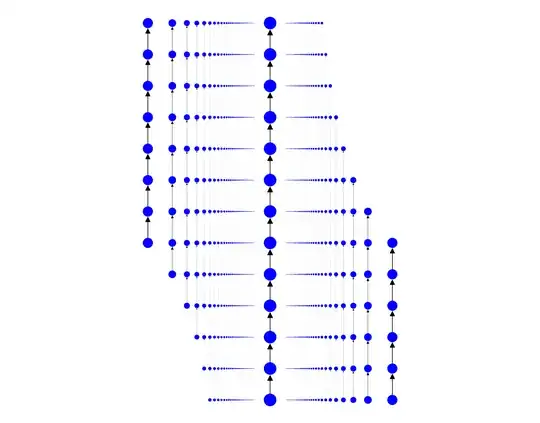
To give you an idea of the initial "discrete" example I had, here is a drawing of it. I don't explain more, it's very similar to what I said above. I built by trying to contradict the properness of the action in the simplest way possible.
Dabouliplop
  • 2,131
  • I'm sorry for the late reply to your answer. In your drawings, it looks to me as if the fibers are circles, rather than copies of the real line, and I don't see an easy way to fix this. If the fibers are drawn as straight lines, they always seem to end up back again where they started, eventually. (It first goes in a straight line from height a to height b, then it starts again at height -b and goes in a straight line from height -b to height -a, which means it starts at height a again afterwards) – Jens Hemelaer Jan 19 '21 at 14:19
  • 1
    @JensHemelaer No problem for the late reply. My example is actually exactly the same as the one given by Moishe Kohan in the comments, but drawn differently. I don't know which drawing you are speaking about when you explain the loop you see but let's take the last hand drawing (the one just before the one with the blue dots). – Dabouliplop Jan 19 '21 at 14:33
  • 1
    The black fiber is split in two. The left part goes at infinity toward the "down" direction and the right part goes at infinity toward the "up" direction. Now let's look at the drawing just before it, with a "V" pointing upward in red. Actually, this is not really a V since the point at the top is lacking. The left part of the V is connected to the right part only through the identification of the left and right borders! If you look at the black fiber, it seems clear to me that it is homeomorphic to $\mathbb{R}$ and not $S^1$. Is it clearer? – Dabouliplop Jan 19 '21 at 14:33
  • 1
    Notice that the up and down borders of the square in the first drawings are not part of the Möbius band. – Dabouliplop Jan 19 '21 at 14:34
  • 1
    @JensHemelaer In the last hand-drawing, the red line is an asymptote to the two lines going toward it, they never cross. – Dabouliplop Jan 19 '21 at 15:32
  • Thanks, with the top of the red "V" removed, I agree that it is homeomorphic to $\mathbb{R}$. But then I don't see which orbit the top of the "V" is part of. That said, I see it working as soon as I remove the top of the red "V", and the halfline above it, from the Möbius strip. – Jens Hemelaer Jan 19 '21 at 15:53
  • 1
    @JensHemelaer Yes, you need to remove this line, I should have added this precision. The Möbius band I'm speaking about is not a closed (compact) surface, the border is empty! This is what represents the fact that the top and bottom borders are dashed lines: they are not included in the surface. – Dabouliplop Jan 19 '21 at 16:05
  • Ah, I get it now, thanks! – Jens Hemelaer Jan 19 '21 at 17:56