Instead of starting with $MQ'=MQ$ as a given condition, and trying to prove the equality of tangents, in order to show that $CQ'$ is the radical axis, this approach starts from the equality of tangents $LH$, $LJ$ and proves $MQ'=MQ$, and hence that $CQ'$ is the radical axis.
$DQ$ is perpendicular bisector of $AB$, $M$ is midpoint of $OP$, as in the posted question.
$BA$ and $OP$ extended meet at $G$. $HJ$, tangent to the circles at $H$, $J$, is known to concur with $OP$ and $BA$ at $G$.
From $L$, the midpoint of $HJ$, drop $LQ'$ perpendicular to $OP$, and extend it upward to meet $QD$ at $C$.
Join $HO$, $DM$, $ML$, $PJ$.
We prove$$QM=Q'M$$
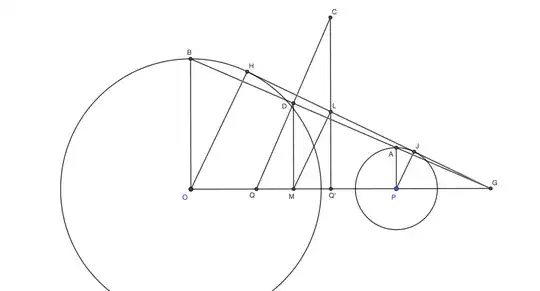
Since $M$, $L$ bisect $OP$, $HJ$, and $OH\perp HJ$, then $$ML\perp LJ$$
Therefore$$\triangle LMQ'\sim\triangle GML\sim\triangle GOH$$and$$\triangle DQM\sim\triangle GQD\sim\triangle GBO$$But$$OH=OB$$therefore$$QM=Q'M$$
And $LH$, $LJ$ are equal tangents. Therefore $L$ lies on the radical axis.
Repeating the same construction and argument in the lower halfplane, we get a second point $L'$ on $LQ'$ extended. Therefore $CQ'$ is the radical axis.


