I've attached a model for the Möbius band. The vertices are $a$ and $b$. The ones that eventually get glued together are given the same letter. The edges are labeled $A$, $B$ and $C$. There are two edges labelled $A$, and they have arrows. The must be glued so that the arrows agree, i.e. you need to give a half twist before you glue. The arrows on $B$ and $C$ are only there because we must orient simplices. Finally, $\alpha$ is the one face. I don't know how to put a clockwise arrow around it, so please add one.
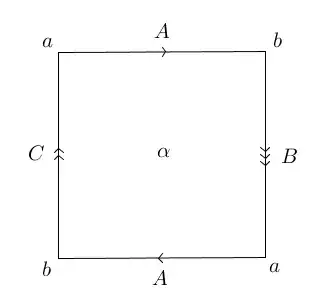
To find the homology groups, we must look at the images and the kernels of the boundary maps. Consider the series of maps $0 \to F \to E \to V \to 0$, where $F$ stands for faces, $E$ for edges and $V$ for vertices. In between each is a boundary map.
- Consider $\partial : 0 \to F$. The image and the kernel are both $0$.
- Consider $\partial : F \to E$. We have $\partial \alpha = 2A+B+C$ and so the image is non-empty. There was only one face, so the image is isomorphic to $\mathbb{Z}$. The only face had a non-zero image so the kernel is $0$.
- Consider $\partial : E \to V$. We have $\partial A = b-a$, $\partial B = a-b$ and $\partial C = a-b$. Up to an integer, the images are all $a-b$ and so the image is one dimensional: $\mathbb{Z}$. There were three edges, and the image was one dimensional, so the kernel must be two dimensional: $\mathbb{Z}^2$.
- Consider $\partial : V \to 0$. We have $\partial a = \partial b = 0$ and so the image is $0$. There are two vertices, and so the kernel must be $\mathbb{Z}^2.$
We can put all of this together. The group $H_2(M,\mathbb{Z})$ is given by the quotient of the kernel of $F \to E$ by the image of $0 \to F$, i.e. $0/0 \cong 0$. The group $H_1(M,\mathbb{Z})$ is given by the quotient of the kernel of $E \to V$ by the image of $F \to E$, i.e. $\mathbb{Z}^2/\mathbb{Z} \cong \mathbb{Z}$. The group $H_0(M,\mathbb{Z})$ is given by the quotient of the kernel of $V \to 0$ by the image of $E \to V$, i.e. $\mathbb{Z}^2/\mathbb{Z} \cong \mathbb{Z}$. Hence:
\begin{array}{ccc}
H_2(M,\mathbb{Z}) &\cong& \{0\} \\
H_1(M,\mathbb{Z}) &\cong& \mathbb{Z} \\
H_0(M,\mathbb{Z}) &\cong& \mathbb{Z}
\end{array}


