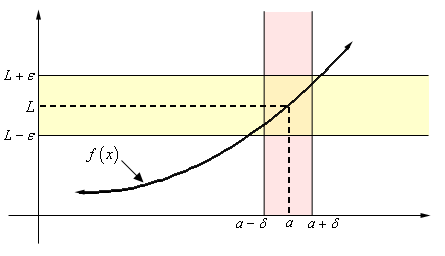
1

So the definition of Limit I see is

$$\lim_{x \to a}f(x) = L$$ means: for all $\epsilon >0$, there exists a $\delta >0$ such that $$0<|x - a| < \delta \Rightarrow |f(x) - L| < \epsilon $$

I was wondering if modifying the definition to: Limit exists when for all $\delta >0,$ there exists a $\epsilon > 0$ such that

$0<|f(x) - L| < \epsilon $ $\Rightarrow |x - a| < \delta$

would cause any problem.

Because to me it seems like this definition should also work except it does seem a lot harder when it comes to the actual proving part.

Can this flipped version of the limit definition also work? Why did mathematicians define in this order?

Mardia
  • 323
  • This is not answered by the questioned linked above: There are many ways of reordering the symbols used in the $\epsilon-\delta$ definition of continuity and this question uses:(a) $\forall \delta>0 \exists \epsilon>0: 0<|f(x)-L|<\epsilon \implies |x-a|<\delta$, were the linked question considers (b) $\forall \delta>0 \exists \epsilon>0: |x-a|<\delta \implies 0<|f(x)-L|<\epsilon$ (though it switches the roles of $\delta$ and $\epsilon$ which is a cause for confusion). Thus there are functions which are continuous which do not satisfy (a) while any locally bounded function satisfies (b). – krm2233 Dec 27 '23 at 10:24

2 Answers2

4

That is not equivalent to the usual definition. For instance, if $f\colon\Bbb R\longrightarrow\Bbb R$ is the constant function $L$, then $\lim_{x\to a}f(x)=L$ (for any $a\in\Bbb R$), according to the usual definition. But not according to your definition.

  • (+1) ... but what is $f$ is locally invertible? – Mark Viola Jul 26 '20 at 18:39
  • "but what is f is locally invertible?" way too huge an assumption to make the definition meaningful. But if so you must find the region within which it is invertible and restrict your $\delta$ $\epsilon$ within it. – fleablood Jul 26 '20 at 18:44
  • If $f$ is locally invertible and its domain is an interval, then it seems that those definitions are equivalent, yes. – José Carlos Santos Jul 26 '20 at 18:44
  • @fleablood Indeed. But with that overly restrictive condition, the statements are equivalent. – Mark Viola Jul 26 '20 at 18:48
  • $\sin$ is locally inverable. But $|f(x) - L| < \epsilon \not \implies |x-a| < \delta$. Instead $|f(x) - L| < \epsilon \implies \exists k\in \mathbb Z;$ either $|(2\pi k +x)-a| < \delta$ or $|((2k+1)\pi-x)-a| < \delta$. I think we need the entire function to be invertible .... Or am I missing what "locally invertable" means? – fleablood Jul 26 '20 at 19:23
  • @fleablood The function $\sin$ is not locally invertible near, say, $\frac\pi2$. – José Carlos Santos Jul 26 '20 at 19:38
  • but in the areas not near $\frac \pi 2 + k\pi$? Does locally invertible at $x=a$ mean there is a neighborhood $N_a$ of $a$ so that $f$ restricted to $N_a$ is injective? Or does locally invertible mean that there is a neighborhood $E_{f(a)}$ of $f(a)$ so that the preimage of every point in $E_{f(a)}$ is a singleton (or empty) [i.e. $f$ restricted to $f^{-1}(E_{f(a)}$ is injective]? If the former $\sin x$ is locally invertable except at extrema. If the latter only functions that sometimes pass the "horizontal line test" are locally invertable. – fleablood Jul 26 '20 at 20:47
  • I had in mind your first option. So, indeed, $\sin$ is locally invertible at every $a\notin\left{\frac\pi2+k\pi,\middle|,k\in\Bbb Z\right}$. – José Carlos Santos Jul 26 '20 at 21:42
1

Huge problems.

Basic issue. We hone in on the function by honing in on the image of the function by honing in on the domain. We can't hone in on the domain by honing in on the function because the function needn't be invert-- it may fail the horizontal line test-- and we have point in the image close together that are miles apart in the domain.

Example a constant function. Or the periodic $\sin$ function where $|f(x) - L| < \epsilon$ would not mean $|x-a| < \delta$ as $x$ may be multiples of $2\pi$ distant for $a$. So $|f(x)-L| < \epsilon \not \implies |x-a| < \delta$.

... Now that counter-intuitive aspect that confuses every student (except the students who lie) is that it seems if we are honing in one the domain ($\delta$) to hone in on the image, should we start with the $\delta$??? Doesn't starting with the $\epsilon$ seem backwards.

And .... yes, it seems that way, but if you draw enough pictures and practice enough you will see that we must work backwards by establishing "acceptable error" range in the final image and finding the intial input range to produce the acceptable error. That's the only way it'll work. The wording sound backwards... but it's how it must be.

We start with the "acceptable error" range in the end result, to retrofit and finish with ant initial input range.

That's why it's $\epsilon$ first, then $\delta$ and not the other way around.

And if you are confused, rest assured every student before you either was equally confused at one time or are is lying about it.

fleablood
  • 130,341
  • From drawing pictures, it just seems like I can find the satisfying interval of the image from the arbitrary interval in the domain. I am talking about the pictures of graphs that are used to explain the epsilon-delta limit concept. On those pictures, the lines from epsilon interval are drawn first then the lines of delta interval. It seems intuitive that I can also start the line from any delta interval and connect those lines to epsilon interval. link – Mardia Jul 26 '20 at 19:18
  • Yes, ... but it's backwards engineering... to me, that seems to be the best way to think of it. – fleablood Jul 26 '20 at 19:25
  • Sorry, I don't understand what you mean by backwards engineering here? – Mardia Jul 26 '20 at 19:27
  • I mean simply that the idea of a limit is that if you get arbtrarily close to $a$ (that is $|x-a|<\delta$ then you get arbtrarily close to $L$ (that is $|f(x)-L| < \epsilon$). It's the tweaking of $x$ and $\delta$ that causes the tweaking of $f(x)$ and $\epsilon$. But to set this in motion we must first establish an error range of $\epsilon$ for which we set the input range of $\delta$. We use the ouptut to establish the input.... reverse engineering. – fleablood Jul 26 '20 at 20:52