For the well-known problem
In an isosceles triangle with base $AB$ and $\angle CAB=80^\circ$ taken $D$ on the segment $CA$, $E$ on the segment $CB$ such that $\angle BAE=60^\circ$, $\angle ABD=50^\circ$, find $\angle EDB$.
The question is what is a canonical or otherwise simple without being too artificial way of solving it? Or what was the solution you heard/seen/found first?
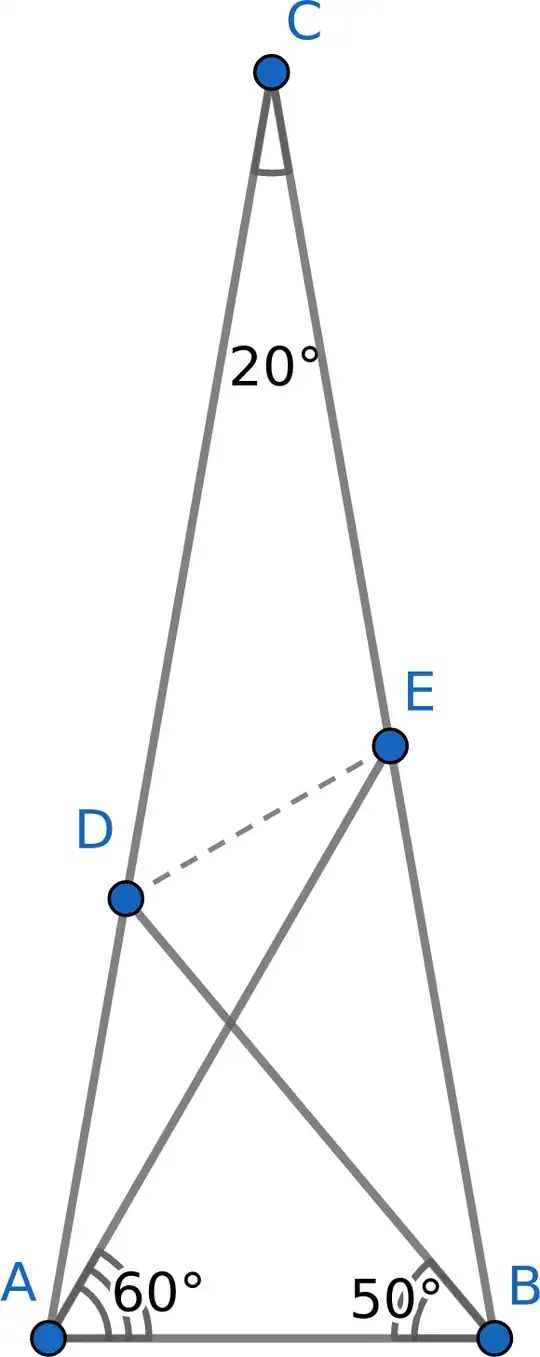
Btw, simple angle chasing does not help. The first way I can think of is considering difference of heights $DH_d$ and $EH_e$ of triangles $ABD$ and $ABE$ respectively along with $H_dH_e$ which together give the inclination angle of $DE$ relative to $AB$ and thus the desired angle. Needed for that lengths of $AD,\,BD,\,AE,\,BE$ can be expressed in terms of $AB$ and known angles by the sine rule. Almost like putting the thing into Cartesian coordinates.
Another approach could be vectors, then taking $A$ or $B$ as the origin makes things more simple, than taking $CA,\,CB$ as basis vectors, IMHO.
By "too artificial" I mean things like this:
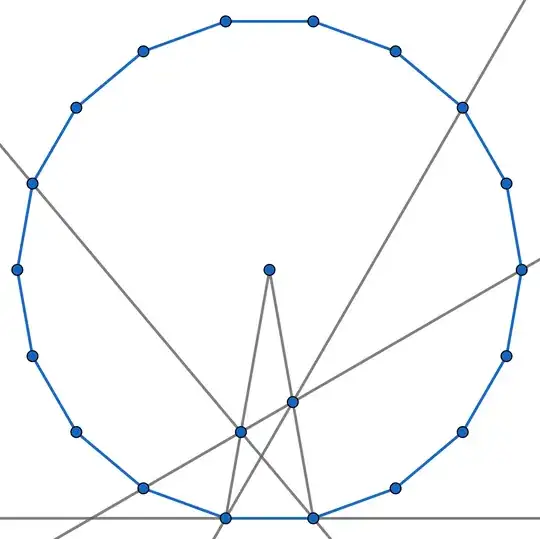
constructing a regular $18$-gon with side $AB$, proving lines $AE,\,BD,\,DE$ contain some diagonals and then finding the angle very easy by angle chasing.
Update:
The solutions are not as trivial as one would expect from the statement. It's called Langley's problem of adventitious angles first posed in The Mathematical Gazette in 1922.
Check out An Intriguing Geometry Problem by Tom Rike.
(from this answer).


