2

This kind of product can hardly be called intuitively understandable. Here is the relevant excerpt of the classical book «New foundations for classical mechanics» by David Hestenes. enter image description here Hestenes introduces the product as a mathematical abstraction, some positivistic notion, entirely justified by the principle «it just works» carefully avoiding the question of physical meaning of this construction. However, this product is not some thing artificial, an empirical observation; it can be easily deduced if one writes down formula for the product of two decomposed vectors (taking into account the following assumptions that are natural for Euclidean world: $x^2 = y^2 = 1$ and $x\wedge y = -x\wedge y$): $$ (ax + by)(cx + dy) = acx^2 + adx\wedge y + bcy\wedge x + bdy^2 = (ac + bd) + (ad - bc)x\wedge y $$ So, one has two equivalent entities of grade (Hestenes' term) one, namely vectors, that can be easily attributed physical meaning, as input and the product black-box produces single entity of grade zero and single entity of grade two. Can this operation itself be prescribed any physical or philosophical meaning? Elementary arithmetics tells us that some «law of grade conservation» holds, but what does this law describe? Are there other mathematical constructions qualitatively similar to this one in the sense described above?

P. S. Please do not mistake my question for some thing like «What is geometric algebra and why do we need it?». I am interested in knowing what this specific formula tells us about the World.

S. N.
  • 161
  • 4
  • Clifford algebras go back to William Kingdom Clifford in the nineteenth century. There's a clue in the name. – Angina Seng Jun 10 '20 at 17:08
  • @AnginaSeng That is very astute and extremely helpful. – S. N. Jun 10 '20 at 17:13
  • Looks like a duplicate of https://math.stackexchange.com/questions/3193125/intuition-for-geometric-product-being-dot-wedge-product – rob3c Jun 11 '20 at 19:44

2 Answers2

3

This is based on my answer to a similar question here: https://math.stackexchange.com/a/3196259/330319

There's a direct isomorphism to complex numbers, assuming complex numbers are ok intuitively, that is! :-) The symmetric dot product part corresponds to the real part of a complex number, and the antisymmetric wedge part corresponds to the imaginary part.

Hestenes offered the intuition of thinking about it as a "directed arc" in his Oersted Medal Lecture, making the analogy with vectors as directed lines.

However, i prefer the following intuition:

The geometric product between two vectors produces a geometric operator that can perform a scaled rotation of another vector (or other GA objects via linearity) according to the properties of the relationship it captures between the two vectors: their relative angle and magnitudes. However you label it, the main intuition for visualizing it is that it is an operator with the potential to perform a scaled rotation (rather than being a rotation itself or 'directed arc' a la Hestenes, which creates more confusion than clarity IMHO).

To see it easily without cranking through the details, note that the geometric product results in a value with scalar and bivector parts. When multiplying a third vector by the product (now an operator), the operator's scalar part will just create a weighted version of the vector along its same direction, and the operator's bivector part will created a weighted vector in its orthogonal direction, since wedging a vector with a bivector 'cancels' any part in the shared direction. The sum of those two vector 'components' results in the third vector being essentially rotated/scaled, depending on all of the relative magnitudes and angles.

Update:

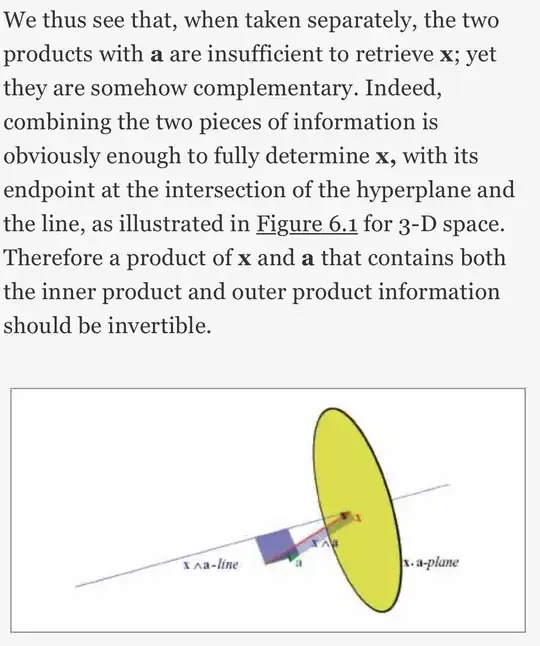
I want to also partly address the philosophical part of your question by mentioning the invertibility of the geometric product. Dot and wedge products alone throw away information and are not individually invertible. However, by combining them into a single mathematical entity via the geometric product, the product becomes invertible and allows a meaningful vector division.

Here's a nice diagram that I think illustrates how it works in an intuitive way. It's from the 2010 book by Dorst, Fontijne and Mann called "Geometric Algebra for Computer Science: An Object-Oriented Approach to Geometry", which I highly recommend. In addition to paper copies, it's also available in electronic form with an O'Reilly subscription (formerly Safari Books Online).

Figure 6.1: Combination of the noninvertible subspace products leads to the invertible geometric product

rob3c
  • 186
  • 1
    Thank you very much. I find your interpretation of the product as mapping between direct product of two copies of vector space and space of operators (i. e., complex numbers) acting on the third copy of the space to be quite interesting and natural. Also, I checked the thread you are referred to (had I revealed it earlier, I would probably refrained from starting this thread). I am going to go through the Hestenes' lecture. Any way, your reply together with references you provided pretty much answered my question. – S. N. Jun 13 '20 at 09:52
  • 2
    Off to the side. The more I learn about geometric algebra, the more enamoured and fascinated with it I become. Such a beautiful, elegant, general and efficient approach. It is difficult to believe such a gem had been laying dormant for almost a century, until its preciousness was realised. – S. N. Jun 13 '20 at 09:53
  • I agree! I certainly wish I had discovered it much earlier. Clifford's early death probably contributed to its dormancy. As for the geometric product, there's an invertibility aspect that I meant to add towards addressing the philosophical part of your question. I'll try to update my answer with the a nice diagram from the 2010 book by Dorst, Fontijne and Mann. – rob3c Jun 14 '20 at 23:38
0

This is based on my answer given here: https://math.stackexchange.com/a/4304117/322997

Vectors can be thought of as representing (hyper)planes. For example, in 3D space a vector can be used to represent a plane through the origin. Now, a plane $u$ can be reflected in a plane $v$ using

$$ v[u] = -vuv^{-1}, $$

where the minus sign is needed such that when you reflect $v$ in itself, the front and back of the mirror flip ($v[v] = -v$). If we now also perform a reflection in a second plane $w$, we get the rotation

$$ w[v[u]] = (wv)u v^{-1} w^{-1} = (wv) u (wv)^{-1} $$

The composition of two reflections $wv$ is called a bireflection, and could in fact be either a rotation, translation, or a boost. The picture below shows how two intersecting reflections form a rotation, while parallel reflections form a translation.

enter image description here

So the product of two vectors is a bireflection. The "apples and oranges" of scalar plus bivector only appear because in order to actually compute it, we would have to somehow choose a basis. Staying with the 3D example, we could choose an orthogonal basis $e_1, e_2, e_3$ such that $e_i e_j = \delta_{ij} + e_{ij}$ and represent any plane as $x = \sum_i x^i e_i$.

Now, when we compute the bireflection $wv$ we will get a scalar and bivector part: $$ w v = \sum_{ij}(w^i e_i) (v^j e_j) = \sum_i w^i v^i + \sum_{i \neq j} w^iv^j e_{ij}. $$

So just remember the truth: there are no apples and oranges. This works in any number of dimensions: the vectors of a geometric algebra $\mathbb{R}_{p,q,r}$ form the reflection group $Pin(p,q,r)$. For more detail on this approach I would refer to this video, or to the Graded Symmetry Groups paper. Full disclaimer: I'm one of the authors.

tBuLi
  • 153