1

In this question, the letters $a,b,c$ for stating the Pythagorean theorem are said to be parameters. $$a^2+b^2=c^2$$

I am wondering if it is possible to set the letters $a,b$ to be variables and the letter $c$ to be a parameter as the equation of a circle. $$x^2+y^2=r^2$$ with the given parameter $r$.

MS.Kim
  • 808
  • 2
    Yes, of course that's fine. The difference between constants, variables and parameters isn't really well-defined mathematically, it just depends on context. Here you could say $r$ is a parameter because you're thinking of it as one. – Jair Taylor Feb 05 '20 at 17:54
  • 2
    That is, you think of $r$ as a property of the circle rather than as a coordinate. – Jair Taylor Feb 05 '20 at 17:55
  • 2
    Variables are just place holders so, of course, you can do this. But notice! This says something VERY important about the relationship between circles and right triangles. Can you put it into words? Can you prove it geometrically? – fleablood Feb 05 '20 at 18:01
  • 1
    Oh... I suppose I should have read the cited questions and post and answer first. So the $a,b,c$ in the Pythagoreon theorem are "parameters" and in a circle the $x,y,r$ are "variables". Okay, the tl;dr answer is ... in context and meaning they serve different functions and roles, but in the gritty turning the wheels and mechanically doing the math... they both do the same thing. ... Honestly, I wouldn't worry about the differences between parameters and variables unless you are doing high(low) level axiom construction. – fleablood Feb 05 '20 at 18:17
  • @JairTaylor, Under what context do we consider all letters are parameters in an equation? – MS.Kim Feb 07 '20 at 16:29
  • @fleablood Can we always switch parameters and variables? For example, in a simple linear relation y=ax+b, can we simply swap the role of a, b and x, and consider the equation as a function of a, b to y? – MS.Kim Feb 07 '20 at 16:36
  • 1
    mechanically yes, in my opinion numbers are numbers and unknowns are unknowns. Conceptually the question that that will answer will be a different question. For instance. If $x$ time and $y$ is height and $b$ some initial height we have a way of predicting height. We can make $x = \frac {y-b}a$ but that doesnt mean we invented a time machine. And we can make $b=y-ax$ but that doesn't mean we can engineer how tall babies are. – fleablood Feb 07 '20 at 17:02
  • @MS.Kim Like I said, the difference is very context-dependent. One situation where difference between "variables" and "parameters" matters when a parameter is constant with respect to other variables, e.g. your $r$, as opposed to a variable such as $x$ or $y$ in an equation $y = f(x)$ where you think of both as changing along a curve. Maybe if you are describing a relationship between parameters that are all considered "constant" with respect to some other variables, all the unknowns in the equation could be considered parameters. – Jair Taylor Feb 09 '20 at 23:53

1 Answers1

1

Yes. Variables are just place holders.

Congratulations! You just discovered trigonometry!

Think of what this means. If $(x,y)$ is a point on a circle with radius $r$ then $x^2 + y^2 = r^2$ which means there is always a right triangle that has has $|x|, |y|$ as sides and $r$ as a hypothesis.

In other words. If you take the point $A=(x,y)$; drop it to the $x$-axis and take the point $B= (x,0)$ and and $C = (0,0)$ then the triangle $\triangle ABC$ will always be a right triangle with a hypotenuse of length $r$.
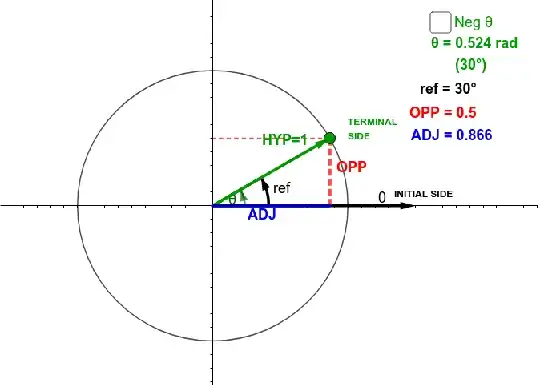
enter image description here

(image from here which discusses this very issue.)

Welcome to the wonderful world of trigonometry! (Seriously... Trigonometry is ENTIRELY about this.)

=====

Actually, all this is backwards.

FIRST we know that $A=(x,y)$ and $B=(x,0)$ and $C=(0,0)$ must be a right triangle becuase the $x$ and $y$ axis are perpendicular and $\overline {AB}$ is parallel to the $y$-axix.

And then BECAUSE it is a right triangle we know that $\overline {AC}$ which we know is equal to the radius of the circle, $r$ thatn $r^2 = (AC)^2= (AB)^2 + (BC)^2= x^2 + y^2$.

And that is how we came up with the formula for the circle in the first place!

Similarly, this is also how we came up with the distance formula. The distance between $(x_1, y_1)$ and $(x_2, y_2)$ is $\sqrt{(x_2-x_1)^2 + (y_2 - y_2)^2}$ because the points $(x_1, y_1), (x_2, y_1),(x_2, y_2)$ make a right triangle with sides of lengths $(x_2-x_1)$ and $(y_2 - y_2)$ and a hypotenuse the distance between the two points.

And a circle always having a distance of $r$ means for any $(x,y)$ on the circle that $r$, the distance between $(x,y)$ and $(0,0)$, must be $\sqrt{(x-0)^2 + (y-0)^2}$. Or in other words it must be that $x^2 + y^2 = r^2$.

fleablood
  • 130,341