1

I have an expression below which I need to do the laplace transform

Any help is highly appreicated.

The expression is :

$$ \frac{\exp\left(\frac{x}{2}\sqrt{(U/D)^2+4s/D}\right)}{s\sqrt{(U/D)^2+4s/D}} $$

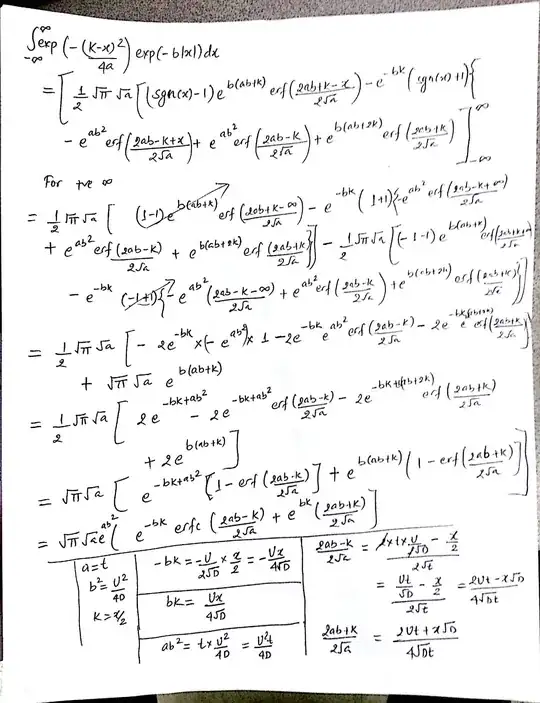
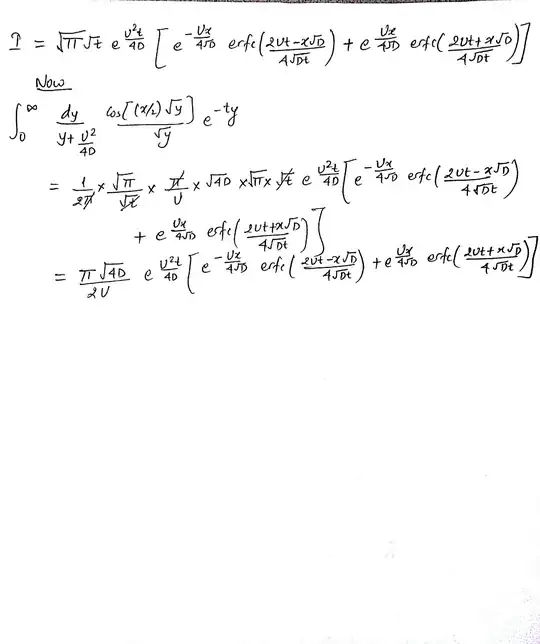
The integral of Ron Gordon's expression:

The first expression on the solution was extracted from Wolfram from the following link: http://bit.ly/YFbLfH enter image description here

enter image description here

Jdbaba
  • 197
  • The numerator is part of exponential – Jdbaba Apr 06 '13 at 01:47
  • I have edited to make that clearer to the naked eye. Also, your first sentence says you need to do the laplace transform, whereas the title says laplace inverse transform (and you have the inverse-problems tag); clarify if it's indeed the latter? – anon Apr 06 '13 at 02:18

1 Answers1

2

I will reduce this to an integral over the real line. Consider the integral in the complex plane:

$$\displaystyle \oint_C \frac{dz}{z} \frac{\exp{\left[\frac{x}{2} \sqrt{\left(\frac{U}{D} \right)^2 + 4 \frac{z}{D}}\right]}}{\sqrt{\left(\frac{U}{D} \right)^2 + 4 \frac{z}{D}}} e^{t z}$$

where $C$ is the following contour
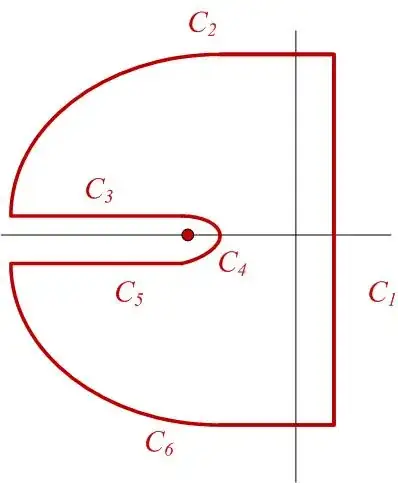
contour

Note the point is the branch point. I will assert without proof that the integral vanishes along the sections $C_2$, $C_4$, and $C_6$ of $C$. This leaves $C_1$ (the ILT), $C_3$, and $C_5$. There is a pole within the contour at $z=0$, so by the residue theorem, we have

$$\frac{1}{i 2 \pi}\left [\int_{C_1} + \int_{C_3} + \int_{C_5} \right ]\frac{dz}{z} \frac{\exp{\left[\frac{x}{2} \sqrt{\left(\frac{U}{D} \right)^2 + 4 \frac{z}{D}}\right]}}{\sqrt{\left(\frac{U}{D} \right)^2 + 4 \frac{z}{D}}} e^{t z} = \frac{D}{U} e^{U x/(2 D)}$$

Along $C_3$, note that there is a branch point at $z=-U^2/(4 D)$. Thus we parametrize $z=-U^2/(4 D) + e^{i \pi} y$; the integral over $C_3$ becomes

$$-i \int_{\infty}^0 \frac{dy}{y+\frac{U^2}{4 D}} \frac{e^{i (x/2) \sqrt{y}}}{\sqrt{y}} e^{-t y}$$

Similarly, along $C_5$, let $z=-U^2/(4 D) + e^{-i \pi} y$; the integral over $C_5$ becomes

$$i \int_0^{\infty} \frac{dy}{y+\frac{U^2}{4 D}} \frac{e^{-i (x/2) \sqrt{y}}}{\sqrt{y}} e^{-t y}$$

Putting this all together as above, we get an expression for the ILT:

$$\frac{1}{i 2 \pi}\int_{c-i \infty}^{c+i \infty} \frac{ds}{s} \frac{\exp{\left[\frac{x}{2} \sqrt{\left(\frac{U}{D} \right)^2 + 4 \frac{s}{D}}\right]}}{\sqrt{\left(\frac{U}{D} \right)^2 + 4 \frac{s}{D}}} e^{t s} = \\ \frac{D}{U} e^{U x/(2 D)} - \frac{1}{\pi} \int_0^{\infty} \frac{dy}{y+\frac{U^2}{4 D}} \frac{\cos{[(x/2) \sqrt{y}]}}{\sqrt{y}} e^{-t y}$$

So evaluation of the posted ILT depends on the ability to evaluate

$$\int_0^{\infty} \frac{dy}{y+\frac{U^2}{4 D}} \frac{\cos{[(x/2) \sqrt{y}]}}{\sqrt{y}} e^{-t y}$$

This integral may be evaluated first by substituting $y=u^2$ and then applying the convolution theorem (or Parseval's theorem, depending on your mood). The substitution produces

$$\int_{-\infty}^{\infty} \frac{du}{u^2+b^2} e^{-a u^2} e^{i k u}$$

where $a = t$, $b^2=U^2/(4 D)$, and $k=x/2$. You may then use the convolution theorem on the Fourier transforms of the functions

$$\int_{-\infty}^{\infty} e^{-a u^2} e^{i k u} = \sqrt{\frac{\pi}{a}} e^{-k^2/(4 a)}$$

$$\int_{-\infty}^{\infty} \frac{du}{u^2+b^2} e^{i k u} = \frac{\pi}{b} e^{-b |k|}$$

Then

$$\int_{-\infty}^{\infty} \frac{du}{u^2+b^2} e^{-a u^2} e^{i k u} = \frac{1}{2 \pi} \sqrt{\frac{\pi}{a}} \frac{\pi}{b} \int_{-\infty}^{\infty} dk' e^{-(k-k')^2/(4 a)} e^{-b |k'|}$$

Frankly, the evaluation of this integral is straightforward but a mess, the derivation of which is not very instructive and will only serve to obfuscate the result. I leave it to the reader with assurances that I have done this out myself, by hand. The result is that

$$\int_0^{\infty} \frac{dy}{y+\frac{U^2}{4 D}} \frac{\cos{[(x/2) \sqrt{y}]}}{\sqrt{y}} e^{-t y} = \pi \frac{\sqrt{4 D}}{U} e^{U^2 t/(4 D)} \left [ e^{-U x/(4\sqrt{D})} \text{erfc}\left(-U \sqrt{\frac{t}{D}}+\frac{x}{4 \sqrt{t}}\right) + e^{U x/(4 \sqrt{D})} \text{erfc}\left(-U \sqrt{\frac{t}{D}}-\frac{x}{4 \sqrt{t}}\right) \right]$$

where erfc is the complementary error function. Plug this expression in the equation for the ILT and you are done.
Ron Gordon
  • 141,538
  • You are a genius of solving contour integrals! Can you also help me on e.g. expressing $\mathcal{L}^{-1}_{s\to x}{e^{as^2+bs}}$ $(a\neq0)$ in terms of integrals with real lower limit and upper limit in http://math.stackexchange.com/questions/169275? – doraemonpaul Apr 06 '13 at 16:02
  • @doraemonpaul: I am flattered, but I don't think I'd call myself that. In any case, I am not sure how these techniques could help you there, because that function has no poles or branch point singularities. Further, I am not sure of the convergence of such an integral over the contours I have laid out. Perhaps a wedge would work - let me think about it a bit. – Ron Gordon Apr 06 '13 at 16:14
  • @RonGordon Dear Ron, Thank you so much for your detailed solution. This is exactly what I needed. It took a while to get back to you because I was evaluating the values from the solution you gave. One thing I am not sure of is whether we have term "t" on the exponential of the part outside the large brackets in the final expression. I would appreciate if you could send me your hand made calculation to my email so that I could refer that as well. My email id is bishwamitradas@gmail.com . Thanks again for your time and effort. You are a life saver. – Jdbaba Apr 07 '13 at 18:17
  • @Jdbaba: I will send you the hand calc, but it may be a little bit as work has caught up to me. I think the $t$ is right, but check my calc when you get it. I also compared with Mathematica output but the notation was not spot on. Also, please accept the solution if you find it useful. Thanks. – Ron Gordon Apr 07 '13 at 18:45
  • @RonGordon I have one more question to ask here. How would the solution change if I have negative sign inside the exponential in my original question ? – Jdbaba Apr 07 '13 at 18:49
  • @Jdbaba: you mean $-x/2$, or $-4 z/D$? – Ron Gordon Apr 07 '13 at 18:51
  • @ RonGordon: Yes exp(-x/2\sqrt......) – Jdbaba Apr 07 '13 at 18:53
  • @Jdbaba: in that case, the solution would not change. – Ron Gordon Apr 07 '13 at 18:53
  • @RonGordon Thank you for clarifying. So, does this mean the solution is independent of the sign of the exponential ? $$ \frac{\exp\left(-\frac{x}{2}\sqrt{(U/D)^2+4s/D}\right)}{s\sqrt{(U/D)^2+4s/D}} $$ – Jdbaba Apr 07 '13 at 18:56
  • @Jdbaba: yes, that is correct. Note that this is encapsulated in the cosine term in the integral. BTW you may wish to verify the solution by taking its LT and making sure it reduces to your original expression, although I doubt that this would be a simple task. – Ron Gordon Apr 07 '13 at 19:03
  • Hi Ron, I tried to integrate the integral that you posed before posting the final solution and I got slightly different result. I have added that result to my original question. Would you please take a look and see whether there is anything wrong ? I also want to ask you how different the results will be if I have the expression like this? $$ xexp(Ux/2D)\frac{\exp\left(\frac{x}{2}\sqrt{(U/D)^2+4s/D}\right)}{s\sqrt{(U/D)^2+4s/D}} $$ – Jdbaba Apr 07 '13 at 23:35
  • @Jdbaba: you did catch a mistake of mine - I forgot to put in a factor of $k$ in those exponentials. Thanks. I have edited the final result to reflect this. – Ron Gordon Apr 07 '13 at 23:50
  • @RonGordon: another good question http://math.stackexchange.com/questions/356450. I think this will be sightly easier for you than http://math.stackexchange.com/questions/354476 and http://math.stackexchange.com/questions/169275. – doraemonpaul Apr 10 '13 at 22:05