31

This is exercise 1.3.14 in page 80 of Hatcher's book Algebraic topology.

It's equivalent to consider subgroups of $\pi_1(X_1\vee X_2)=\mathbb Z_2 * \mathbb Z_2 =\langle a \rangle *\langle b \rangle$.

To move this question out of the unanswered list, I put my solution in answer.

Andrews
  • 4,293
  • The list of cyclic subgroups of order 2 seems incomplete: $bab$ will generate one, in the same way that $aba$ will. – Hew Wolff Dec 12 '19 at 16:02
  • Thanks for pointing this out. If we don't care about the choice of basepoint, there're only two covering spaces corresponding to subgroups isomorphic to cyclic group of order $2$. I'll modify the whole proof. – Andrews Dec 13 '19 at 04:29

1 Answers1

59

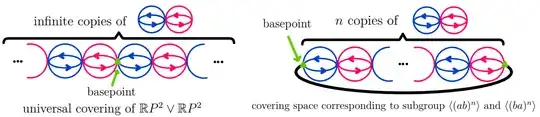
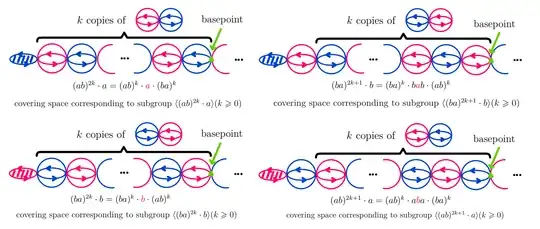
In the following pictures, green dots means basepoints, black curve means its two endpoints are attached. Covering map maps blue $S^2$ to $X_1$ and red $S^2$ to $X_2$.

Let $X_1$ and $X_2$ denote the first and second copy of $\mathbb RP^2$.

$\pi_1(X_1)=\mathbb Z_2=\langle a \rangle,\ \pi_1(X_2)=\mathbb Z_2=\langle b \rangle$.

pic1

$1$. For trivial subgroup $1$, it corresponds to the the universal cover, i.e. the infinite chain of $S^2$.

$2$. For subgroup isomorphic to infinite cyclic group $\mathbb Z$, it is generated by $(ab)^n$ or $(ba)^n$ of index $2n$ $(n \geqslant 1)$ and it corresponds to a "necklace" of $2n$ copies of $S^2$.
pic2

$3$. For subgroup isomorphic to $\mathbb Z_2$, it's generated by $(ab)^{m}\cdot a$ or $(ba)^{m}\cdot b$ $(k\geqslant 0)$ and it corresponds to $\mathbb RP^2$ attached to an infinite chain of $S^2$.
pic3

$4$. For subgroup isomorphic to the infinite dihedral group $\mathbb Z_2 * \mathbb Z_2$, it's generated by $(ab)^n$ and $(ab)^m \cdot a$ $(m\leqslant n)$ and it corresponds to a finite chain of $S^2$'s with both ends attached an $\mathbb RP^2$.

pic4

Andrews
  • 4,293
  • 8
    Beautiful pictures, how did you make them? – Alessandro Codenotti Feb 09 '20 at 10:02
  • 22
    @AlessandroCodenotti Thank you. Actually I draw them in OneNote by hand, and it took a lot of time, but I think that's worthy if it can really benefit others. The answer to this question is not hard, but most of the answers are descriptive. – Andrews Feb 09 '20 at 10:42
  • I understand given a group $G$, one can always construct a universal cover $\tilde{X}_G$. But is the covering space you draw corresponding to each subgroup of $G$ universal? It seems, for example, the second covering space corresponding to the subgroup $\langle (ab)^n \rangle$ is not simply connected. – manzujizhe Feb 14 '22 at 03:37
  • @ZelongLi Why should it be simply connected? Only the covering space corresponding to the trivial subgroup should be simply connected. – feynhat May 26 '22 at 03:53