In terms of the leading term coefficient the following identities hold true:
\begin{eqnarray}
c_d&=&\int\limits_{0 \le x_1 \le \cdots x_d \le 1} \prod\limits_{1 \le p < q \le d} (x_p - x_q)\cdot \prod\limits_{p=1}^d dx_p\\
&=&\sum\limits_{\sigma \in \Pi} \mbox{sign($\sigma$)} \frac{1}{\prod\limits_{i=1}^d \sum\limits_{j=1}^i \sigma_j} \quad (1)\\
&=& \int\limits_{[0,1]^d} \left(\prod\limits_{p=1}^d x_p^{\binom{p}{2}+p-1} \right) \cdot
\prod\limits_{p=1}^d \prod\limits_{q=p+1}^d \left(1-\prod\limits_{\xi=p}^{q-1} x_\xi\right) \cdot \prod\limits_{p=1}^d d x_p \quad (2) \\
&\underbrace{=}_{?}& \prod\limits_{\xi=1}^{d-1} \frac{(\xi!)^2}{(2 \xi+1)!}
\end{eqnarray}
where in $(1)$ we expanded the Vandermonde determinant in a sum over permutations $\Pi$ and then integrated term by term and in $(2)$ we we used the trick $1/p = \int\limits_0^1 x^{p-1} dx$ and the definition of the Vandermonde determinant again.
The representations above are readily used to compute the result for $d \le 9$. We have:
In[484]:= d =.;
ss = Table[
  Total[Signature[#] Product[1/(Total[Take[#, i]]), {i, 1, d}] & /@
    Permutations[Range[1, d]]], {d, 1, 9}]
Table[Expand[
   Product[x[p]^(Binomial[p, 2] + p - 1), {p, 1,
      d}] Product[(1 - Product[x[xi], {xi, p, q - 1}]), {p, 1, d}, {q,
       p + 1, d}]] /. x[n_]^p_. :> 1/(p + 1), {d, 1, 9}]
Table[Product[(xi!)^2/(2 xi + 1)!, {xi, 1, d - 1}], {d, 1, 9}]

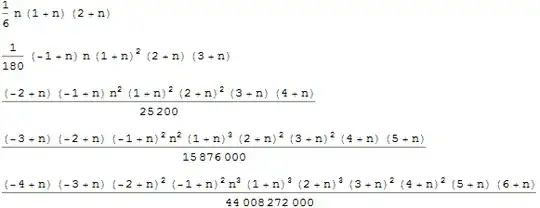
Update: Let us denote:
\begin{eqnarray}
{\mathcal S}_d^{(n)} := \sum\limits_{0 \le i_1 < i_2 < \cdots < i_d \le n} \prod\limits_{1 \le p < q \le d} (i_q-i_p)
\end{eqnarray}
for $n \ge d-1$. Then my conjecture is the following:
\begin{eqnarray}
{\mathcal S}_d^{(n)} = \left[\prod\limits_{\xi=1}^{d-1} \frac{(\xi!)^2}{(2 \xi+1)!}\right] \cdot
\left[\prod\limits_{j=-d+1}^1 (n+j)^{\lceil \frac{j+d-1}{2} \rceil}\right] \cdot (n+2)^{\lfloor \frac{d}{2}\rfloor} \cdot
\left[\prod\limits_{j=3}^d (n+j)^{\lceil \frac{d-j+1}{2} \rceil }\right]
\end{eqnarray}
I have verified this conjecture for $d \le 6$ using the code below:
d = 2; Clear[a]; Clear[aa]; i[0] = 0;
aa = Table[a[p], {p, 0, d - 1}];
smnD = Product[i[q] - i[p], {p, 1, d}, {q, p + 1, d}];
subst = First@
    Solve[CoefficientList[
       smnD - (Sum[Binomial[i[d] - i[d - 1], p] a[p], {p, 0, d - 1}]),
        i[d]] == 0, aa] // Simplify;
(*Sum over i[d] done.*)
S = Sum[Binomial[n + 1 - i[d - 1], p + 1] a[p], {p, 0, d - 1}] /.
   subst;
upLim = d - 1;
For[count = 1, count <= d - 1, count++,
  upLim = upLim + d - count;
  aa = Table[a[p], {p, 0, upLim}];
  subst =
   First@Solve[
      CoefficientList[
        FunctionExpand@(S - (Sum[
             Binomial[i[d - count] - i[d - count - 1], p] a[p], {p, 0,
               upLim}])), i[d - count]] == 0, aa] // Simplify;
  (*Sum over i[d-count] done.*)
  S = Sum[
     Binomial[n + 1 - i[d - count - 1], p + 1] a[p], {p, 0,
      upLim}] /. subst;
  Print["count=", count, "done"];
  ];
Factor[FunctionExpand@S]