Consider the following isosceles triangle (not drawn to scale)
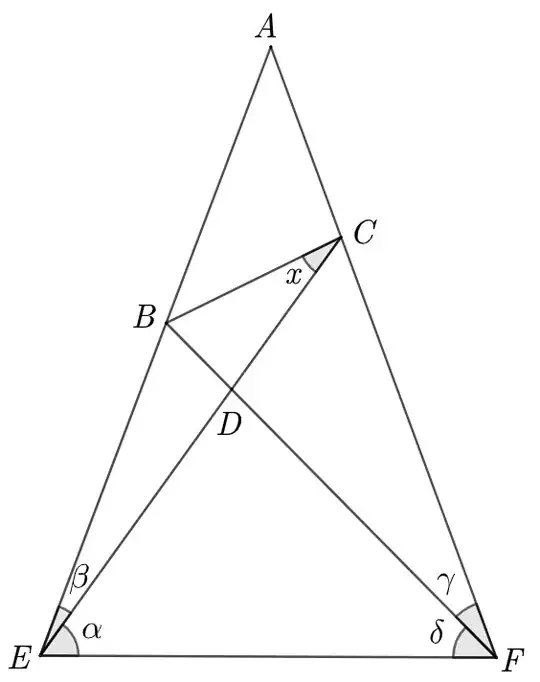
where $\alpha=70^\circ$, $\beta=10^\circ$, $\gamma=20^\circ$ and $\delta=60^\circ$. Find $x$.
A friend gave me this problem a few weeks ago and the only hint I was given was to use elementary geometry, such as the sum of the interior angles of a triangle equals $180^\circ$. I concluded that I eventually need to draw extra lines and possibly deduce something from similar triangles, but so far I haven't figured out much. Any ideas? Am I missing some result that is crucial to the proof?
