What are these as topological spaces? A proof I'm reading is referring to these as counter examples and I can't figure out what they mean?
Asked
Active
Viewed 811 times
5
-
2Each of them has a natural linear order, and they are topologized with the order topology, just as $\Bbb R$ is topologized from its natural order. – Brian M. Scott Mar 19 '13 at 00:21
2 Answers
9
These are ordinal spaces. Ordinals are linearly ordered sets which are also well-ordered, namely every subset has a least element (a generalization of the natural numbers with their ordering).
$\omega_1$ is the linear ordering that every initial segment is countable, but the whole set is uncountable. $\omega_1+1$ is the same order, but now with a maximum which is the unique point that has uncountably many points smaller than itself.
Linear orders generate a very nice topology with the order topology, which is what and how we usually topologize ordinals (I think that any other topology would have been explicitly mentioned).

Asaf Karagila
- 405,794
-
Thank you! I wasn't sure what they were called so I couldn't even google them. Thanks again! Also yes it did refer to them in the order topology. – Mar 19 '13 at 00:21
-
1@AllisonCameron , For more information see, 1. S. Willard General topology p10. and 2. The First Uncountable Ordinal – M.Sina Mar 19 '13 at 07:10
-
1In addition to Willard's book, see Andy Miller's notes. Also, a lot of results involving ordinal spaces for countable ordinals--results that are difficult to find elsewhere--can be found in Chapter II.8 (Compact $0$-dimensional spaces) of Zbigniew Semadeni's 1971 book Banach Spaces of Continuous Functions. – Dave L. Renfro Mar 19 '13 at 14:35
-
@DaveL.Renfro , I search for semandeni'S book but i cant find it in googlebooks or anywhere. If u can please Share a link to read online or download :) Tnx – M.Sina Mar 20 '13 at 15:36
-
@M.Sina: I do not think it is freely available on the internet, but at least in the U.S. it can be found in most university libraries (where I've seen it for over 35 years, probably in over 15 different libraries). His book is in the well known Monografie Matematyczne series, but at this time it seems volumes only up to 1968 are freely available. Semadeni's treatment of this topic is fairly elementary and it reminds me of Sierpinski's book Cardinal and Ordinal Numbers. CONTINUED – Dave L. Renfro Mar 20 '13 at 16:28
-
@M.Sina: CONTINUATION The discussion I'm thinking about in Semadeni's book is probably too specialized for what the original poster is interested in, but I mentioned it because I thought it might not be very well known to those who may have an interest in these things. (People interested in set theory and general topology would probably not expect to find something like this in a book titled Banach Spaces of Continuous Functions.) – Dave L. Renfro Mar 20 '13 at 16:34
-
@DaveL.Renfro , I find Sierpinski's book in un. library. Thank you for the Description and suggest such a good reference. – M.Sina Mar 20 '13 at 17:23
-
1@M.Sina: About a week ago I posted some comments about one aspect of Sierpinski's book. Since I'm here, I may as well mention another book of possible interest (and getting even further off topic from the original poster's question): V. Kannan's Ordinal Invariants in Topology (1981). I don't know if this book is freely available on the internet, but you can get a good idea of what it is about here. – Dave L. Renfro Mar 20 '13 at 18:09
1
The answer is come from here. It is very interesting. So I copy it for you as an answer.
I find pictures to help. The idea here is that $\omega$ is a limit ordinal and tacking on the ordinal $1$ after it is fundamentally different:
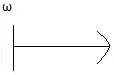

The picture for $\omega$ has a curved edge which indicates that it is a limit ordinal opposed to being a successor ordinal. When we tack on $1$ to the right of $\omega$ we have this ordinal $\omega+1$ that contains a limit ordinal which is not something that occurs in $\omega$. This means that $\omega$ and $\omega+1$ can't be isomorphic.

Martin Sleziak
- 56,060

Paul
- 21,141
-
1Wow thank you. One last question, why is $\omega$ a closed subset of $\omega+1$? (That's the last claim of the proof I'm trying to understand). – Mar 19 '13 at 00:28
-
1
-
3Note that the question was about $\omega_1$ (and its successor), not $\omega$. – Andreas Blass Mar 19 '13 at 00:55
-