Conjecture and prove a formula for $$\sum\limits_{i=1}^n\sum\limits_{j=1}^i j.$$ Note when $n=12$ the sum equals the total number of gifts given in the "twelve days of xmas" song.
Asked
Active
Viewed 1,260 times
1


-
diagonals in Pascal's triangle. – Will Jagy Mar 18 '13 at 18:15
-
1I posted Posted Pascal's triangle, slightly more rows than needed. It's for the children. – Will Jagy Mar 18 '13 at 18:52
4 Answers
5
Hint: $$\sum_{j=1}^ij=\frac{i(i+1)}{2}$$ $$\sum_{i=1}^ni^2=\frac{n(n+1)(2n+1)}{6}$$
3
When you’re asked to make a conjecture, the first thing to do is collect some data:
$$\begin{array}{c|c|c} n&\sum_{k=1}^nk&\sum_{k=1}^n\sum_{i=1}^ki\\ \hline 1&1&1\\ 2&3&4\\ 3&6&10\\ 4&10&20\\ 5&15&35\\ 6&21&56 \end{array}$$
Where you go from here depends on what you already know. If you’re familiar with Pascal’s triangle and binomial coefficients, shown below in rectangular form, you might recognize the three columns of the table above as the non-zero parts of the $1,2$, and $3$ columns of Pascal’s triangle.
$$\begin{array}{c|ccccc|ccccc} n\backslash k&0&1&2&3&4&0&1&2&3&4\\ \hline 0&1&0&0&0&0&\binom00&\binom01&\binom02&\binom03&\binom04\\ 1&1&1&0&0&0&\binom10&\binom11&\binom12&\binom13&\binom14\\ 2&1&2&1&0&0&\binom20&\binom21&\binom22&\binom23&\binom24\\ 3&1&3&3&1&0&\binom30&\binom31&\binom32&\binom33&\binom34\\ 4&1&4&6&4&1&\binom40&\binom41&\binom42&\binom43&\binom44\\ 5&1&5&10&10&5&\binom50&\binom51&\binom52&\binom53&\binom54\\ 6&1&6&15&20&15&\binom60&\binom61&\binom62&\binom63&\binom64\\ 7&1&7&21&35&35&\binom70&\binom71&\binom72&\binom73&\binom74\\ 8&1&8&28&56&70&\binom80&\binom81&\binom82&\binom83&\binom84 \end{array}$$
In that case you could conjecture that
$$\sum_{k=1}^n\sum_{i=1}^ki=\binom{n+2}3$$
and then try to prove it by induction on $n$. If you’re not yet acquainted with binomial coefficients and Pascal’s triangle but do know formulas for the sum of consecutive integers and squares, you might realize that
$$\sum_{i=1}^ki=\frac{k(k+1)}2=\frac12\left(k^2+k\right)$$
and work from there.

Brian M. Scott
- 631,399
2
=-=-=-=-=-=-=-=-=-=-=-=-=
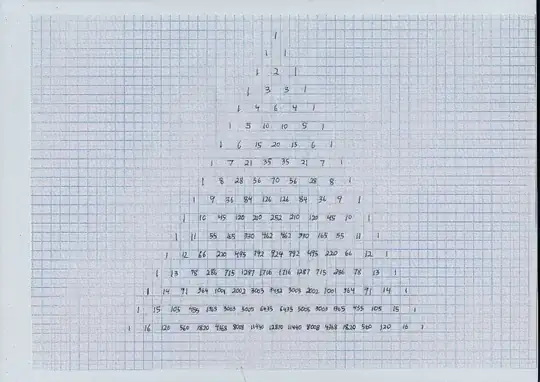
=-=-=-=-=-=-=-=-=-=-=-=-=
I like the part in the binomial coefficients in row 14 where we get 1001, 2002, 3003 in a row. It is clear from a diagram of the Gaussian normal distribution that this happens for real numbers, but here we have actual integers. Plus it illustrates the part about certain elements being divisible by primes, including some in later rows, in this case primes 7,11,13, the 7 shows up because 14 = 2 * 7.
Anyway, as I said, look carefully at the diagonals.

Will Jagy
- 146,052
0
The lyrics for the song The Twelve Days of Christmas may be stated in mathematical form as follows:
$$\sum_{n=1}^{12}\left(g(n)+\sum_{i=1}^n f(n+1-i)\right)$$ where
$g(n)=$ On the $n$-th day of Christmas my true love sent to me
$f(1) \;\ =$ A partridge in a pear tree
$f(2) \;\ =$ Two turtle doves and
$f(3) \;\ =$ Three french hens
$f(4) \;\ =$ Four calling birds
$f(5) \;\ =$ Five golden rings
$f(6) \;\ =$ Six geese a-laying
$f(7) \;\ =$ Seven swans a-swimming
$f(8) \;\ =$ Eight maids a-milking
$f(9) \;\ =$ Nine ladies dancing
$f(10)=$ Ten lords a-leaping
$f(11)=$ Eleven pipers piping
$f(12)=$ Twelve drummers drumming
The total number of gifts may be computed as follows: $$\begin{align} \color{red}{\sum_{n=1}^{12}}\color{orange}{\sum_{i=1}^n}\color{green}{ (n+1-i)} &=\color{red}{\sum_{n=1}^{12}}\color{orange}{\sum_{i=1}^n}\color{green}{ \sum_{j=i}^n 1}\\ &=\color{red}{\sum_{i=1}^n}\color{green}{ \sum_{j=1}^n}\color{orange}{\sum_{i=1}^j 1}\\ &=\color{red}{\sum_{n=1}^{12}}\color{green}{\sum_{j=1}^n}\color{orange}{ \binom j1}\\ &=\color{red}{\sum_{n=1}^{12}}\color{green}{\binom {n+1}2}\\ &=\color{red}{\binom {12+2}3}\\ &=\color{red}{\binom {14}3}\\ &=\color{red}{364\quad\blacksquare} \end{align}$$

Hypergeometricx
- 23,235