8

I've read the question: "Why does the derivative of sine only work for radians?" and I can follow the derivation for the derivative of sine when measured in degrees, but the result confuses me.

Does this mean the derivative of the sine changes values when measured in different units?

For example, would the derivative of sine at $45$ degrees not be the same as the derivative of the sine at $\pi/4$ radians? How could this be the case?

MarianD
  • 2,963
  • Is ${\sin 45^\circ\over 45} = {\sin \pi/4\over \pi/4}$? How can you expect the derivative of $\sin x$ at $0$ turn out to be $1$ if you work in degrees? All the difference quotients are different. – saulspatz Jun 03 '19 at 01:09
  • Change of units always involves a conversion factor. – Paramanand Singh Jun 04 '19 at 02:46

7 Answers7

8

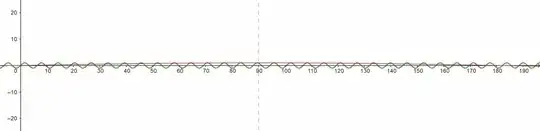
Compare graphs of the two functions - the $\color{green} {green}$ one is for $\,\color{green}{y=\sin(x)}\ $ for $\color{green}x$ in radians, the $\color{red} {red}$ one is for $\color{red}{y=\sin(x)}\ $ for $\color{red}x$ in degrees:
enter image description here

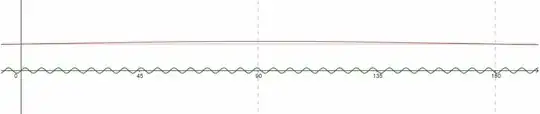
Here are the same graphs, but separated one from the other to better differentiate one from the other:
enter image description here

You may see, that the appearance of the $\color{red}{red}$ graph is almost horizontal line, with the maximum $\color{red}1$ at $\color{red}{x=90^o}$, because $\, \color{red}{\sin(90^o)= 1}$.

Now, the derivative in the arbitrary point $x$ is the slope of the tangent to the graph at the point $[x, \sin x]$.

You may see, that the slopes are not the same for the most $x$. It is even impossible, because the slope of the red $\,\color{red}{\sin(x)}$ is always damn near $\color{red}0$ (more precisely, it varies from cca $\color{red}{-0.017}$ to cca $\color{red}{+0.017}$), whereas the slope of green $\color{green}{\sin(x)}$ varies from $\color{green}{-1}$ to $\color{green}{+1}$.

MarianD
  • 2,963
3

What's so special about radians, anyway?

That is the crux of your question. And the answer is simple: radian measure is unique in the sense that the radian measure of an angle equals the length of the unit circle arc that it subtends. So in the unit circle, a central angle has radian measure equal to the (counterclockwise) arc length it cuts.

The consequence of this property is that when an angle $\theta$ approaches $0$, the sine of the angle is "well-approximated" by the angle measure itself; i.e., $$\sin \theta \approx \theta.$$ To be clear, this is only true when $\theta$ is measured in radians; otherwise, all we can say for small angles is $$\sin \theta \propto \theta.$$

heropup
  • 143,828
1

If you call $\bar\sin$ the function that associates to the angle measured in degrees its sine, you clearly have $$ \bar\sin x=\sin(\pi x/180). $$ where $\sin$ is the usual sine function. Then, by the chain rule, $$ \bar\sin'(x)=\frac{\pi}{180}\sin'(\pi x/180)=\frac{\pi}{180}\sin'(y) $$ where $y$ is the radian measure of the angle of $x$ degrees. So, the derivatives are proportional at any point, and the conversion factor is $\frac{\pi}{180}$. So, for example, $$ \bar\sin'(0)=\frac{\pi}{180}. $$

GReyes
  • 17,926
  • I think this goes directly to the heart of the question. In order to have a derivative of a function in single-variable differential calculus, first you must have a function from numbers to numbers. How do you get such a function from the idea of the sine of $x$ degrees? This answer shows how. – David K Jun 03 '19 at 17:41
0

Showing that $\sin'(x) = \cos(x) $ and $\cos'(x) = -\sin(x) $ depends on $\lim_{h \to 0} \dfrac{\sin(h)}{h} =1 $ and this only holds for radians.

marty cohen
  • 110,450
0

Several other answers are correct, and appropriate for first year calculus. There is another way to see why from a more advanced perspective.

One way to think about the number $e$ is to consider the exponential functions $$ f(x) = a^x $$ for various values of $a$. You can prove that each of these functions is proportional to its derivative. For $a=e$ the proportionality constant is $1$. That is, $f(x) = e^x$ solves the exponential growth differential equation $$ f'(x) = f(x). $$ Once you know that you can solve the differential equation $$ f'(x) = kf(x) $$ by simple scaling: the solution is $f(x) = e^{kx}$.

When you want to think about oscillation rather than growth the differential equation is $$ f"(x) = -k^2f(x) $$ so that the second derivative is proportional to the value, with a negative constant. The solutions to this equation are the functions $\sin(kx)$ and $\cos(kx)$, when $x$ is measured in radians. So radian measure in the definition of $\sin$ is provides the natural solution to the differential equation $$ f"(x) = -f(x). $$

Later, when you study complex analysis, you will tie all this together with Euler's beautiful realization that $$ e^{ix} = \cos(x) + i \sin(x) $$\ when $x$ is measured in radians. It's an ugly formula with degrees instead.

Ethan Bolker
  • 103,433
0

Here's a point to think about.

Let me use the variable $x$ for angle measured in radians, and the variable $\theta$ for angle in degrees. So, $\theta = \frac{180 x}{\pi} x$ and $x = \frac{\pi}{180} \theta$.

Now let's use $y=f(x)=\sin(x)$ for the sine function with angle measured in radians. It follows that $$y=g(\theta) = f\left(\frac{\pi}{180}\theta\right) = \sin\left(\frac{\pi}{180}\theta\right) $$ is the sine function measured in degrees.

The derivative of sine with angle measured in radians is $$\frac{dy}{dx} = \frac{d}{dx} \sin(x) = \cos(x) $$ And the derivative of sine with angle measured in degrees is $$\frac{dy}{d\theta} = \frac{d}{d\theta} \sin\left(\frac{\pi}{180}\theta\right) = \frac{\pi}{180} \sin\left(\frac{\pi}{180} \theta\right) $$ So, now for your question:

How can the units of angle measurement affect the derivative?

Answer: because of the chain rule. The functions $f(x)$ and $g(\theta)$ differ only in units of measurement. When we change the units, we introduce a chain rule factor of $\frac{dx}{d\theta} = \frac{\pi}{180}$: $$\frac{dy}{d\theta} = \frac{dy}{dx} \frac{dx}{d\theta} = \sin(x) \frac{\pi}{180} = \sin\left(\frac{\pi}{180}\theta\right) \frac{\pi}{180} $$

In fact, the exact same principle holds whenever you change the units of measurement of any function.

Lee Mosher
  • 135,265
0

That's right: the slope of sine in the degrees world is not merely the cosine of the equivalent radian angle.

It is a fallacy that having the same value at equivalent inputs guarantees having the same slope at equivalent inputs, and the crux of the matter is that the sine function that takes in degrees input and the natural sine function are different functions: letting $$f_d(x):=\sin_{deg}x^{\circ}\quad\text{and}\quad f_r(y):=\sin y,$$ observe that $$x^{\circ}=y\text{ rad}\implies f_d'(x) =\frac{180}{\pi}f_d'(x) \ne f_r'(y)$$ even though $$x^{\circ}=y\text{ rad}\implies f_d(x)=f_r(y).$$

ryang
  • 44,428