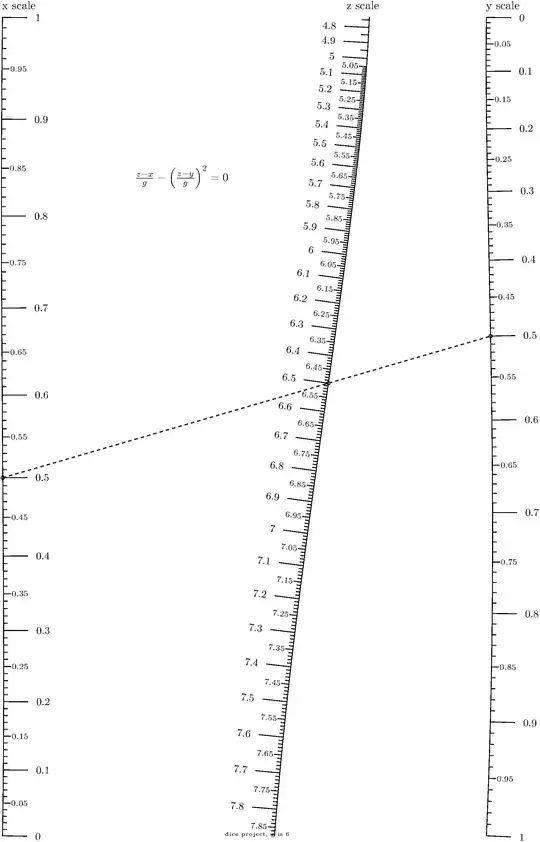
I am attempting to make a nomogram for the equation
$$\frac{z-x}{g} - \left(\frac{z-y}{g}\right)^2 =0$$
(here $g$ is a constant). You can use the quadratic formula to solve for $z$, in which case:
$$z = \frac{g}{2} + y \,\pm \, \sqrt{g}\sqrt{\frac{g}{4} + y-x}$$
And we can take just the positive branch, for example. What stumps me is the presence of $y-x$ under the square root, along with $y$ being outside of the square root. It seems difficult to find a way to separate the $y-x$ term to form a determinant.
I can of course reparameterize with $c\equiv y-x$ so that $$z=\frac{g}{2} +x+c \pm\;\sqrt{g}\sqrt{\frac{g}{4} + c}$$
but reparameterization is inconvenient for my application (computing outcomes when rolling dice).
I have also considered moving the $y$ term to the left hand side and squaring, but this creates a lot of linearly-independent terms:
$$z^2 - 2(y-g/2)z + (y-g/2)^2 = g(x-y) + g^2/4$$
Substituting $u\equiv (x - g/4)$ and $v \equiv (y-g/2)$, we have the slightly simpler form:
$$(z-v)^2 = g(u-v)$$
$$z^2 - 2vz + v^2 = g(u-v)$$
There are three variables and five functional forms $z^2, z, v, v^2, u$, making this apparently a nomogram of genus 5-3 = 2.
Is there a way forward?