Let us visualize the system in the case $N=5$ :
$$\begin{pmatrix}u'_1(t)\\ u'_2(t)\\ u'_3(t)\\ u'_4(t)\\ u'_5(t)\end{pmatrix}=\left(\begin{array}{rrrr|r}-\lambda_1&0&0&0&0\\\lambda_1&-\lambda_2&0&0&0\\0&\lambda_2&-\lambda_3&0&0\\0&0&\lambda_3&-\lambda_4&0\\ \hline 0&0&0&-\lambda_4&0\end{array}\right)
\begin{pmatrix}u_1(t)\\u_2(t)\\u_3(t)\\u_4(t)\\u_5(t)\end{pmatrix}\tag{0}$$
with its solutions (Fig. 1) for a certain set of initial conditions :
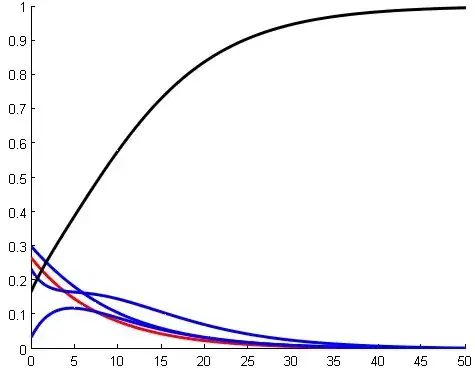
Fig. 1 : The $N=5$ curves of functions $u_k$ ; $u_1(t)=a e^{-\lambda_1 t}$ is figured in red. The curves for $u_2, u_3, u_4$ are in blue. The curve of $u_5$ (in black) has a particular horizontal asymptote y=C.
First remark : adding the $N$ diff. equations gives :
$$\left(\sum_{k=1}^N u_k\right)'=0,$$
whence
$$\sum_{k=1}^N u_k=C \ \ \text{(constant).}\tag{1}$$
Consider now the linear system $X'=AX$ obtained by leaving aside the $N$th differential equation.
$A$ being a $N-1 \times N-1$ triangular matrix (upper left block in (0)), its eigenvalues are the $-\lambda_k$s one finds on its diagonal.
Let us assume that all $\lambda_k$s are distinct (I think this hypothesis is reasonable).
Then $A$ is diagonalizable with $A=B\Lambda B^{-1}$, out of which $$\exp(tA)=B \exp(t \Lambda) B^{-1} \ = \ B \ \text{diag}(e^{- \lambda_k t})\ B^{-1} \to 0 \ \text{when} \ t \to \infty$$
(because all $\lambda_k$s are $>0$). As a consequence, whatever the vector $X(0)$ of initial conditions :
$$X(t)=\exp(tA)X(0) \to 0 \ \ \text{when} \ \ t \to \infty\tag{2}$$
As the coordinates of $X(t)$ are the $u_k(t)$, another way to state (2) is that
$$\lim_{t\to +\infty} u_k(t)=0, \quad k=1,\dots, N-1,\tag{3}$$
Now, using (1), we deduce from (3) that
$$\lim_{t\to +\infty} u_N(t)=C.$$
Remark : if some $\lambda_k$s are identical, we have to replace diagonalization $A=B\Lambda B^{-1}$ by a Jordan block decomposition. See for example the answer to How to calculate the matrix exponential explicitly for a matrix which isn't diagonalizable?
$\phantom{Here is the program}$


