What follows is not a solution (an excellent one has been given by @greedoid) but a heuristic method that provides an efficient angle of attack of this locus and loci of the same "flavour". This presentation has a handwaving side, but I think that this kind of intuitive reasoning can have some interest, in particular for students in mathematics in order to convey the spirit of discoverers of infinitesimal calculus.
Let :
$$q(X):=\frac{n(X)}{d(X)}, \ \ \ \text{with}$$
$$n(X):=XA+XB \ \text{and } $$
$$d(X):=XC+XD+XE$$
Remark :
$\lim q(X)=\frac23$ when $\|\overrightarrow{OX}\|$ tends to $\infty$.
Consider figure $1$ that depicts some contour lines of functions $n$ (in blue) and $d$ (in red) :
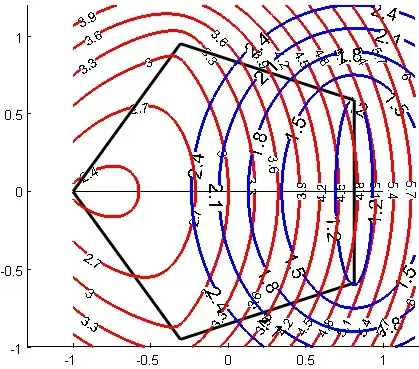
Fig. 1. : To each point $X$ in the plane is attached two curves, a red one and a blue one giving the locus of points having resp. the same numerator $n(X)$ and the same denominator $d(X)$. One shouldn't be surprized that the blue curves are confocal ellipses (with foci $A$ and $B$).
What usage can we do of these two families of curves ?
A first result is that a point $X$ can be a minimum of function $q$ (or at least a relative minimum), if the blue and the red contour lines passing through $X$ are tangent ; otherwise, if these curves are transverse in $X$ (transverse = non tangent), there are two directions (see Fig. 2) one can take that are more advantageous.
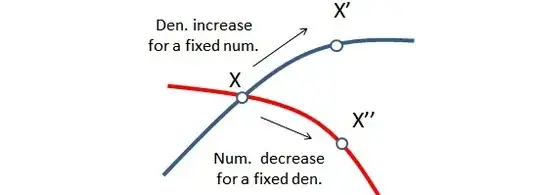
Fig. 2 : A minimum of function $q$ cannot occur in a point $X$ with transverse intersection of the blue and red contour lines passing through this point : indeed, moving $X$ in one of the given directions decreases the value of $q$.
Caveat : tangency in $X$ of the red and the blue curves passing through $X$ is a necessary condition, not a sufficient one ; let us take the (counter) example of a point $X$ belonging to the interval $I=(-1,\cos(\pi/5))$ of the $x$ axis; moving $X$ to the right into $X'$ still in $I$, will also give $q(X')<q(X)$ (a particulary favorable case where $n(X)$ decreases while $d(X)$ increases!).
More generally, it is possible to eliminate all points of the $x$-axis (except point $(1,0)$) although blue and red curves are tangent in these points.
What are the remaining candidate points for the minimum of $q(.)$ ? A concrete example is provided by the tangency of blue curve indexed by $1.2$ (the most elongated ellipse) and the red curve indexed by $5.1$ [just at the right of vertical line segment $AB$]. A detailed look show that all solution points $X$ are in this area and constitute a continuum of points ; a more detailed analysis is needed to prove that this "continuum" is the small circular arc $AB$ of the unit circle. I haven't done it.
Besides, and this is a second idea, one can have access to a numerical solution using gradient computations.
Let us first recall that the value of the gradient of distance function defined by $f(M)=AM$, where $A$ is any fixed point of the plane, is the unit norm vector defined in point $M$ as :
$$\overrightarrow{grad}(f)(M)=\frac{\overrightarrow{AM}}{AM}.$$
See Gradient of distance vector length and Appendix 2.
Thus the gradients in $X$ of functions $n$ and $d$ are resp.
$$\overrightarrow{grad}(n)(X)=\frac{\overrightarrow{AX}}{AX}+\frac{\overrightarrow{BX}}{BX},$$
$$\text{and} \ \ \overrightarrow{grad}(d)(X)=\frac{\overrightarrow{CX}}{CX}+\frac{\overrightarrow{DX}}{DX}+\frac{\overrightarrow{EX}}{EX} \tag{1}$$
The tangency condition will then be transferred as a gradients' proportionality. Moreover, we will switch to a complex function treatment that will give a more compact formulation :
$$arg(r(z-a)+r(z-b))=arg(r(z-c)+r(z-d)+r(z-e))+k \pi\tag{2}$$
where
$$r(z):=\frac{z}{|z|}$$
where $a,b,c,d,e$ stand for the complex numbers associated with $A,B,C,D,E$ resp. Indeed, having the same angle with $k$ even or opposite angles with $k$ odd means proportionality ; a further step is to replace (2) by a criterium on the imaginary part of the complex logarithm function (see line 8 in program below) :
$$\operatorname{Im}(\log(f(z))) \ \text{with}$$
$$f(z):=\frac{r(z-a)+r(z-b)}{r(z-c)+r(z-d)+r(z-e)} \tag{3}$$
(recall : $log(re^{i \theta})=log(r)+i \theta$ for the principal branch of complex logarithm function). Why is this formulation interesting ? Because we have converted the search of minima into the search of zeroes of a certain function (more exactly, the minima constitute a subset of this set of zeroes : see explanation upwards about necessary and sufficient condition).
Let us use formulation (3) to obtain a graphical representation of the points under consideration : see figure $3$ below (which does not constitute - of course - a mathematical proof) where the circular arc AB appears as the solution.

Fig. 3. In black, all points $X$ having almost proportional gradients. See Appendix 1.
Appendix 1 : The Matlab program that has generated Fig. 3. reminder : this program generates all points for which this expression is close to $0$.
i=complex(0,1);
b=exp(i*pi/5);a=b^9;c=b^3;d=-1;e=b^7;% pentagon vertices
r=@(z)(z./abs(z));
dg=@(z)(r(z-c)+r(z-d)+r(z-e));
ng=@(z)(r(z-a)+r(z-b));
f=@(z)(ng(z)./dg(z));
[X,Y]=meshgrid(-2:0.005:2);
I=imag(log(f(X+i*Y)));% = imag(log(ng(X+i*Y))-log(dg(X+i*Y)));% if zero : gradients' proportionality
J=abs(I)>0.01;
imshow(J);
Appendix 2 : the gradient at point $X$ of function $n(.)$ for example is the inward or outward normal to the blue curve passing through $X$ (think to the blue curves as isobaric curves and to the gradient as depicting the wind's direction).


