6

How can we find some radius of circle with center at origin which contains $x\arctan(x)-ax+y\arctan(y)-by=0$,

where $\pi/2>a>0$ and $\pi/2>b>0$.

I'm not sure how can we prove that these inequalities should hold so we can have closed curve: $\pi/2>a$ and $\pi/2>b$ .

Also very interesting similar equation $x\arctan(x)-ax+(-x+y)\arctan(-x+y)-b(-x+y)+y\arctan(y)-cy=0$.

I need some approximate estimation so I can prove that for some radius this estimation will be correct.

For example I've found such a circle for $a=1.5$ and $b=1.5$:

enter image description here

And for $x\arctan(x)-1.5x+(-x+y)\arctan(-x+y)-1.5(-x+y)+y\arctan(y)-1.5y=0$:

enter image description here

Maybe Lagrange multipliers can help? I'm also interested in higher dimensions where we can add $z$ and find some radius of a sphere which fully contains $x\arctan(x)-ax+y\arctan(y)-by+z\arctan(z)-cz=0$. But I think it can be done in similar way as for two dimensions.

Tag
  • 139
  • 6
  • Are you looking for the smallest circle, or the smallest one centred on $O$? – J.G. Dec 10 '18 at 17:09
  • I need a circle centred on $O$ (origin). And not necessarily the smallest (but the smallest will be good, of course). – Tag Dec 10 '18 at 17:11

1 Answers1

5

Definition. Given $a\in\mathbb R$, define the function $f_a(x)=x(\arctan x-a)$.

Definition. Given $a,b\in\mathbb R$, consider the closed set $$ \begin{split} E_{a,b} &= \{(x,y)\in\mathbb R^2 : x(\arctan x-a)+y(\arctan y-b)=0\} \\ &= \{(x,y)\in\mathbb R^2 : f_a(x)+f_b(y)=0\} \end{split} $$

Lemma 1. For every $a\in\mathbb R$, the set $[0,\infty)$ is in the image of $f_a$.

Proof. Assume $a\geq0$. Then $f_a(0)=0$ and $$ \lim_{x\to-\infty}x(\arctan x-a)=(-\pi/2-a) \lim_{x\to-\infty}x=\infty. $$ Since $f_a$ is continous, these limits imply the thesis. The case $a\leq0$ is analogous, with the signs changed. □

Lemma 2. If $|a|>\pi/2$, then the function $f_a:\mathbb R\to\mathbb R$ is surjective.

Proof. Assume $a>\pi/2$. We have $\pm\pi/2-a < 0$, so $$ \lim_{x\to+\infty} x(\arctan x-a) = (\pi/2-a)\lim_{x\to\infty} x = -\infty $$ and $$ \lim_{x\to-\infty} x(\arctan x-a) = (-\pi/2-a)\lim_{x\to-\infty} x = \infty. $$ Since $f_a$ is continuous, these limits imply that it is surjective. The case $a<-\pi/2$ is analogous. □

Lemma 3. If $|a|<\pi/2$, then $$ \lim_{x\to\pm\infty} f_a(x) = \infty. $$

Proof. A direct computation shows $$ \lim_{x\to\infty} f_a(x) = (\pi/2-a)\lim_{x\to\infty}x = \infty $$ and the same holds for $x\to-\infty$. □

Proposition. If $|a|>\pi/2$. Then $E_{a,b}$ is unbounded.

Proof. Since $f_a$ is surjective by Lemma 2, for every $y\in\mathbb R$ there exists $x\in\mathbb R$ such that $f_a(x)=-f_b(y)$. This means that $(x,y)\in E_{a,b}$. Therefore the set $E_{a,b}$ is unbounded because we can find points with arbitrary large $y$.

Proposition. If $|a|=\pi/2$. Then $E_{a,b}$ is unbounded.

Proof. Assume $a=\pi/2$. The other case is analogous. Recall the well known limit $$ \lim_{x\to\infty} f_{\pi/2}(x) = \lim_{x\to\infty} x(\arctan x-\pi/2) = -1. $$ For every $x$ sufficiently large we have that $f_{\pi/2}(x)\leq0$, so by Lemma 1 there exists $y\in\mathbb R$ such that $f_b(y)=-f_a(x)\in[0,\infty)$. Therefore we can find points $(x,y)\in E_{\pi/2,b}$ with arbitrary large $x$. □

Proposition. If $|a|<\pi/2$ and $|b|<\pi/2$, then $E_{a,b}$ is bounded.

Proof. By Lemma 3, the function $f_a(x)+f_b(y)$ is coercive, meaning that $f_a(x)+f_b(y)\to\infty$ if $|(x,y)|\to\infty$, therefore its sublevel sets are bounded. In particular $E_{a,b}$ is bounded as a consequence. □

Corollary. $E_{a,b}$ is bounded if and only if $|a|<\pi/2$ and $|b|<\pi/2$.


Now, given $a,b\in(-\pi/2,\pi/2)$, how can we find an estimate on $\max_{(x,y)\in E_{a,b}} x^2+y^2$? We could try the Lagrange multipliers approach again, similarly to what we did here. The stationary points must satisfy $$ \bigl(f'_a(x), f'_b(y)\bigr) = \lambda (x, y) \qquad \text{for some $\lambda\in\mathbb R$}, $$ which is equivalent to $$ \frac1{1+x^2} + \frac{\arctan x-a}x = \frac{f'_a(x)}{x} = \lambda = \frac{f'_b(y)}{y} =\frac1{1+y^2} + \frac{\arctan y-b}y. $$

Unfortunately, this time I'm not able to find a closed form solution to the system of equations $$ \left\{\begin{array}{l} f_a(x)+f_b(y)=0 , \\ \frac{f'_a(x)}x=\frac{f'_b(y)}y . \end{array}\right. $$

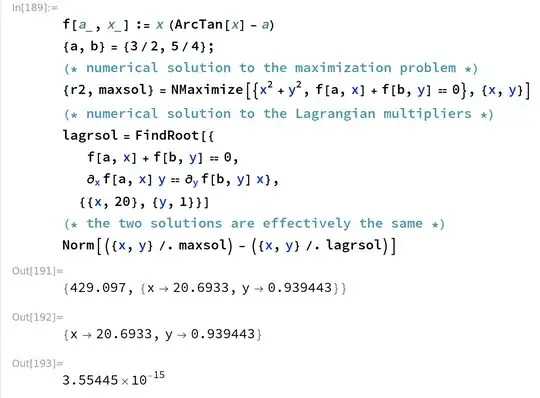
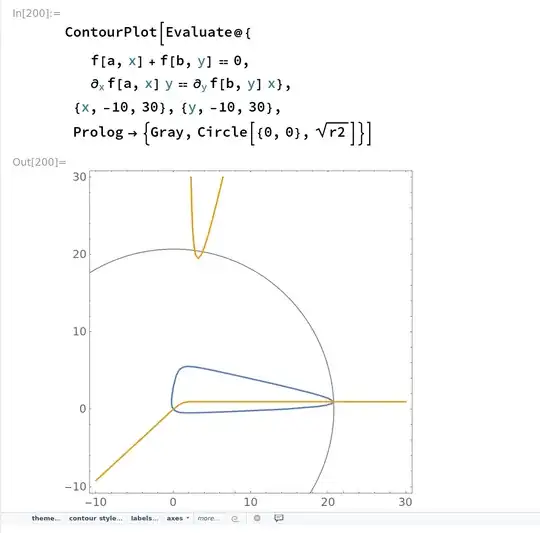
One can of course fall back to numerical solutions. I'm using Mathematica for that. Here I fix the values $a=3/2$ and $b=5/4$, then I find extremal points numerically both with the built-in NMaximize function and by solving the Lagrange multiplier system with FindRoot. The two solutions are the same, up to machine precision. Then I plot the set $E_{a,b}$ in blue, the root locus of the Lagrange multiplier equation in orange, and the smallest fitting circle in gray.
enter image description here

enter image description here

Federico
  • 6,010
  • Wow, this is elegant and looks beautiful. I'm especially interested in second case where $x\arctan(x)-ax+(-x+y)\arctan(-x+y)-b(-x+y)+y\arctan(y)-cy=0$ – Tag Dec 11 '18 at 16:47
  • @Tag I'm sorry Tag, I don't have time right now to analyze also this other problem. I leave it to you as an exercise :D – Federico Dec 11 '18 at 17:35
  • As far as I understand the only problem with numerical solution is that we can't say that it will be found for ALL $\abs(a)<\pi/2 and \abs(b)<\pi/2<$ – Tag Dec 11 '18 at 17:54
  • What do you mean? The bound exists, it's just impossible to find in explicit closed form. But numerically you can – Federico Dec 11 '18 at 17:56
  • I mean you've found it for $a=3/2$ and $b=5/2$. Can we be sure that if take different $a$ and $b$ the numerical solution will be stable and give us concrete number (there will be no some divergence)? – Tag Dec 11 '18 at 18:01
  • 1
    Well, that falls in the broad question of numerical optimization. I proved that the set is bounded. Therefore the problem $\max_{(x,y)\in E_{a,b}} x^2+y^2$ is well posed. Then there are plenty of algorithms to perform numerical maximization. Here everything is smooth, so there should be no problems with running any numerical algorithm. There cannot be a divergence, because the set is bounded! – Federico Dec 11 '18 at 18:05
  • Unfortunately in this case it is not possible (I believe) to give an analytic solution to the system of equations arising from the use of Lagrange multipliers, in contrast with your other problem. So the numerical approach is the only viable way to compute the radius. – Federico Dec 11 '18 at 18:08
  • Of course you could probably prove that the number of stationary points is at most $4$, by looking at some monotonicity of $f_a'(x)/x$, but this is not very useful from the practical perspective. – Federico Dec 11 '18 at 18:13
  • Thank you very much for your answers, they are very helpful. – Tag Dec 11 '18 at 18:16
  • I have one more question. Is it possible to generalize this numerical solution to $n$-dimensional space? I see that all the reasoning can be but I'm no sure about numerical estimation. At the same time we have some kind of symmetry, for example when all coefficients are the same $a=b=...$, so probably it is possible? – Tag Dec 13 '18 at 09:03
  • 1
    Ok, so for the $n$-dimensional version, the same statement holds. Namely, if you define $E_{a_1,\dots,a_n}={f_{a_1}(x_1)+\dots+f_{a_n}(x_n)=0}$, then $E_{a_1,\dots,a_n}$ is bounded if and only if $|a_i|<\pi/2$ for all $i=1,\dots,n$. The proof is also the same – Federico Dec 13 '18 at 14:33
  • 1
    Once you have this condition ($|a_i|<\pi/2\ \forall i$), you can apply again a numerical scheme to maximize $x_1^2+\dots+x_n^2$ over $E_{a_1,\dots,a_n}$ and it should be able to find the optimum – Federico Dec 13 '18 at 14:35
  • 1
    You mention the symmetry in the case $a_1=\dots=a_n$. While it is true that in this case $E_{a_1,\dots,a_n}$ is symmetric w.r.t. permutations of the variables, be aware that the maximum of $x_1^2+\dots+x_n^2$ is not achieved when all $x_i$'s except one are zero, or when $x_1=\dots=x_n$. The maximum is achieved at a point which is not particularly special from the point of view of symmetries. This is something different from your other problem – Federico Dec 13 '18 at 14:38
  • Could you give a hint how can we prove boundeness in the second case. I'm not sure how can we analyze $\lim((-x+y)\arctan(-x+y)-a)$, because we have two variables here. – Tag Dec 17 '18 at 12:49
  • 1
    @Tag The set ${(x,y):f_a(x)+f_b(y)+f_c(y-x)=0}$ is equal to the projection on the $(x,y)$ plane of $E_{a,b,c}\cap{z=y-x}={(x,y,z):f_a(x)+f_b(y)+f_c(z)=0}\cap{z=y-x}$. So, if $a,b,c\in(-\pi/2,\pi/2)$, then $E_{a,b,c}$ is bounded and therefore slicing and projecting it gives a bounded set. Notice that in this case it is no longer an "if and only if". I'm not sure we can say that if ${(x,y):f_a(x)+f_b(y)+f_c(y-x)=0}$ is bounded then $a,b,c\in(-\pi/2,\pi/2)$. I don't know the answer because I haven't analyzed this problem in detail. But at least the other implication is true. – Federico Dec 17 '18 at 16:55
  • Will this theorem holds if we take more dimensions, for example $x_1(\arctan(x_1)-a_1)+(-x_1+x_2)(\arctan(-x_1+x_2)-a_2)+(-x_2+x_3)(\arctan(-x_2+x_3)-a_3)+x_3(\arctan(x_3)-a_3)$ ? And even in case of $n-$dimensions? – Tag Dec 17 '18 at 17:34
  • 1
    @Tag Of course, they are projections of slices of $E_{a_1,\dots,a_k}$, therefore they are bounded sets as long as $|a_i|<\pi/2\ \forall i$. But it is not an equivalence. It might be bounded also in some other cases. I don't know. And I don't care to investigate further – Federico Dec 17 '18 at 17:37
  • Many thanks for your answers. – Tag Dec 17 '18 at 17:38