Let's assume we have a one-direction graph and we want to produce a matrix that represents relations:
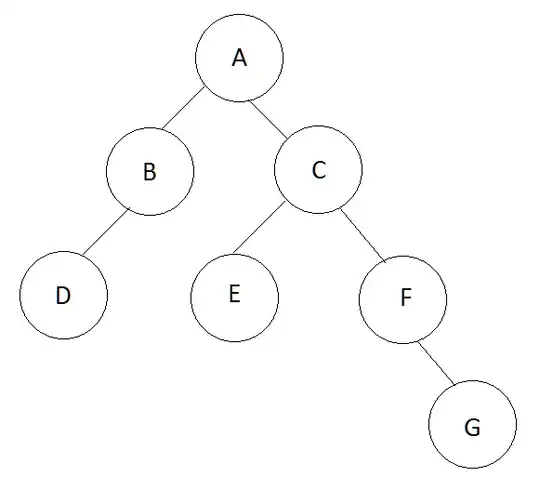
At first step we have only a matrix that contains straight relations, so for given image we have this matrix:
    A    B    C    D    E    F    G
A   1    1    1    0    0    0    0
B   0    1    0    1    0    0    0
C   0    0    1    0    1    1    0
D   0    0    0    1    0    0    0
E   0    0    0    0    1    0    0
F   0    0    0    0    0    1    1
G   0    0    0    0    0    0    1
Now I want a way to calculate final matrix in a way that for each node, if there is any path to destination node, it has 1 else 0 in the matrix:
    A    B    C    D    E    F    G
A   1    1    1    1    1    1    1
B   0    1    0    1    0    0    0
C   0    0    1    0    1    1    1
D   0    0    0    1    0    0    0
E   0    0    0    0    1    0    0
F   0    0    0    0    0    1    1
G   0    0    0    0    0    0    1
If we call the first matrix A, what should I do to achieve the second matrix?


