3

I have took many times to get antiderivative of the below integral A in $\Bbb R$, but $I$ didn't succeed however it is a constant from $-\infty \to +\infty$ and it's approximately equal to $1.4389$.

$$\int_{\Bbb R}\frac{x+2}{\left(x^2+x+2\right)\sqrt{x^2+2x+3}}\,dx$$

But, I’m sure that it has a closed form where inverse symbole calculator didn't give me anything, then is there any way help me to get it's antiderivative over $\Bbb R$?

Integreek
  • 8,530

3 Answers3

5

HINT:

If you wish to find the antiderivative, you can do the following.

By making the substitution $x=\sqrt2\sinh(y)-1$, one obtains $$A=\int\frac{2\sinh(y)+\sqrt2}{\cosh(2y)-\sqrt2\sinh(y)+1}dy$$

Using the definition of $\sinh$ and $\cosh$ in terms of exponentials, and letting $z=e^y$, $$A=2\int\frac{z^2+\sqrt2z-1}{z^4-\sqrt2z^3+2z^2+\sqrt2z+1}dz$$

You may proceed by partial fraction decomposition and polynomial division. The denominator is a quartic equation and surely has closed form solutions(maybe messy).

For integration from $-\infty$ to $\infty$ of the original integral, residue theorem may help you. After the substitutions, the integration limits become from $0$ to $\infty$.

p.s. By graphing, the denominator has no real roots.

ADDED:

Wolfy knows it.:)
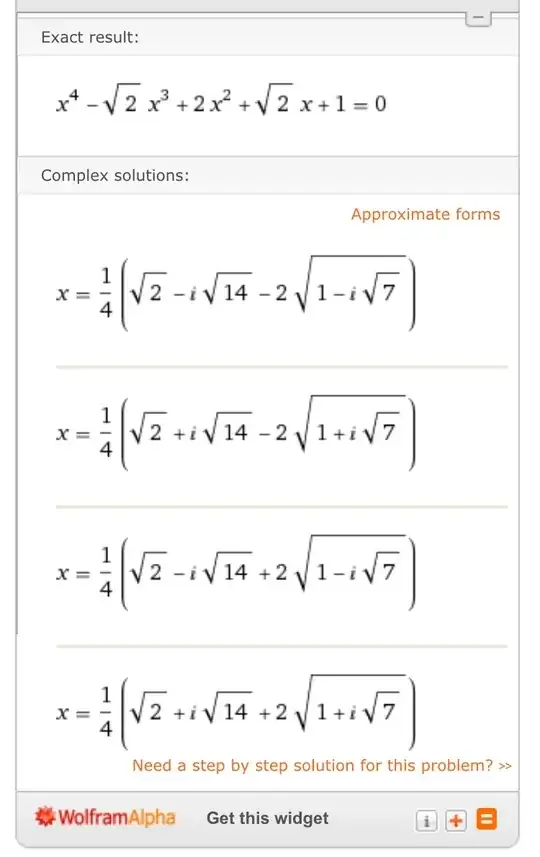
Because the integration is not on the whole real line, using residue theorem may be difficult. Knowing the roots, just go ahead for the antiderivative.

Lee
  • 11,728
1

Using Mathematica with Rubi 4.15.1 we can find very simple form antiderivative:

$$\int \frac{x+2}{\left(x^2+x+2\right) \sqrt{x^2+2 x+3}} \, dx=\\-\sqrt{\frac{1}{14} \left(11+8 \sqrt{2}\right)} \tan ^{-1}\left(\frac{1+2 \sqrt{2}-\left(5+3 \sqrt{2}\right) x}{\sqrt{7 \left(11+8 \sqrt{2}\right)} \sqrt{3+2 x+x^2}}\right)+\sqrt{\frac{1}{14} \left(-11+8 \sqrt{2}\right)} \tanh ^{-1}\left(\frac{1-2 \sqrt{2}-\left(5-3 \sqrt{2}\right) x}{\sqrt{7 \left(-11+8 \sqrt{2}\right)} \sqrt{3+2 x+x^2}}\right)$$

MMA code:

HoldForm[Integrate[(x + 2)/((x^2 + x + 2)*Sqrt[x^2 + 2 x + 3]), 
x] == -Sqrt[1/14 (11 + 8 Sqrt[2])] ArcTan[(
  1 + 2 Sqrt[2] - (5 + 3 Sqrt[2]) x)/(
  Sqrt[7 (11 + 8 Sqrt[2])] Sqrt[3 + 2 x + x^2])] + 
Sqrt[1/14 (-11 + 8 Sqrt[2])]
  ArcTanh[(1 - 2 Sqrt[2] - (5 - 3 Sqrt[2]) x)/(
  Sqrt[7 (-11 + 8 Sqrt[2])] Sqrt[3 + 2 x + x^2])]] // TeXForm

and define integral:

$$\color{blue}{\int_{-\infty }^{\infty } \frac{x+2}{\left(x^2+x+2\right) \sqrt{x^2+2 x+3}} \, dx=\sqrt{\frac{2}{7} \left(11+8 \sqrt{2}\right)} \tan ^{-1}\left(\sqrt{\frac{1}{7} \left(1+2 \sqrt{2}\right)}\right)-\sqrt{\frac{1}{14} \left(-11+8 \sqrt{2}\right)} \ln \left(1+\frac{1}{\sqrt{2}}+\sqrt{\frac{1}{2}+\sqrt{2}}\right)}$$

MMA code:

HoldForm[Integrate[(x + 2)/((x^2 + x + 2)*Sqrt[x^2 + 2 x + 3]), {x, -Infinity, Infinity}] == 
Sqrt[2/7 (11 + 8 Sqrt[2])] ArcTan[Sqrt[1/7 (1 + 2 Sqrt[2])]] - 
Sqrt[1/14 (-11 + 8 Sqrt[2])]Log[1 + 1/Sqrt[2] + Sqrt[1/2 + Sqrt[2]]]] // TeXForm
1

Substitute $t_{\pm}=\frac{x+1\pm \sqrt2}{\sqrt{x^2+2x+3}} $

\begin{align} &\int_{-\infty}^\infty\frac{x+2}{\left(x^2+x+2\right)\sqrt{x^2+2x+3}}dx\\ =& \int_{-1}^1 \frac{\frac1{\sqrt2}+1}{2\sqrt2-1+t_-^2}dt_- + \frac{\frac1{\sqrt2}-1}{2\sqrt2+1-t_+^2}dt_+\\ =& \ \frac{\sqrt2+2}{\sqrt{2\sqrt2-1}}\cot^{-1}\sqrt{2\sqrt2-1} +\frac{\sqrt2-2}{\sqrt{2\sqrt2+1}}\coth^{-1}\sqrt{2\sqrt2+1} \end{align}

Quanto
  • 120,125