3

I'm trying to see why this picture below is homeomorphic to the $\mathbb R^2$. It's really hard, please I need an intuitive idea of this. This seems very weird for me, I need help.

Thanks a lot
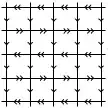
enter image description here

user42912
  • 24,130
  • 1
    If you mean the thing resulted from identifying the edges as shown, then it's not even a manifold, not to say $\mathbb{R}^2$. A small neighborhood along a point on those identifying edges would look like many half solid circles gluing along their diameter. –  Jan 08 '13 at 03:56
  • 1
    What exactly is the equivalence relation that the picture is trying to convey? It looks like you're glueing together the lines ${n} \times \mathbb R$ together and then the lines $\mathbb R \times {n}$ reversing orientation depending on the parity of $n$. This isn't going to even get you a manifold. – JSchlather Jan 08 '13 at 03:57

1 Answers1

2

I don't think it is. From what I understand in the picture you have some group acting on $\Bbb{R}^2$, the resulting quotient space is what you get by doing the identifications as given by the arrows. The resulting space is the Klein Bottle that is not even homotopy equivalent to $\Bbb{R}^2$ (because for example its fundamental group is not zero and is given here).

Added later: In case you would like more information about this specific picture you should look at Example 1.42 of Hatcher on page 74.

  • Then, this picture is homeomorphic to the Klein bottle? thank you very much for your answer :) – user42912 Jan 08 '13 at 04:09
  • 2
    how do you get klien bottle.each small part is but the full? – Koushik Jan 08 '13 at 05:39
  • @K.Ghosh The resulting quotient space is the Klein Bottle –  Jan 08 '13 at 05:40
  • 1
    how do you get that..that's what i am asking – Koushik Jan 08 '13 at 05:43
  • this picture is in $\mathbb R^2$. In the Hatcher's book is in $\mathbb Z\times \mathbb Z$ – user42912 Jan 08 '13 at 12:40
  • 2
    OP should really clarify what the diagram means. BenjaLim is interpreting it as the quotient space of $\mathbb{Z}^2$ acting on $\mathbb{R}^2$ by translations. On the other hand I think I'm not alone in interpreting that each square, subtracting the boundary, is not identified with another such square. –  Jan 08 '13 at 18:19