Consider projectile with parameters as shown in diagram below.
$\hspace{4cm}$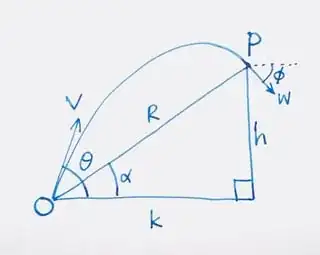
Let $T$ be the total time taken for the journey of the projectile, and $\beta$ be the angle between the initial and terminal velocities.

Refer to diagrams above. As the projectile is a motion under constant acceleration, it can be modelled as either
(a) First Scenario:-
- $(1)$ motion at constant velocity $\mathbf v$ from $O$ to $A$ for the first half of $T$ (distance travelled: $\frac {vT}2$),and
- $(2)$ motion at constant velocity $\mathbf w$ from $A$ to $P$ for the second half of $T$ (distance travelled: $\frac {wT}2$).
or
(b) Second Scenario**:- as a composite motion of the following:
- $(1)$ motion at constant velocity $\mathbf v$ from $O$ to $B$ for time $T$ (distance travelled: $vT$) and
- $(2)$ vertical free fall under gravity from $B$ to $P$ for time $T$ (distance travelled: $\frac 12gT^2$).
(NB - velocity here refers to a vector quantity, i.e. both speed and direction.)
Consider the diagram on the right, which is the left diagram scaled by $\frac 2T$.
$$\begin{align}
\triangle O'B'P'=
\tfrac 12 \cdot 2v\cdot w\cdot \sin\beta
&=\tfrac 12\cdot gT\cdot \tfrac {2R}T\cos\alpha
\\
vw\sin\beta&=gR\cos\alpha\\
vw\sin\beta&=gk\\
\color{red}{v^*w^*}&\color{red}{=gk}
\end{align}$$
As $g,k, $ are fixed, $v,w$ will be at a minimum when $\sin\beta$ is at a maximum, i.e. $\sin\beta=1 (\beta=\tfrac\pi2)$, hence $v^*, w^* $ are mutually perpendicular. Note that $w^2=v^2-2gh$ per energy conservation, and as $h$ is fixed, minimum $w^*$ corresponds to minimum $v^*$.
EARLIER SOLUTION (posted 21 March 2018)
For minimum velocity (i.e. minimum kinetic energy),
$$\begin{align}
{v^*}^2+{w^*}^2&=2gR\qquad\qquad\;\tag{1}\end{align}$$
where $^*$ indicates quantities corresponding to the minimum velocity case.
See Footnote for additional details.
Also, from conservation of energy ($V^2=U^2+2AS$), we have, for the general case,
$$\begin{align}
v^2-w^2&=2gh\color{lightgrey}{=2gR\sin\alpha}\tag{2}\end{align}$$
$\tfrac 12 \big((1)\pm (2)\big)$ :
$${v^*}^2=g(R+h)\color{lightgrey}{=gR(1+\sin\alpha)}\\
{w^*}^2=g(R-h)\color{lightgrey}{=gR(1-\sin\alpha)}$$
and it follows that
$$\begin{align}
{v^*}^2{w^*}^2&=g^2(R^2-h^2)\color{lightgrey}{=g^2R^2(1-\sin^2\alpha)}\
\\&=g^2k^2\qquad\;\;\color{lightgrey}{=g^2R^2\cos^2\alpha}\\
\color{red}{v^*w^*}&\color{red}{=gk\;\blacksquare}\;\;\ \qquad\color{lightgrey}{=gR\cos\alpha}\end{align}$$
$\hspace{5cm}$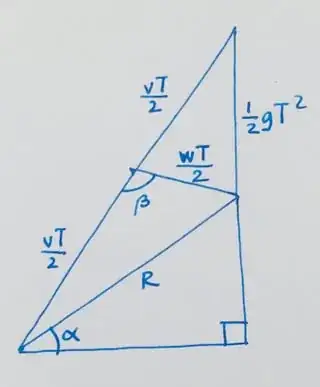
Footnote
Using the cosine rule twice,we have
$$\begin{align}
R^2
&=\left(\tfrac {vT}2\right)^2+\left(\tfrac {wT}2\right)^2-2\left(\tfrac {vT}2\right)\left(\tfrac {wT}2\right)\cos\beta\qquad
\tag{3}\\
\left(\tfrac 12 gT^2\right)^2
&=\left(\tfrac {vT}2\right)^2+\left(\tfrac {wT}2\right)^2-2\left(\tfrac {vT}2\right)\left(\tfrac {wT}2\right)\cos (\pi-\beta)
\tag{4}\\
(3)+(4):\hspace{2cm}\\
R^2+\left(\tfrac 12 gT^2\right)^2
&=2\big(\left(\tfrac {vT}2\right)^2+\left(\tfrac {wT}2\right)^2\big)
\\
v^2+w^2&=\tfrac 12 \left(g^2T^2+\tfrac {4R^2}{T^2}\right)\\
&=\tfrac 12\underbrace{\left(gT-\tfrac {2R}T\right)^2}_{\ge0}+2gR\\
&\ge 2gR\\
{v^*}^2+{w^*}^2&=2gR
\end{align}$$
which is as used in equation $(1)$ above, with $^*$ indicating quantities corresponding to the minimum velocity case.
This occurs when ${T^*}^2=\tfrac {2R}g$, i.e. $\tfrac 12g{T^*}^2=R$. Using this and from the diagram we deduce that $\beta^*=\frac {\pi}2$, i.e. at minimum $v,w$, both $\mathbf v, \mathbf w$ are perpendicular to each other. This is shown in the diagram below.
$\hspace{4cm}$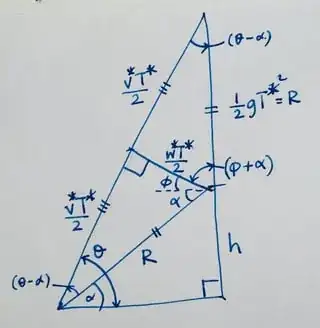
To deduce the values of $\theta$ and $\phi$, consider the triangles shown below.
$\hspace{4cm}$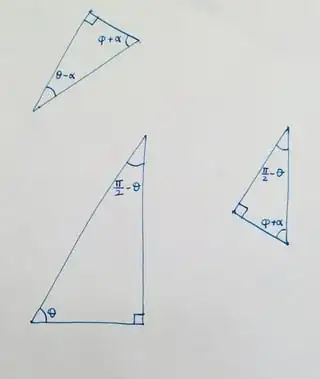
From first triangle,
$$\begin{align}
(\theta-\alpha)+(\phi+\alpha)&=\tfrac \pi 2\\
\theta+\phi&=\tfrac\pi 2\tag{5}
\end{align}$$
From the lower two triangles,
$$\begin{align}
(\tfrac\pi2-\theta)+(\phi+\alpha)&=\tfrac\pi2\\
\theta-\phi&=\alpha\tag{6}\\
\tfrac 12 \big((5)\pm (6)\big):\quad\qquad\\
\theta&=\tfrac\pi4+\tfrac\alpha2\\
\phi&=\tfrac\pi4-\tfrac\alpha2
\end{align}$$
which are launch and terminal angles corresponding to the minimum velocity case.
Conversely this also gives the well-known result, where the optimal launch angle to achieve maximum distance in direction $\alpha$ is one that bisects $\alpha$ and the vertical.
** An alternative Second Scenario would be a composite motion of the following:
- $(1)$ vertical launch at $gT$ under gravity for time $T$ (distance travelled: $\frac 12gT^2$), and
- $(2)$ motion at constant velocity $\mathbf w$ for time $T$ (distance travelled: $wT$) and
Alternative Interpretation
An alternative interpretation to the results might be given as follows. Refer to the diagram below.
$\hspace{3cm}$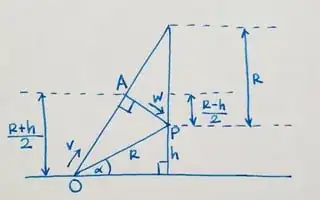
Let $A$ be the highest point reached by the particle under the scenario above where it travels half the time at constant initial launch velocity under zero gravity. The vertical distances from $A$ to $O,P$ are $\frac {R+h}2$ and $\frac {R-h}2$ respectively.
For a particle dropped from a height $H$ from the ground and falling vertically under gravity, its velocity upon reaching the ground is $\sqrt{2gH}$. Similarly, a particle under free fall of gravity, when launched vertically upwards at a velocity if $\sqrt{2gH}$, will reach a height of $H$. Here we refer to $\sqrt{2gH}$ as the vertical launch velocity for height $H$.
The magnitudes of the initial and terminal velocities of the projectile, $v^*,w^*$ are
equal to the vertical launch velocities for heights $\frac {R+h}2, \frac {R-h}2$ respectively, i.e.
$${v^*}^2=2g\left(\tfrac {R+h}2\right)=g(R+h)\\
{w^*}^2=2g\left(\tfrac {R-h}2\right)=g(R-h)\\$$
which gives
$${v^*}^2+{w^*}^2=2gR$$
and also
$$v^*w^*=g\sqrt{R^2-h^2}=gk$$
MUCH EARLIER SOLUTION (Not so neat) (Posted 5 March 2018)
Note that $w^2=v^2-2gh$. Since $h$ is fixed, therefore minimum $w$ corresponds to minimum $v$.
Let $v^*, w^*$ be the minimum values of $v, w$ respectively. $$\begin{align}
v^2w^2&=v^2(v^2-2gh)\\
&=v^2\left[v^2-2g\left(k\tan\theta-\frac {gk^2}{2v^2}(\tan^2\theta+1)\right)\right]\\
&=v^4-2gkv^2\tan\theta+g^2k^2\tan^2\theta+g^2k^2\\
&=\underbrace{\left(v^2-gk\tan\theta\right)^2}_{\ge 0}+g^2k^2\\
&\ge g^2k^2\\
\color{red}{v^*w^*}&\color{red}{=gk\qquad\blacksquare}\end{align}$$
This occurs when ${v^\ }^2={v^*}^2=gk\tan\theta$.
Additional Note
It can be shown that $\tan\theta=\dfrac {R+h}k$, where $R=\sqrt{k^2+h^2}$.
Hence $${v^*}^2=g(R+h)\\
{w^*}^2=g(R-h)$$


