Numerical experiment
The following numerical experiment yields, as we will see later, the correct assumptions for getting a good candidate for the optimum. Convexity will help us show that this candidate is indeed the optimum.
We plot the active set of the optimum of a discretization:
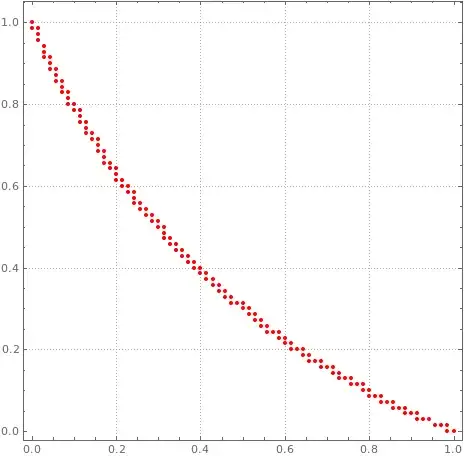
This is the output of the following code:
activeset[k_] :=
  Module[{h, constraints, vars, objective, optresult, result, pts},
   h = 1/(2 k - 2);
   constraints =
    Flatten[Table[
      Table[x[i] x[j] >= (2 k - i - j) h, {j, i, k}], {i, 1, k}]];
   constraints = Join[constraints, Table[x[i] >= 0, {i, 1, k}]];
   vars = Table[x[i], {i, 1, k}];
   objective = Sum[x[i], {i, 1, k}] + Sum[x[i], {i, 2, k - 1}];
   optresult =
    FindMinimum[{objective, constraints}, vars,
     Method -> "InteriorPoint"];
   result = Table[{(i - 1) h, x[i]}, {i, 1, k}] /. optresult[[2]];
   pts = Select[Flatten[Table[{i, j}, {i, 1, k}, {j, 1, k}], 1],
     Abs[x[#[[1]]] x[#[[2]]] - (2 k - #[[1]] - #[[2]]) h] <
        10^(-5) /. optresult[[2]] &];
   ListPlot[(pts - 1)/(k - 1), AspectRatio -> 1, PlotStyle -> Red,
    PlotTheme -> "Detailed"]
   ];
activeset[71]
Full solution
Set $S:=\{(x,y) \in [0,1]^2 : x+y \leq 1\}$. We define the maps
\begin{alignat*}{2}
&J : C[0,1] \rightarrow \mathbb{R},\quad &&J(u) := \int_0^1 \! \exp(u(x)) \, \mathrm{d}x,
\\[1em]
&I : C[0,1] \rightarrow C(S),\quad &&I(u)(x,y) := u(x)+u(y)-\log(2-x-y).
\end{alignat*}
We will study the optimization problems
\begin{align}
& \text{minimize} && J(u) \nonumber\\
& \text{subject to} && I(u) \geq 0, \tag{1}
\\[1em] \text{and}\nonumber
\\[1em]
& \text{minimize} && \int_0^1 \! f(x) \, \mathrm{d}x \nonumber\\
& \text{subject to} && f \in C[0,1], \tag{2}\\
&&& f \geq 0, \nonumber\\
&&& f(x)f(y) \geq |x-y| \text{ for all } x,y \in [0,1]. \nonumber
\end{align}
We will show that:
The unique solution $\bar{u}$ of $(1)$ is given by
\begin{align*}
\exp(\bar{u}(x)) &= \sqrt{2 \left(1+\sqrt{2}\right)}-\sqrt{2 x+\sqrt{2}-1},
\\[1em] J(\bar{u}) &= \frac{2}{3}\sqrt{1+\sqrt{2}}.
\end{align*}
The unique solution $\bar{f}$ of $(2)$ is given by
\begin{align*}
\bar{f}(x) &=
\begin{cases}
\dfrac{\exp(\bar{u}(2x))}{\sqrt{2}}&\text{if}\quad 0 \leq x \leq \frac{1}{2},\\
\dfrac{\exp(\bar{u}(2(1-x)))}{\sqrt{2}}&\text{if}\quad \frac{1}{2} < x \leq 1,
\end{cases}
\\[1em] \int_0^1 \! \bar{f}(x) \, \mathrm{d}x &= \frac{1}{3} \sqrt{2 \left(1+\sqrt{2}\right)}\quad (\approx 0.732456)
\end{align*}
where $\bar{u}$ is the unique solution of $(1)$.
Theorem 1 (Generalized Kuhn-Tucker Theorem).
Let $X$ be a normed space and $Y$ a normed space having positive cone $P$. Assume that $P$ contains an interior point.
Let $J$ be a Fréchet differentiable real-valued functional on $X$ and $I$ a Fréchet differentiable mapping from $X$ into $Y$. Suppose $\bar{u}$ minimizes $J$ subject to $I(\bar{u}) \geq 0$ and that $\bar{u}$ is a regular point of the inequality $I(\bar{u}) \geq 0$ i.e. there exists an $h \in X$ such that $I(\bar{u}) + I'(\bar{u})(h) > 0$. Then there is a positive functional $\psi \in Y^*$ such that
\begin{align}
J'(\bar{u}) &= \psi \circ I'(\bar{u}), \tag{3}
\\\psi(I(\bar{u})) &= 0. \tag{4}
\end{align}
Proof. See [Luenberger, David G, Optimization by vector space methods, Wiley, New York,
1969, p. 249].
$$\tag*{$\Box$}$$
Note: The following assumption (iii) is inspired by our numerical experiment.
Claim 1.
If
(i) $\bar{u}$ is the solution of $(1)$
(ii) $\bar{u} \in C[0,1]$
(iii) there exists $g \in C^1[0,1]$ such that $$A:=\{(x,g(x)) : x \in [0,1]\} = \left\{(x,y) \in S : I(\bar{u})(x,y) = 0\right\},$$
then $g$ is an involution and $$\exp(\bar{u}(x)) = -g'(x)\exp(\bar{u}(g(x)))$$
for all $x \in [0,1]$.
Proof.
By (iii) we have $I(\bar{u})(x,g(x)) = 0$ for all $x \in [0,1]$.
Since $I(\bar{u})(x,y) = I(\bar{u})(y,x)$ for all $x,y \in [0,1]$, we have $I(\bar{u})(g(x),x) = 0$ and thus $g(g(x)) = x$ by (iii) for all $x \in [0,1]$. Therefore $g$ is an involution.
We will now apply Theorem 1. The point $\bar{u}$ is regular, since $I'(\bar{u})(\mathbf{1}_{[0,1]}) = 2\cdot \mathbf{1}_S.$
Thus there exists a positive functional $\psi \in C(S)^*$ such that $(3)$ and $(4)$ are satisfied. Since $S$ is compact, there is a unique regular Borel measure $\nu$ on $\mathcal{B}(S)$ by the Riesz-Markov-Kakutani representation theorem such that $$\psi(v) = \int_S v(x,y) \, \mathrm{d}\nu(x,y)$$
for all $v \in C(S)$. We define a measure on $\mathcal{B}(S)$ by setting
$$\mu(E) := \lambda\left(\{x \in [0,1] : (x,g(x)) \in E\}\right)$$ for all $E \in \mathcal{B}(S)$, where $\lambda$ is the Lebesgue measure on $[0,1]$. We will show that $\nu \ll \mu$, i.e. that $\nu$ is absolutely continuous with respect to $\mu$. Let $N \in \mathcal{B}(S)$ such that $\mu(N)=0$. By $(4)$ we have $\psi(I(\bar{u})) = 0$. Therefore $$\int_{S} I(\bar{u})(x,y) \, \mathrm{d}\nu(x,y) = 0,$$
and since $I(\bar{u}) \geq 0$, we have $\nu(S\setminus A)=0$ and $\nu(N \cap (S\setminus A))=0$. By $(3)$ we have
$$\int_0^1 \exp(\bar{u}(x)) h(x) \, \mathrm{d}x = \int_S h(x) + h(y) \, \mathrm{d}\nu(x,y)$$ for all $h \in C[0,1]$. Set $N' = \{x \in [0,1] : (x,g(x)) \in N\}$. By definition of $\mu$ we have $\lambda(N') = 0$. Let $\epsilon > 0$. Then there exists $\bar{h} \in C[0,1]$ such that $\bar{h}(x) = 1$ for all $x \in N'$, $\bar{h}\geq 0$, and $\int_0^1 \exp(\bar{u}(x)) \bar{h}(x) \, \mathrm{d}x<\epsilon$. Now we have
\begin{align*}
\nu(N \cap A) &= \int_S \mathbf{1}_{N \cap A}(x,y) \, \mathrm{d}\nu(x,y)
\\[1em] &= \int_S \mathbf{1}_{N'}(x) \, \mathrm{d}\nu(x,y)
\\[1em] &\leq \int_S \bar{h}(x) + \bar{h}(y) \, \mathrm{d}\nu(x,y)
\\[1em] &= \int_0^1 \exp(\bar{u}(x)) \bar{h}(x) \, \mathrm{d}x<\epsilon.
\end{align*}
Therefore $\nu(N \cap A) = 0$, thus $\nu(N) = 0$ and $\nu \ll \mu$. By the Radon–Nikodym theorem there exists a measurable function $w : S \rightarrow [0,\infty)$ such that $$\psi(v) = \int_S v(x,y)\, \mathrm{d}\nu(x,y) = \int_S v(x,y)\,w(x,y) \, \mathrm{d}\mu(x,y)$$ for all $v \in C(S)$. Since $\mu$ is the pushforward measure under $x \mapsto (x,g(x))$ we have $$\psi(v) = \int_0^1 v(x,g(x))\,w(x,g(x)) \, \mathrm{d}x$$ for all $v \in C(S)$. By $(4)$ we now have
$$\int_0^1 \exp(\bar{u}(x)) h(x) \, \mathrm{d}x = \int_0^1 (h(x) + h(g(x)))\,w(x,g(x)) \, \mathrm{d}x$$ for all $h \in C[0,1]$. Since $g$ is a $C^1$-involution on $[0,1]$, we can substitute $g(x)$ for $x$ in $\int_0^1 h(g(x))\,w(x,g(x)) \, \mathrm{d}x$. We get $$\int_0^1 \exp(\bar{u}(x)) h(x) \, \mathrm{d}x = \int_0^1 h(x) (w(x,g(x))-w(g(x),x)g'(x)) \, \mathrm{d}x$$ for all $h \in C[0,1]$. Therefore
$$\exp(\bar{u}(x)) = w(x,g(x))-w(g(x),x)g'(x)$$ for almost all $x \in [0,1]$. Since $g$ is an involution, we have
\begin{align*}
\exp(\bar{u}(g(x))) &= w(g(x),g(g(x)))-w(g(g(x)),g(x))g'(g(x))
\\[1em] &= w(g(x),x)-w(x,g(x)) \frac{1}{g'(x)}
\\[1em] &= -\frac{1}{g'(x)}(w(x,g(x))-w(g(x),x)g'(x))
\\[1em] &= -\frac{1}{g'(x)}\exp(\bar{u}(x))
\end{align*}
for almost all $x \in [0,1]$. Since $g$, $g'$ and $\bar{u}$ are continuous we have
\begin{align}
\exp(\bar{u}(x)) = -g'(x)\exp(\bar{u}(g(x))) \tag{5}
\end{align}
for all $x \in [0,1]$.
$$\tag*{$\Box$}$$
Claim 2.
If
(i) $\bar{u}$ is the solution of $(1)$
(ii) $\bar{u} \in C^1[0,1]$
(iii) there exists $g \in C^2[0,1]$ such that $$\{(x,g(x)) : x \in [0,1]\} = \left\{(x,y) \in S : I(\bar{u})(x,y) = 0\right\}$$ and $$\{(x,g(x)) : x \in (0,1)\} \subseteq \operatorname{int}(S),$$
then $$g(x) = 1+\sqrt{2}+x-\sqrt{4 \left(1+\sqrt{2}\right) x+2},$$ and
$$\exp(\bar{u}(x)) = \sqrt{2 \left(1+\sqrt{2}\right)}-\sqrt{2 x+\sqrt{2}-1}.$$
Proof.
Let $x \in (0,1)$. We have $I(\bar{u})(x,g(x)) = 0$. Since $I(\bar{u}) \geq 0$, we have that $(x,g(x))$ is a minimum point of $I(\bar{u})$. Since $I(\bar{u})$ is a $C^1$-function by $(ii)$, we have that $I(\bar{u})'(x,g(x)) = 0$. Therefore
\begin{align}
\bar{u}'(x) = -\frac{1}{2-x-g(x)}. \tag{6}
\end{align}
By Claim 1 we have $(5)$.
We will see that $(5)$ and $(6)$ determine $g$ and $\bar{u}$ uniquely. The following calculations hold for all $x \in [0,1]$.
Since $I(\bar{u})(x,g(x)) = 0$, we have
\begin{align*}
\bar{u}(g(x)) = \log(2-x-g(x)) - \bar{u}(x),
\end{align*}
and thus with $(5)$ we have
\begin{align}
\bar{u}(x) = \frac{1}{2}\left(\log(-g'(x)) + \log(2-x-g(x))\right), \tag{7}
\end{align}
and thus
\begin{align}
\bar{u}'(x) = \frac{1}{2}\left(\frac{g''(x)}{g'(x)} + \frac{-1-g'(x)}{2-x-g(x)}\right). \tag{8}
\end{align}
Putting $(6)$ and $(8)$ together yields
$$g''(x)(2-x-g(x)) -g'(x)^2 +g'(x) = 0.$$
Therefore
\begin{align}
g'(x)(2-x-g(x)) +2g(x) = a. \tag{9}
\end{align} for some $a \in \mathbb{R}$. In particular, we have
\begin{align}
g'(0)(2-g(0)) +2g(0)= g'(1)(1-g(1)) +2g(1). \tag{10}
\end{align}
Since $g$ is an involution we have $g(0) = 1$, $g(1) = 0$, $1 = g'(g(0))g'(0)= g'(1)g'(0)$ and $g' < 0$. We put this into $(10)$ and get $a = 1-\sqrt{2}$. Thus
\begin{align}
g'(x) = \frac{1-\sqrt{2}-2g(x)}{2-x-g(x)}. \tag{11}
\end{align}
Now we replace $x$ with $g(x)$ in $(9)$ and then use $g'(g(x)) = \frac{1}{g'(x)}$. We get
\begin{align}
g'(x) = \frac{2-x-g(x)}{1-\sqrt{2}-2x}. \tag{12}
\end{align}
Putting $(11)$ and $(12)$ together yields a quadratic equation for $g(x)$. Only the solution \begin{align}
g(x) = 1+\sqrt{2}+x-\sqrt{4 \left(1+\sqrt{2}\right) x+2} \tag{13}
\end{align}
satisfies $g(0)=1$. We also have
\begin{align*}
\exp(\bar{u}(g(x)))^2 &\underset{\hphantom{(12)}}{=} \frac{2-x-g(x)}{\exp(\bar{u}(x))}\exp(\bar{u}(g(x)))
\\[1em] &\underset{(5)\hphantom{0}}{=} -\frac{2-x-g(x)}{g'(x)}
\\[1em] &\underset{(12)}{=} 2 x+\sqrt{2}-1,
\end{align*}
and thus
\begin{align*}
\exp(\bar{u}(x)) &\underset{\hphantom{(12)}}{=} \frac{2-x-g(x)}{\sqrt{2 x+\sqrt{2}-1}}
\\[1em] &\underset{(13)}{=} \frac{1-2x-\sqrt{2}+\sqrt{4 \left(1+\sqrt{2}\right) x+2}}{\sqrt{2 x+\sqrt{2}-1}}
\\[1em] &\underset{\hphantom{(12)}}{=} -\sqrt{2 x+\sqrt{2}-1}+\frac{\sqrt{4 \left(1+\sqrt{2}\right) x+2}}{\sqrt{2 x+\sqrt{2}-1}}
\\[1em] &\underset{\hphantom{(12)}}{=} -\sqrt{2 x+\sqrt{2}-1}+\sqrt{2 \left(1+\sqrt{2}\right)}.
\end{align*}
$$\tag*{$\Box$}$$
We define
\begin{align*}
\bar{u} : [0,1] \rightarrow \mathbb{R}, \quad \bar{u}(x) &:= \log\left(\sqrt{2 \left(1+\sqrt{2}\right)}-\sqrt{2 x+\sqrt{2}-1}\right),
\\[1em]g : [0,1] \rightarrow [0,1], \quad g(x) &:= 1+\sqrt{2}+x-\sqrt{4 \left(1+\sqrt{2}\right) x+2}.
\end{align*}
Claim 3. $g$ is an involution. We have
\begin{align*}
I(\bar{u})(x,g(x)) &= 0,
\\[0.5em] \exp(\bar{u}(x) + \bar{u}(y)) &\geq 2-x-y
\end{align*}
for all $x,y \in [0,1]^2$, and thus $I(\bar{u}) \geq 0$.
Proof.
We solve $g(x)=y$ for $x$ and see that $x=g(y)$. Thus $g(g(x))=x$ and $g$ is an involution on $[0,1]$.
We define
$$F : [0,1]^2 \rightarrow \mathbb{R}, \quad F(x,y) := \exp(\bar{u}(x)+\bar{u}(y)) - (2-x-y).$$
For all $x \in [0,1]$ we have $x + g(x) \leq 1$ and thus $(x,g(x)) \in S$.
We see that $\exp(\bar{u}(x))^2 = 2 g(x)+\sqrt{2}-1$, thus $\exp(\bar{u}(g(x)))^2 = 2 x+\sqrt{2}-1$ and by putting this into $F(x,g(x))$ we get $F(x,g(x)) = 0$ and $I(\bar{u})(x,g(x)) = 0$. For all $y \in [0,1]$ we have
\begin{align*}
(\partial_{y y} F)(x,y) &= \exp(\bar{u}(x))\, \partial_{y y} \exp(\bar{u}(y))
\\ &= \exp(\bar{u}(x))\, \frac{1}{\left(2 y+\sqrt{2}-1\right)^{3/2}}
\\ &> 0.
\end{align*}
Therefore $y \mapsto F(x,y)$ is convex and since $(\partial_y F)(x,g(x))= 0$, we have that $(x,g(x))$ is the global minimizer of $y \mapsto F(x,y)$. Since $F(x,g(x)) = 0$ we have $F \geq 0$ and thus $I(\bar{u}) \geq 0$.
$$\tag*{$\Box$}$$
Claim 4. $\bar{u}$ is the unique solution of $(1)$.
Proof.
We define
\begin{alignat*}{2}
&w : [0,1] \rightarrow [0,\infty), \quad &&w(x) := \frac{\exp(\bar{u}(x))}{1-g'(x)},
\\[1em]
&\psi : C(S) \rightarrow \mathbb{R}, \quad &&\psi(v) := \int_0^1 v(x,g(x)) \, w(x) \, \mathrm{d}x,
\\[1em]
&L : C[0,1] \rightarrow \mathbb{R}, \quad &&L(u) := J(u) - \psi(I(u)).
\end{alignat*}
$w$ is well-defined since $g$ being an involution and not the identity implies $g'\leq0$.
$\psi$ is well-defined since $(x,g(x)) \in S$ for all $x \in [0,1]$. We have $w(g(x))=w(x)$ and thus
\begin{align*}
L'(\bar{u})(h) &= J'(\bar{u})(h) - \psi'(I(\bar{u}))(I'(h))
\\[1em] &= J'(\bar{u})(h) - \psi(I'(h))
\\[1em] &= \int_0^1 \exp(\bar{u}(x))\, h(x) \, \mathrm{d}x - \int_0^1 (h(x)+h(g(x))) \, w(x) \, \mathrm{d}x
\\[1em] \text{by substitution:}
\\[0.5em] &= \int_0^1 \exp(\bar{u}(x))\, h(x) \, \mathrm{d}x - \int_0^1 h(x) \, (1-g'(x)) \,w(x)\, \mathrm{d}x
\\[1em] &= \int_0^1 \exp(\bar{u}(x))\, h(x) \, \mathrm{d}x - \int_0^1 \exp(\bar{u}(x)) \, h(x) \, \mathrm{d}x
\\[1em] &= 0.
\end{align*}
for all $h \in C[0,1]$. Since $J$ and $-(\psi \circ I)$ are convex, $L$ is convex. We have $L'(\bar{u})=0$ and thus $\bar{u}$ is a global minimizer of $L$. Since $\psi$ is a positive functional, we have $L(u) \leq J(u)$ for all $u \in C[0,1]$ with $I(u) \geq 0$. But $\psi(I(\bar{u}))= 0$ since $I(\bar{u})(x,g(x))=0$ by Claim 3 for all $x \in [0,1]$. Therefore $L(\bar{u})=J(\bar{u})$ and thus $J(\bar{u}) \leq J(u)$ for all $u \in C[0,1]$ with $I(u) \geq 0$. By Claim 3 we have $I(\bar{u}) \geq 0$. Therefore $\bar{u}$ is a solution of $(1)$.
Assume there is a $\tilde{u} \in C[0,1]$ such that $I(\tilde{u}) \geq 0$ and $J(\tilde{u}) \leq J(\bar{u})$. We set $$\widehat{u} := \frac{\tilde{u} + \bar{u}}{2}.$$
We have $I(\widehat{u})\geq 0$.
Since $J$ is strictly convex, $\bar{u} = \widehat{u} = \tilde{u}$. Therefore $\bar{u}$ is the unique solution of $(1)$.
$$\tag*{$\Box$}$$
Claim 5. The unique solution of $(2)$ is given by
$$\bar{f}(x)=
\begin{cases}
\dfrac{\exp(\bar{u}(2x))}{\sqrt{2}}&\text{if}\quad 0 \leq x \leq \frac{1}{2},\\
\dfrac{\exp(\bar{u}(2(1-x)))}{\sqrt{2}}&\text{if}\quad \frac{1}{2} < x \leq 1.
\end{cases}$$
Proof.
Since $\exp > 0$, we have $\bar{f} > 0$. Let $x,y \in[0,1]$ such that $x \leq y$.
If $x \leq \frac{1}{2} \leq y$, then
\begin{align}
\bar{f}(x)\bar{f}(y)&=\frac{1}{2}\exp\left(\bar{u}(2x)+\bar{u}(2(1-y))\right) \nonumber
\\ &\geq \frac{1}{2}(2- 2x - 2(1-y)) \qquad \text{(by Claim 3)} \nonumber
\\ &=y-x \tag{14}
\\ &= |x-y|. \nonumber
\end{align}
If $x \leq y \leq \frac{1}{2}$, then
$$\bar{f}(x)\bar{f}(y)=\bar{f}(x)\bar{f}(1-y) \underset{(14)}{\geq} 1-y-x \geq y-x = |x-y|.$$
If $\frac{1}{2} \leq x \leq y$, then
$$\bar{f}(x)\bar{f}(y)=\bar{f}(1-x)\bar{f}(y) \underset{(14)}{\geq} y-(1-x) \geq y-x = |x-y|.$$
Thus $\bar{f}(x)\bar{f}(y) \geq |x-y|$ for all $x,y \in [0,1]$.
Assume there exists $\tilde{f}$ such that $\tilde{f}$ satisfies the constraints of (2) and $$\int_0^1 \tilde{f} \, \mathrm{d}x \leq \int_0^1 \bar{f} \, \mathrm{d}x.$$
We set $$\widehat{f}(x):= \left(\tilde{f}(x)\tilde{f}(1-x)\bar{f}(x)^2\right)^\frac{1}{4}.$$ $\widehat{f}$ satisfies the constraints of (2) and
\begin{align}
\int_0^1 \widehat{f}(x) \, \mathrm{d}x &= \int_0^1 \left(\tilde{f}(x)\tilde{f}(1-x)\bar{f}(x)^2\right)^\frac{1}{4} \, \mathrm{d}x \nonumber
\\[1em] &\leq \int_0^1 \frac{\tilde{f}(x)+\tilde{f}(1-x)+2\bar{f}(1-x)}{4} \, \mathrm{d}x \tag{15}
\\[1em] &= \int_0^1 \frac{\tilde{f}(x)+\bar{f}(x)}{2} \, \mathrm{d}x \nonumber
\\[1em] &\leq \int_0^1 \bar{f}(x) \, \mathrm{d}x. \nonumber
\end{align}
Since $\widehat{f}(x) = \widehat{f}(1-x)$ and $\bar{f}(x) = \bar{f}(1-x)$ for all $x \in [0,1]$, we thus have
\begin{align}
\int_0^{\frac{1}{2}} \widehat{f}(x) \, \mathrm{d}x \leq \int_0^{\frac{1}{2}} \bar{f}(x) \, \mathrm{d}x. \tag{16}
\end{align}
We set $$\widehat{u}(x) := \log\left(\sqrt{2}\, \widehat{f}\left(\frac{x}{2}\right)\right),$$
and by $(16)$ we have $J(\widehat{u}) \leq J(\bar{u})$.
We also have $I(\widehat{u}) \geq 0$ since
\begin{align*}
\exp(\widehat{u}(x)+\widehat{u}(y)) &= 2\widehat{f}\left(\frac{x}{2}\right)\widehat{f}\left(\frac{y}{2}\right)
\\[1em] &= 2\widehat{f}\left(\frac{x}{2}\right)\widehat{f}\left(1-\frac{y}{2}\right)
\\[1em] &\geq 2\left|1-\frac{x}{2}-\frac{y}{2}\right|
\\[1em] &= 2-x-y
\end{align*}
for all $x,y \in [0,1]$.
By Claim 4, $\widehat{u} = \bar{u}$. Since $$\widehat{f}(x)=\frac{\exp(\widehat{u}(2x))}{\sqrt{2}}$$ for all $x \in [0,\frac{1}{2}]$ by definition of $\widehat{u}$, we have $\widehat{f} = \bar{f}$. The inequality at $(15)$ must be an equality and thus $\tilde{f} = \widehat{f} = \bar{f}$. Therefore $\bar{f}$ is the unique solution of $(2)$.
$$\tag*{$\Box$}$$


