7

If $x^2+y^2\leq 1$ then maximum of $ax+by$

Here what I have done so far.

Let $ax+by=k$ . Thus $by=k-ax$.

So we can have that $$b^2x^2+(k-ax)^2 \leq b^2$$

$$b^2x^2+k^2-2akx +a^2x^2-b^2\leq 0 $$

By re-writing as a quadratic of $x$ ,

$$(a^2+b^2)x^2-2akx +k^2-b^2\leq 0 $$

Since $a^2+b^2$ is positive , above quadratic has a minimum. Thus it to be negeative it must have roots.

So $$(-2ak)^2-4(a^2+b^2)(k^2-b^2) \geq 0$$

$$a^2k^2-(a^2+b^2)k^2+(a^2+b^2)b^2 \geq 0$$ $$(a^2+b^2) \geq k^2$$

So maximum of $k$ is $\sqrt{a^2+b^2}$

Is this correct ?

If it is correct any shorter method ? Thanks in advance.

Angelo Mark
  • 6,226

4 Answers4

3

Use Cauchy Буняко́вський Schwarz, $|\langle (a,b), (x,y) \rangle| \le \|(a,b)\| \|x,y\|$. Choosing $(x,y)= {1 \over \|(a,b)\|} (a,b)$ shows equality.

copper.hat
  • 178,207
3

Let $x=r \cos \theta$ and $y=r \sin \theta$ with $r \leq 1$ so that $x^2+y^2 \leq 1$. Then,

$$ax+by=r(a\cos \theta+b\sin \theta)$$

But one may show that we may write,

$$a \cos \theta+b \sin \theta=\sqrt{a^2+b^2} \cos (\theta+\phi)$$

For some $\phi$.

Hence $ax+by \leq (1)(\sqrt{a^2+b^2})$.

2

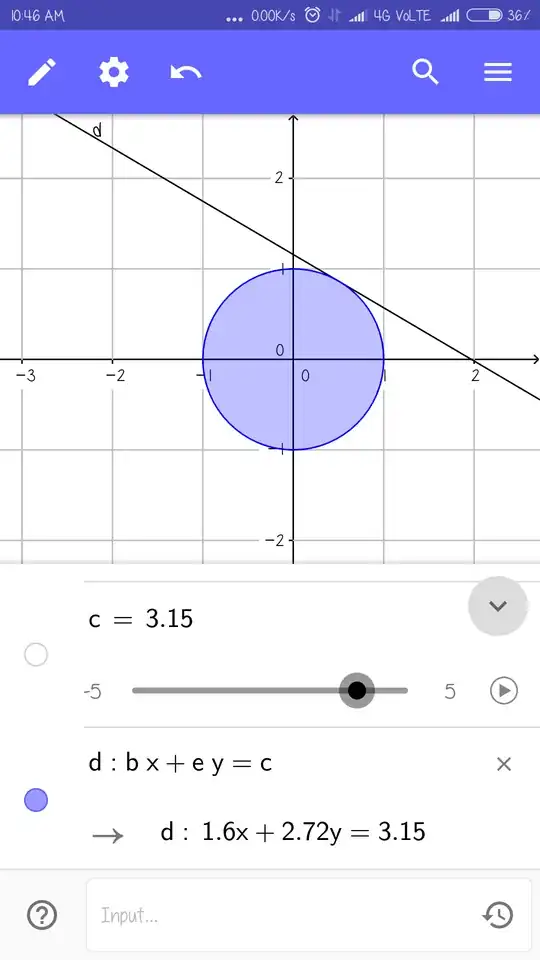
We can solve this by geometry,

$$x^2+y^2\le 1$$ is area bounded by circle with centre at origin and radius 1

&

$$ax+by=c$$ Is a line

We want to find max value of c,

Note: a and b are positive so slope is negative.

We want to find (x,y) such that it lies in circle and on line but also that line gives us maximum intersect at y-axis (which is $=\frac{c}{b}$)

If i draw the circle, and couple of lines In above picture we see that y-intersect is max when line is tangent to circle

In above picture we see that y-intersect is max when line is tangent to circle

Using basic coordinate knowledge, we can deduce the web of line such that it is tangent to circle

and then get c.

1

You can consider $$(ax+by)^2+(bx-ay)^2=(a^2+b^2)(x^2+y^2)\le a^2+b^2$$ so that $$(ax+by)^2\le a^2+b^2-(bx-ay)^2$$

Equality is attained when $x^2+y^2=1$ and $bx=ay$


How did I get that second square? Well I wanted to work with the square of the target expression and to get a term in $x^2+y^2$, so I needed to swap $a$ and $b$ around so I had equivalent terms in $x$ and $y$. Then I wanted to eliminate the cross term, so I put the minus sign in to achieve that.

It is sometimes useful to pick out the cross term and eliminate the squares by doing something like $$(ax+by)^2-(ax-by)^2=4abxy$$ - for example in working with an area represented by the cross term.

Mark Bennet
  • 101,769