2

Question: Determine all pairs of positive integers $(x,y)$ for which $2^x+3^y$ is a perfect square.
Doubt: This question was posted before and a screenshot of one of the hints is attached. I don't understand how do we arrive at $ 2^{s+1} +1=3^y$. Doesn't that require us to assume the factors are $1$ and $3^y$? Why can't both the factors be powers of three other than $0$?
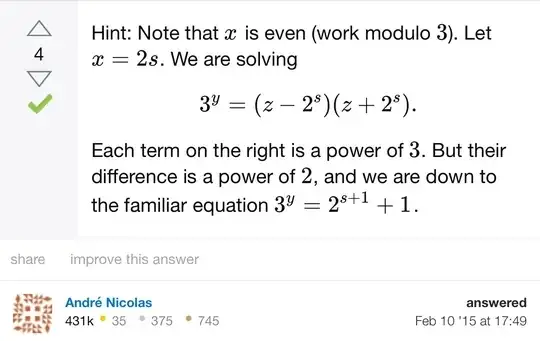
enter image description here

NeshDude
  • 161
  • 9

1 Answers1

1

If $$z - 2^s = 3^a$$ and $$z + 2^s = 3^b$$

Note that $b \gt a$.

Subtracting the first from the second gives us

$$2^{s+1} = 3^b - 3^a = 3^a(3^{b-a} - 1)$$

Since the left side is a power of $2$ which is not divisible by $3$, we must have $3^a = 1$ and so $a = 0$.

Aryabhata
  • 83,877
  • Ohhh yes! Also I wanted to ask an additional question. By brute force I found that the difference $b-a$ must be either $1 $ or $2$ for $3^{b-a} -1$ to be a power 2. So does this mean that $b= 2 $ or $b=1$ are the only two cases? Am I correct ? – NeshDude Aug 01 '17 at 05:31
  • @Viraam: That $b = 1$ or $2$ needs to be shown. Brute force won't work (did you exhaust all possibilities?). – Aryabhata Aug 01 '17 at 05:41
  • Yes I agree. I just noticed it for a few powers. Saw that after $3^2-1$ the any number of the form $3^m-1 $ has factors other than 2. – NeshDude Aug 01 '17 at 05:42
  • @Viraam: See this answer for some ideas which might work: https://math.stackexchange.com/questions/6324/are-there-integer-solutions-to-9x-8y-1/6326#6326 – Aryabhata Aug 01 '17 at 05:43
  • Ok. Suppose I take my first case to be $ 3^{b-a} = 2^n$ such that $n > 1$. Then I can use mod $4$ and I get that the difference $b-a$ has to be even. How can I prove it has to be equal to 2. Just a hint would be fine as well. – NeshDude Aug 01 '17 at 05:59
  • @Viraam: $3^y = 2^{x} + 1$. Now if $x = 1$ or $2 \mod 3$, then $2^x = ? \mod 3$. – Aryabhata Aug 01 '17 at 06:05
  • So if $y$ is even (your $b-a$), and $x$ is a multiple of $3$ you have the exact same question which I linked to. – Aryabhata Aug 01 '17 at 06:06