$\require{begingroup}\begingroup$
Here is the setup:

That is, $H$ is the height of the swing set, $\theta$ is the angle the swing deviates from rest, $v_0$ is the launch speed, $x_0$ and $y_0$ are the position coordinates of launch, and $x$ is the final landing position.
For this problem, I assume that before launch, you are swinging the full $-90^\circ$ to $90^\circ$ thereby maximizing the would-be launch speed at each $\theta$. I also assume that the swing's length is the same as its height (i.e. at rest, the swing's seat just barely touches the ground). This simplification seems justified since (on a real swing) when you land, your bottom will likely be at about the same height that the swing's seat would be at rest (well, assuming you land on your feet $\overset{.\ .}{\smile}$).
Now, with a little geometry, you can convince yourself that the angle of launch is the same as the angle of swing. Knowing this, the problem of figuring out where you land given a launch angle reduces to a projectile motion problem if we can figure out how $v_0$ varies against $\theta$.
To do so, let's analyze the energy conservation equation for this setup:
$\newcommand{\KE}{\operatorname{KE}}
\newcommand{\PE}{\operatorname{PE}}$
\begin{align}
\KE_0 + \PE_0 &= \PE_\mathrm{max} \\
\frac{1}{2} mv_0^2 + mgy_0 &= mgH \\
\implies v_0^2 &= 2g(H-y_0)
\end{align}
Now, looking at the picture, we see that
$$ \cos\theta = \frac{H-y_0}{H} \iff H-y_0 = H \cos \theta $$
So we get for $v_0^2$:
$$ v_0^2 = 2gH \cos \theta $$
So now we know how $v_0$ varies against $\theta$. To compute how far you (our projectile) fly, we need to know how long you will be in the air. We can do this using the projectile equation
$$ \Delta y = v_0 t + \frac{1}{2} at^2 $$
In our case:
\begin{align}
&-y_0 = (v_0 \sin\theta)t - \frac{1}{2} gt^2 \\
\iff &\frac{1}{2} gt^2 - (v_0 \sin\theta)t - y_0 = 0
\end{align}
Using the quadratic formula, we obtain
$$ t = \frac{v_0 \sin\theta + \sqrt{v_0^2 \sin^2\theta+2gy_0}}{g} $$
and after plugging in the appropriate expressions for $v_0$ and $y_0$ and simplifying we get
$$ t = \sqrt{\frac{2H}{g}} \cdot \left(\sin\theta \sqrt{\cos\theta} + \sqrt{1-\cos^3\theta} \right) $$
Now that we have the travel time, we can compute the horizontal distance using this formula:
$$ x = (v_0 \cos\theta)t + x_0 $$
where the geometry of the picture tells us $x_0 = H \sin\theta$.
Plugging in the various expressions and simplifying, we get
$$ x = H \cos\theta \cdot \left(\sin 2\theta + 2\sqrt{\cos\theta - \cos^4\theta} \right) + H \sin\theta $$
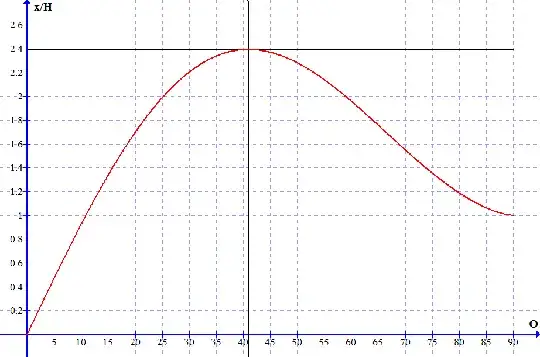
whose derivative we can take to find the maximum. Using Wolfram|Alpha, I got an optimal launch angle of approximately $0.7153$ radians or about $41^\circ$.
Wolfram|Alpha also provided an exact closed form for the solution. It was very ugly, but did lend itself to some simplification. So for those (like me) who enjoy seeing solutions in their full, unabashed glory, here it is:
$$ \theta = 2 \arctan\sqrt{\frac{\sqrt[3]{4\beta} - 10\sqrt[3]{2/\beta}-1}{3}} $$
where
$$ \beta = 11+3\sqrt{69} $$
If we now take this result and plug it into our original expression for $x$, we can compute what the actual maximum distance is. It is given approximately by
$$ \max(x) \approx 2.39354 \, H $$
where $H$, recall, is the height/length of the swing.
(And yes, Wolfram did provide an exact closed form for the $2.39354$ factor, but it is way too long to write down here. Nevertheless, if you're still interested, you can view it here.)
A graph of landing distance per unit swing height ($x/H$) vs launch angle ($\theta$) seems to confirm our results:
Finally, we can also compute the maximum height you will attain after launching from the ideal angle. There are many ways to compute this. I choose to do so using the energy conservation equations again. The maximum height will occur when you are traveling horizontally only and not moving either higher or lower: that is, when your speed is $v_0 \cos\theta$.
\begin{align}
\PE_\mathrm{max} &= \PE_1 + \KE_1 \\
\iff mgH &= mgy_\mathrm{max} + \frac{1}{2} m(v_0 \cos\theta)^2 \\
\implies y_\mathrm{max} &= H - \frac{1}{2g} v_0^2 \cos^2\theta \\
&= H - \frac{1}{2g} (2gH \cos\theta) \cos^2\theta \\
&= H - H \cos^3\theta \\
&= H(1 - \cos^3\theta)
\end{align}
Plugging in the ideal angle, we get
$$ y_\mathrm{max} \approx 0.5698 H $$
(don't ask about the closed form...)
which tells us that, unless you're okay with falling about half the height of your swing set, don't try this at home...
Some follow up questions I didn't try to answer:
- How does the answer change if the swing seat is not assumed to be touching the ground at rest? (e.g. a rope swing, where your lowest point in swing is significantly above the water surface)
- What do the ideal angles look like if we don't start with maximum momentum, i.e. a $-90^\circ$ to $90^\circ$ initial swing?
$\endgroup$


