Let us try to understand $\lambda$ first. Suppose in general that $L, L'$ are two linked (but disjoint) circles in $\Bbb R^3$ and you look at the map $\lambda : L \times L' \to S^2$ defined analogously. Then $\lambda(\mathbf{x}, \mathbf{y})$ is truly the unit direction vector from $\mathbf{x}$ to $\mathbf{y}$. If $\lambda(\mathbf{x}_1, \mathbf{y}_1) = \lambda(\mathbf{x}_2, \mathbf{y}_2) = \vec{\mathbf{a}}$, then this means the unit direction vector from $\mathbf{x}_i$ to $\mathbf{y}_i$ are the same. In other words, if I project $\Bbb R^3$ to the plane perpendicular to $\vec{\mathbf{a}}$, $\mathbf{x}_i, \mathbf{y}_i$ all maps to $0$. So, locally around $(\mathbf{x}_i, \mathbf{y}_i)$, the arrangement of $L$ and $L'$ looks like a crossing (eg the two pictures below) when looked below from that plane, and $\vec{\mathbf{a}}$ is situated in the bit where the crossing happens, which we cannot see.
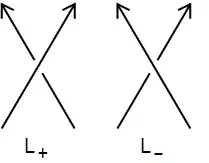
If $(\mathbf{x}_i, \mathbf{y}_i)$ for $i=1, 2$ both have the same orientation numbers as elements of $\lambda^{-1}(\vec{\bf{a}})$, then they both look like the same type of crossing ("both overcrossing" or "both undercrossing") and if they have opposite orientation number, they are crossing of opposite types. Thus, degree of $\lambda$ merely corresponds to the total number of crossings of $L$ and $L'$, upto cancelling crossings of opposite sort. That's why it's called the linking number of $L$ and $L'$.
Let us identify $S^3 \subset \Bbb C^2$ with the unit sphere around the origin given by $|z_0|^2+|z_1|^2 = 1$, and $S^2$ with the Riemann sphere (or the complex projective line) $\Bbb{CP}^1$. Then the Hopf fibration map $\eta : S^3 \to S^2$ is nothing but $\eta(z_0, z_1) = z_0/z_1$.
If $P = p_0/p_1$ and $Q = q_0/q_1$, then $\eta^{-1}(P)$ is the circle in $S^3$ given by $z_0p_1 = z_1p_0$ and $\eta^{-1}(Q)$ is given by $z_0q_1 = z_1q_0$. Note that these give equations for complex lines $\ell_1, \ell_2$ in $\Bbb C^2$, and they intersect with $S^3$ in unit circles $C_i$ centered at origin on $\ell_i$ (which, as subspaces of $S^3$, are fibers of the Hopf map). We are looking at the map $\lambda : C_1 \times C_2 \subset \ell_1 \times \ell_2 \to S^2$ given by the formula you described. By a $\Bbb C$-linear transformation, one can take $\ell_1$ to the $z_0$-line and $\ell_2$ to the $z_1$-line (namely, the "coordinate complex lines").
Hence, it suffices to compute the degree of the map $\lambda : S^1 \times S^1 \subset \Bbb R^2 \times \Bbb R^2 \to S^2$ defined by $\lambda(\mathbf{x}, \mathbf{y}) = (\mathbf{x} - \mathbf{y})/\|\mathbf{x} - \mathbf{y}\|$, where $S^1 \subset \Bbb R^2$ is the unit circle centered at $0$. I claim the degree of this map is $1$. Indeed, those circles constitute the Hopf link:
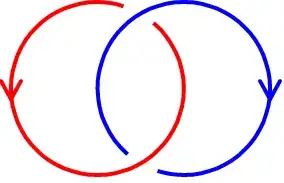
Note carefully that just because there's two crossings going on, it doesn't mean that the degree is 2. This is why; place that picture in the $xy$-plane with $y$-axis going through the two crossings, center origin, and $x$-going perpendicular through the center. The unit direction along the $y$-axis is not a regular value. The unit direction along the $x$-axis is, and preimage gives rise to $3$ crossings (red-blue, blue-red, red-blue from left to right). Two of these have the same orientation, and the third of opposite orientation. So $\deg(\lambda) = 1 + 1 - 1 = 1$, as desired.


