2

This is Prob. 18, Chap. 3 in Baby Rudin.

Let $\alpha$ be a given positive real number, and let $p$ be a given positive integer. For an arbitrary choice of $x_1 > 0$, let's define for every $n\ge1$, $$x_{n+1} = \frac{p-1}{p} x_n + \frac{\alpha}{p} x_n^{-p+1} $$

For $p = 2$ and $x_1 > \sqrt{\alpha}$, this sequence is a monotonically decreasing sequence and converges to $\sqrt{\alpha}$, as in Prob. 16, Chap. 3 in the book Principles of Mathematical Analysis by Walter Rudin, 3rd edition. Now my question is:

What is the behavior of $(x_n)$ for a general positive integer $p$ and for a general $x_1 > 0$?

Based on Rudin's Prob. 16, I get the feeling that if we start with $x_1 > \sqrt[p]{\alpha}$, then this sequence might be a monotonically decreasing sequence converging to $\sqrt[p]{\alpha}$. But is it really so? And if so, then how to prove this rigorously?

What if we start with $x_1 \in (0, \sqrt[p]{\alpha} )$? Do we in that case obtain a monotonically increasing sequence converging to $\sqrt[p]{\alpha}$? If so, then how to prove this rigorously?

How is this recursion formula obtained in the first place?

  • Simply drawing the graph of the function $f(x)=\frac{p-1}px+\frac{a}p\frac1{x^{p-1}}$ would readily prove these claims. In particular, if $x_1<a^{1/p}$ then $x_2>a^{1/p}$ hence one is back to the easy case (sequence decreasing to the fixed point $a^{1/p}$ of $f$). – Did Jan 01 '17 at 10:52
  • Why did you see fit to reinsert "Prob. 18, Chap. 3 in Baby Rudin" in the title, only making said title longer, although this mention was added to the question, where it belongs? – Did Jan 01 '17 at 11:38
  • @Did the reason why I thought it fit to mention the reference in the title itself is, it is in this particular context that I've had this question in the first place and might need to look it up again in, say, two years' time, in which case having the reference in the title makes it more likely to be locatable. – Saaqib Mahmood Jan 01 '17 at 16:48
  • Exactly as locatable, not more not less. – Did Jan 01 '17 at 17:03
  • @Did then it is my poor Internet skill, I must admit, but that's how it is with me. – Saaqib Mahmood Jan 01 '17 at 17:14
  • @Did but, you see, we don't prove theorems in analysis by drawing graphs of functions. – Saaqib Mahmood Jan 01 '17 at 19:59
  • But you see, when simply drawing a graph allows you to directly understand every detail of the situation, why wouldn't we want to? BTW, did you even try? – Did Jan 01 '17 at 21:03

1 Answers1

4

Here is a bit of background which helps understand the behavior of $(x_n)$.

Let $f : [0, \infty) \to \Bbb{R}$ be defined by $f(x) = x^p - \alpha$ and suppose that we want to approximate the zero (which is of course $\sqrt[p]{\alpha}$ of $f$. Because we have no good numerical guess on $\sqrt[p]{\alpha}$, we pick an arbitrary guess $x_0 \in (0, 1)$. If we pretend that $f$ is linear, which amounts to replacing $f$ by the tangent line $y = f(x_0) + f'(x_0)(x - x_0)$, the true zero $x_1$ will be given by

$$ x_1 = x_0 - \frac{f(x_0)}{f'(x_0)} = \frac{p-1}{p}x_0 + \frac{\alpha}{p}x_0^{-p+1} . \tag{*}$$

Of course, $f$ is in general not linear and thus $x_1$ need not be $\sqrt[p]{\alpha}$. Since the tangent line approximates $f$ quite well near $x_0$, however, we can still hope that $x_1$ serves as a better guess for $\sqrt[p]{\alpha}$. Then we may repeat this procedure to improve our guess. Newton's method formalizes this idea.

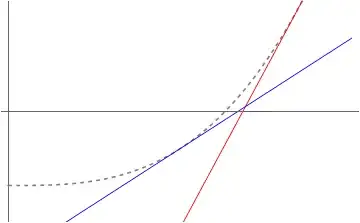
Returning to our problem, we now have a geometric interpretation of $(x_n)$. Notice that $f(x) = x^p - \alpha$ is convex and strictly increasing on $[0, \infty)$ since $p \geq 1$. From this, any tangent line should lie below the graph of $f$. A moment of thought shows that the improved guess $\text{(*)}$ for $\sqrt[p]{\alpha}$ is always greater than or equal to $\sqrt[p]{\alpha}$; see:
enter image description here

In particular, if $x_n > \sqrt[p]{\alpha}$ (which corresponds to the red tangent line above) then $x_{n+1}$ decreases. On the other hand, if $x_n \in (0, \sqrt[p]{\alpha})$ (which corresponds to the blue tangent line above), it follows that $x_{n+1} > \sqrt[p]{\alpha}$. So possibly except for the first term, the sequence $(x_n)$ is always $\geq \sqrt[p]{\alpha}$ and decreases.


Here is an independent proof. I will assume that we are free to use the law of exponents for rational exponents and positive base.

Let $f : (0, \infty) \to \Bbb{R}$ by

$$ f(x) = \frac{p-1}{p}x + \frac{\alpha}{p}x^{-p+1}. $$

  • We claim that $f(x) \geq \sqrt[p]{\alpha}$ for all $x > 0$. Indeed, by the AM-GM inequality,

    $$f(x) = \frac{\overbrace{x + \cdots + x}^{p-1\text{-terms}}+\alpha x^{1-p}}{p} \geq \sqrt[p]{x^{p-1} \cdot \alpha x^{1-p}} = \sqrt[p]{\alpha}. $$

  • We also claim that if $x \geq \sqrt[p]{\alpha}$ then $f(x) \leq x$. Indeed, let us write

    $$ f(x) = x - \frac{x}{p}\left(1 - \frac{\alpha}{x^p}\right) $$

    Since $x \geq \sqrt[p]{\alpha}$, we have $x^p \geq \alpha$ and hence $1 - \frac{\alpha}{x^p} \geq 0$. This shows that $f(x) \leq x$ as desired.

Therefore, possible except for the first term of $(x_n)$, this sequence is monotone decreasing and bounded. Thus $(x_n)$ converges to some limit $\ell \geq \sqrt[p]{\alpha}$ that satisfies $\ell = f(\ell)$. Solving this equation gives $\ell = \sqrt[p]{\alpha}$.

Sangchul Lee
  • 181,930
  • thank you for your answer, but, except for the first part about how the recurrence formula is obtained, your answer only illustrates and never proves anything about this sequence in any rigor. Can you please do things rigorously enough? Please note that this question is from Rudin's Principles of Mathematical Analysis!! – Saaqib Mahmood Jan 01 '17 at 20:13
  • thank you so much. What a wonderful answer!! – Saaqib Mahmood Jan 02 '17 at 19:10