0

I am trying to learn discrete mathematics on my own and have been reading Rosen's discrete math textbook, there is one step in his proof that I do not understand.

Where $<2*k!$ becomes $(K + 1)K!$

he states that $2 < k + 1$ but how is he determining that?

I have attached an image of the proof for viewers to see exactly, it is the second last line of the inequalities.
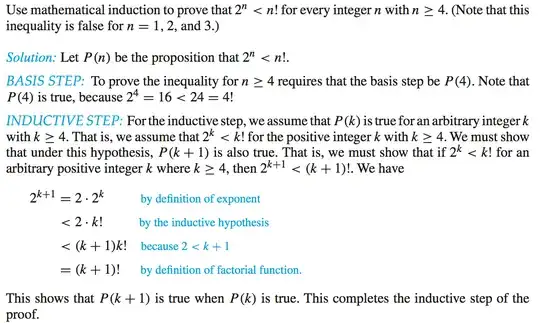
Rosen Description Snapshot

Ben Grossmann
  • 234,171
  • 12
  • 184
  • 355
user2076774
  • 125
  • 1
  • 6

3 Answers3

1

The basis step says, it is true for $k=4$. And then the inductive step assumes that it is valid for a $k$ with $k\geq 4$.
It's quite easy to deduce $k+1 > 2$ then.

tylo
  • 261
0

Check that he has clearly mentioned $k \ge 4$ in the last line of the inductive step. And also it must be kept in mind that the inequality holds only for $k\ge 4$.

So $k+1 \ge 5 > 2$

Hope this helps you.

0

You have to have a base case. Note that your inequality is false until $n=4$, so you should say for all $n\ge 4, 2^n \lt n!$ You prove the $n=4$ case by computation. Then assume you have proved it for $k$ where $k \ge 4$. Since you have $k \ge 4$, you have $2 \lt k+1$

Ross Millikan
  • 383,099