Think geometrically about how $3$ numbers in the unit circle could sum $0$. Assuming some familiarity with the complex plane one should soon get the easy solution
$$
S_0=\{1,e^{i\frac{2\pi}{3}},e^{-i\frac{2\pi}{3}}\}.
$$
After this one rapidly generalizes to
$$
S_\theta=e^{i\theta}S_0=\{e^{i\theta},e^{i(\theta+\frac{2\pi}{3})},e^{i(\theta-\frac{2\pi}{3})}\}.
$$
Graphically:
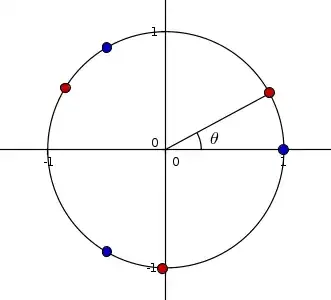
(The three blue dots are the elements of $S_0$, and the three red points the elements of $S_\theta$).
So we have a parametric family of solutions of $z_1+z_2+z_3=0$ in the unit circle. Are there other solution $S$ to this problem that is not of this form? No: If $S$ is not of this form then there are two elements $e^{i\alpha}, e^{i(\alpha+\beta)}\in S$ with $\beta\neq \pm\frac{2\pi}{3}$. Call $w$ the other element of $S$. As the sum of the elements of $S$ must be $0$ we must have
$$
-w=e^{i\alpha}+e^{i(\alpha+\beta)},
$$
so the RHS must have modulus equal to one $1$. Calculating
\begin{align}
|e^{i\alpha}+e^{i(\alpha+\beta)}|^2=&(\cos\alpha+\cos(\alpha+\beta))^2+(\sin\alpha+\sin(\alpha+\beta))^2\\=&\underbrace{\cos^2\alpha+\cos^2\beta}_{1}+\underbrace{\cos^2(\alpha+\beta)+\sin^2(\alpha+\beta)}_{1}+2\underbrace{(\cos\alpha\cos(\alpha+\beta)+\sin\alpha\sin(\alpha+\beta))}_{\cos\beta}.
\end{align}
we arrive at $1^2=2+2\cos\beta\hspace{.1cm}$; i.e. $\cos\beta=-\frac{1}{2}$ which only holds if $\beta=\pm\frac{2\pi}{3}$.
So every solution to $z_1+z_2+z_3=0$ in the unit circle is $S_\theta$ for some $0\leq\theta<2\pi$. This reduces your question to $$\text{"if $S_\theta=\{w_1,w_2,w_3\}$, then what is the value of $w_1^2+w_2^2+w_3^2$ ?",}$$ which becomes obvious with the observation that
$$(z\mapsto z^2)(S_\theta)=S_{2\theta}.$$
I.e. $S_{2\theta}=\{w_1^2,w_2^2,w_3^2\}$, which is a solution of $z_1+z_2+z_3=0$. !!


