Construction.
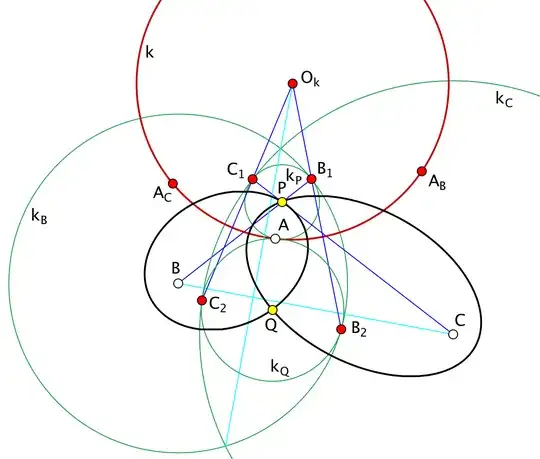
Draw circle $k_P$ centered at point $P$ and of radius $PA$. Draw circle $k_B$ centered at point $B$ and of radius $BP + PA$, and draw circle $k_C$ centered at point $C$ and of radius $CP + PA$. By construction $k_B$ is tangent to $k_P$ and let $B_1$ be the point of tangency (then $B_1 \, \in \, BP$). Also by construction $k_C$ is tangent to $k_P$ and let $C_1$ be the point of tangency (then $C_1 \, \in \, CP$). Construct the point $A_B$ as the inverse image of $A$ with respect to the circle $k_B$ and the point $A_C$ as the inverse image of $A$ with respect to circle $k_C$. Draw the circle $k$ as the circle passing through the three points $A, \, A_B$ and $A_C$. By construction $k$ is mapped to itself (not pointwise, but as a set) by inversion with respect to either of the circles $k_B$ and $k_C$, which means that $k$ is orthogonal to both $k_B$ and $k_C$ simultaneously. Determine the center of $k$ and denote it by $O_k$. By the way, due to the latter fact, $O_k$ lies on the radical axis of $k_B$ and $k_C$, which is the line formed by the two intersection points of $k_B$ and $k_C$ -- a line which is orthogonal to segment $BC$. By the orthogonality between $k$ and $k_B$ whenever one performs an inversion with respect to $k$, circle $k_B$ is mapped to itself. Analogously, circle $k_C$ is mapped to itself by inversion in $k$. Invert points $B_1$ and $C_1$ in $k$ to obtain their respective images $B_2$ and $C_2$. They necessarily lie on the circles $k_B$ and $k_C$ respectively and also on the straight lines $O_kB_1$ and $O_kC_1$ (i.e. $B_2 = O_kB_1 \cap k_B$ and $C_2 = O_kC_1 \cap k_C$ ). Thus, the inverse image with respect to $k$ of circle $k_P$ is the circle $k_Q$ passing thorugh points $A, \, B_2$ and $C_2$ and since $k_P$ is tangent to both $k_B$ and $k_C$, its image $k_Q$ is also tangent to $k_B$ and $k_C$ and the corresponding points of tangency are $B_2$ and $C_2$. Cosntruct the center of $k_Q$ and call it $Q$. This point $Q$ is the second intersection point of the two ellipses. Indeed
$$BQ + QA = BQ + QB_2 = BP + PB_1 = BP + PA $$ $$CQ + QA = CQ + QC_2 = CP + PC_1 = CP + PA $$
Tangents. Denote by $\Gamma_{AB}$ the ellipse with foci $A$ and $B$ and passing through $P$ (and thus through $Q$). Denote by $\Gamma_{AC}$ the ellipse with foci $A$ and $C$ and passing through $P$ (and thus through $Q$).
Let $t_{AB}(P)$ be the tangent to $\Gamma_{AB}$ at point $P$. Then by the reflection property of rays trhough the foci of ellipses, the angle $\angle \,\, BP \, t_{AB}(P) = \angle \,\, AP\, t_{AB}(P)$ which means that $\angle \,\, B_1P\, t_{AB}(P) = \angle \,\, AP \, t_{AB}(P)$ i.e. $t_{AB}(P)$ is the bisector of angle $APB_1$. But since triangle $AB_1P$ is isosceles with $PA = PB_1$, the tangent $t_{AB}(P)$ is orthogonal to $AB_1$ and passes through the midpoint of segment $AB_1$. Absolutely analogous chain of arguments leads to the conclusion that the tangent $t_{AB}(Q)$ to $\Gamma_{AB}$ at the point $Q$ is orthogonal to segment $AB_2$ and passes through the midpoint of $AB_2$.
Now, let us look at the circle $k_{AB}$ defined by the three points $A, \, B_1$ and $B_2$. Then since $B_1$ and $B_2$ are inversive of each other with respect to circle $k$ and $A \in k$, circle $k_{AB}$ is orthogonal to circle $k$. Observe that $t_{AB}(P)$ is the orthogonal bisector of segment $AB_1$ and $t_{AB}(Q)$ is the orthogonal bisector of segment $AB_2$ which means that the intersection point of the two tangents $U = t_{AB}(P) \cap t_{AB}(Q)$ is in fact the center of circle $k_{AB}$. The orthogonality of circles $k$ and $k_{AB}$ is equivalent to the fact the radii $UA$ and $QA$ are orthogonal, i.e. $\angle \,\, UAQ = 90^{\circ}$.
Let $t_{AC}(P)$ be the tangent to $\Gamma_{AC}$ at point $P$ and let $t_{AC}(Q)$ be the tangent to $\Gamma_{AC}$ at point $Q$. Just as before, $t_{AC}(P)$ and $t_{AC}(Q)$ are orthogonal segment bisectors of segments $AC_1$ and $AC_2$ respectively. Then the circle $k_{AC}$ through $A, \, C_1$ and $C_2$ is again orthogonal to $k$ and the two tangents $t_{AC}(P)$ and $t_{AC}(Q)$ pass through the center of $k_{AC}$, which we denote by $V = t_{AC}(P) \cap t_{AC}(Q)$. The orthogonality of circles $k$ and $k_{AC}$ is equivalent to the fact that the radii $VA$ and $QA$ are orthogonal, i.e. $\angle\,\, VAQ = 90^{\circ}$. Thus, each of the two lines $AU$ and $AV$ passes through the point $A$ and is orthogonal to line $QA$, which means that these two lines coincide, i.e. $A$ lies on the line $UV$.
I hope I haven't made too many typos :D ...


