31

We can see intuitively that $$ f(x)=\sin\left(\frac{\pi}{2}\sin\left(\frac{\pi}{2}\sin\left(\frac{\pi}{2}\cdots\sin{x}\cdots\right)\right)\right) $$ is the square wave with period $2\pi$ and has the value $0$ at the jumps, i.e $$ f(x)= \begin{cases} 0 & \text{if } \frac{x}{\pi}\in\mathbb{Z}\\ \mathrm{sign}(\sin{x}) & \text{otherwise} \end{cases} $$ Look at this graph of $x$ and $\sin{\frac{\pi}{2}x}$ to see why :
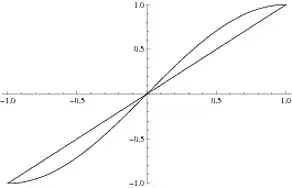
Graph of x and sin(pi/2*x)

But $f(x)$ is then also exactly equal to the Fourier series of the square wave with period $2\pi$ since Dirichlet conditions assure that the series converges to $0$ (the midpoint) at the jumps as do $f(x)$.

Hence we might be able to show that, $$ \sin\left(\frac{\pi}{2}\sin\left(\frac{\pi}{2}\sin\left(\frac{\pi}{2}\cdots\sin{x}\cdots\right)\right)\right)=\frac{4}{\pi}\sum_{k=0}^{\infty}\frac{\sin{(2k+1)x}}{2k+1} $$

Does anyone have an idea of how to prove this directly? Are there other Fourier series that are equal to a recursive formula of trigonometric functions?

Restated, the problem is to show that if $$ f_0(x)=\sin{x},\quad\text{and}\quad f_n(x)=\sin{\left(\frac{\pi}{2}f_{n-1}(x)\right)} $$ then, $$ \lim_{n\to\infty}{f_n(x)}=\frac{4}{\pi}\sum_{k=0}^{\infty}\frac{\sin{(2k+1)x}}{2k+1} $$

M. M.
  • 965
  • Perhaps you should elaborate on the meaning of "directly". This seems pretty direct to me, and I'm having a hard time imagining how it might be shown even more directly. – joriki Aug 04 '12 at 18:58
  • @joriki By directly, I meant cleverly use known identities to see why the equality holds without having to state that both are the square wave. Why I asked this question is because I think that it could bring light on the connection between recurrence relation of trigonometric functions and Fourier series which might gives us insight of how to find other similar identities. – M. M. Aug 04 '12 at 19:17
  • This paper might have something useful... – J. M. ain't a mathematician Aug 04 '12 at 19:32
  • 1
    Thanks @J.M.. Unfortunately, my current lack of knowledge of the German language makes it hard for me to extract useful information. Do they investigate this kind of question in the paper? – M. M. Aug 04 '12 at 20:18
  • New remark : $\frac{4}{\pi}\arctan\left(\frac{4}{\pi}\arctan(\cdots\sin x\cdots)\right)$ works also. In fact, any $g(x)$ satisfying $x<g(x)<1$ for $0<x<1$, $-1<g(x)<x$ for $-1<x<0$ and $g(-1)=-1$, $g(0)=0$, $g(1)=1$ will work with $g(g(g(\cdots\sin x\cdots)))$. Can we find similar conditions for other Fourier Series? The sawtooth wave for example? – M. M. Aug 04 '12 at 20:59
  • 1
    I like the "current" in "current lack of knowledge" :-) "Über die Iteration der ganzen transzendenten Funktionen, insbesondere von $\sin z$ und $\cos z$" means "On the iteration of the entire transcendental functions, in particular of $\sin z$ and $\cos z$" -- but you may have guessed as much already. I don't have free access to the rest of the paper. – joriki Aug 04 '12 at 21:48
  • 1
    The paper seems to be concerned mainly with properties of the set of points you get when iterating. As far as I can tell, the results are not of use for the question here. – Gregor Botero Aug 05 '12 at 00:16
  • 1
    @joriki: late but... J.M.'s (well Töpfer's) paper at gdz – Raymond Manzoni Aug 28 '12 at 12:07

1 Answers1

1

I don't think you can easily compute $\mathcal F{\left( f \circ f \right)}$ from $\mathcal F{(f)}$, where $\mathcal F$ is the Fourier transform.

But you can prove the statement above ($f^n$ means $f \circ \cdots \circ f$, $n$-times):

$$ \lim_{n \to +\infty} f^n(x) = \begin{cases} 0 & \text{if } \frac{x}{\pi}\in\mathbb{Z}\\ \mathrm{sign}(\sin{x}) & \text{otherwise} \end{cases}$$

And then deduce:

$$ \lim_{n\to\infty}{f^n(x)}=\frac{4}{\pi}\sum_{k=0}^{\infty}\frac{\sin{(2k+1)x}}{2k+1} $$ $f(x) = \sin( \frac{\pi}{2} x) $ sends $[-1,1]$ onto itself, it has $3$ fixed points: $-1, 0$ and $1$.

The derivative at these points is respectively: $0, \frac{\pi}{2} > 1$ and $0$. So $-1$ and $1$ are super-attracting fixed points (any point close to $-1$ or $1$ move closer and closer) whereas $0$ is repelling fixed point (any point close to $0$ move away).

If $0 < x < 1$, $f^n(x) \to 1$ (very fast) and if $-1 < x < 0$, $f^n(x) \to -1$.

I can give more details, if needed.

Ilies Zidane
  • 1,004