8

I'm trying to prove the following proposition from Kochman's book. For completion I will write it here the relevant part:

Let $E$ be an oriented spectrum with orientation class $x\in E^2(\mathbb{C}P^{infty})$, then $$ E^*(\mathbb{C}P^n)\cong \pi_*E [i_n(x)] /(i_n(x)^{n+1})$$ as $\pi_*E$-modules.

The proof goes as follows: use AHSS with $E^{p,q}_2=H^p(\mathbb{C}P^n; \pi_q E)$, notice that it collapses at the second page ($\pi_*E$-linearity of differentials + multiplicativity) and then conclude.

What I don't understand is the "and then conclude". I mean, there is the entire extension problem to deal with. The fact that the spectral sequence collapses only means that the stable page is isomorphic to $\pi_*E [i_n(x)] /(i_n(x)^{n+1})$ but then I've to compute the "limit". The same result is stated in several other books: Rudyak's book just refer to the proof here, or the one in Adams' Stable homotopy and generalised homology Lemma $2.5$ page $39$ which simply doesn't prove anything more that the triviality of the SSeq.

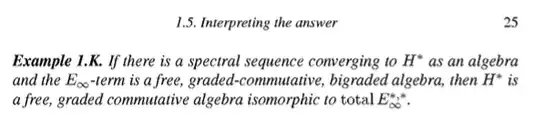
My Idea:I think the key to prove the assertion is that the stable page (i.e. the second page in this case) is a free $\pi_*E$-module, whose generators are $i_n(x),i_n(x^2),i_n(x^3),\dots, i_n(x^n)$. I found the following lemma-example in McCleary's UGtSS page $25$ enter image description here

which seems to suggest that something similarly is true, albeit on seemingly stronger hypothesis: I think a verbatim proof should generalise the reasoning to my situation, but I may have overlooked something, namely maybe somewhere it can have been used that we are working with vector space and therefore the extensions are trivial. I can't spot any error thought.

Then using multiplicativity of the AHSS I should be able to find the right ring-structure of $E^*(\mathbb{C}P^n)$.

In conclusion, the fact that no one seems to prove this result in full details (I'm referring to the proposition at the beginning of the question), leads me to think that there is some folklore result which applies here. If that the case, I'd like to get some reference for it in order to see it once and for all.

Riccardo
  • 7,583

1 Answers1

4

I think I was able to solve my doubt. I wrote the answer here, but I'll type it down here:

So first of all the difficult point is to show that the AHSS collapses at the second page. After that it is almost trivial. In order to prove it, the hypothesis on orientation will be of main importance.

Let me fix some notation: $ i_n \colon \mathbb{C}P^n \to \mathbb{C}P^{\infty}$ is the usual inclusion, and $ y_E$ is the image of the orientation class in the unreduced second cohomology group of $\mathbb{C}P^{\infty}$.

The first step is to identify a certain element in the AHSS for $ \mathbb{C}P^1$ with the orientation $ i_1^* y_E$. Recall that $ H^*(\mathbb{C}P^n)\cong \mathbb{Z}[y]/(y^{n+1})$

Claim 1: The element $ y \otimes \imath \in E^{2,0}$ represents the orientation class $ i_1^*(y_E)$.

Proof of Claim 1: Consider the AHSS for $\mathbb{C}P^1$: enter image description here Since the edge homomorphism for the AHSS is always surjective, we have that the only possible non-zero differentials (the differentials of the 2nd page starting from the zero-th column to the second one) are trivial. This implies that the spectral sequence collapses. Since the second page is generated multiplicatively by $ y\otimes \imath \in E^{2,0}_2$ and it is a free graded $ \pi_*E$-module (i.e. the extension problem is trivial) the isomorphism $ E^2(\mathbb{C} P^1)\xrightarrow{\cong} E^{0,2}_2 \oplus E^{2,0}_2$ maps $ i_1^*(y_E) \mapsto y \otimes \imath$ ( $ E_2^{0,2} =E^2(\ast) $ and the other is the reduced cohomology group).
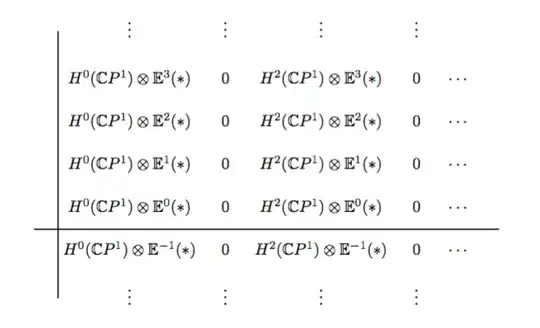
Claim 2: The AHSS for $ \mathbb{C} P^n$ collapses at the second page and we have that $ y \otimes \imath \in E_2^{2,0}$ represents the orientation class $ i_n^*(y_E)$

Proof of Claim 2: Let us have a look at the AHSS for $ \mathbb{C} P^n$: enter image description here
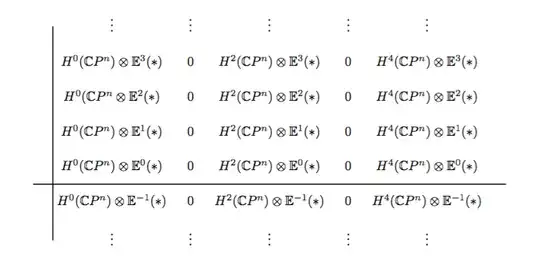
Since the AHSS is multiplicative and thanks to the ring structure of the second page, it's enough to show that the element $ y \otimes \imath \in E_2^{2,0}$ is an infinite cycle. In fact, one proceed inductively using the fact that any other element in the previous page (i.e. in the second page) is a $ \pi_*E$-linear combination of powers of $ y\otimes \imath$. Consider the inclusion $ i_1^n \colon \mathbb{C} P^1 \to \mathbb{C} P^n$. We know that $ i_n^*(y_E)$ is sent to $ i_1^*(y_E)$ by the fact that $ (i_1^n)^*i_n^*=i_1^*$. Now recall that $ i_1^n$ induces a map of spectral sequences. Since we know that AHSS for $ \mathbb{C} P^n$ converges a priori to $ E^*(\mathbb{C}P^n)$ ($ \pi_*E$ is required to be bounded below by Kochman and Adams in another chapter) there is an element in the stable page $ E_{\infty}^{p,q}$, for some $ p,q \in \mathbb{Z}$ which is a representative of $ i_n^*(y_E)$.

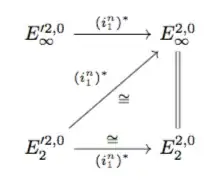
By Claim 1, we already know that the representative of $ i_1^*(y_E)$ lies in $$ E_{\infty}^{2,0}\cong F^2 E^2(\mathbb{C} P^1)/F^3 E^2(\mathbb{C} P^1)$$ Now suppose that the class of $$ i_n^*(y_E)\in F^p E^{p+q}(\mathbb{C} P^n)/F^{p+1} E^{p+q}(\mathbb{C} P^n)$$ since the inclusion preserves the filtration, it would send our class to an element lying in $ F^p E^{p+q}(\mathbb{C} P^1)/F^{p+1} E^{p+q}(\mathbb{C} P^1)$, but since we already established that the image of $$ i_n^*(y_E)\in F^2 E^2(\mathbb{C}P^1) / F^{3} E^2(\mathbb{C}P^1)$$ it must be that $ p\geq 2$ and $ q=0$ (Since $ F^pE^2(\mathbb{C} P^n)\subseteq F^{p-1}E^2(\mathbb{C} P^n)$). By definition of the filtration for the cohomological AHSS, if this element lies in $ F^p E^2(\mathbb{C}P^n) / F^{p+1} E^2(\mathbb{C}P^n)$ for $ p>2$ in particular its representatives lie in $$ F^2 E^2(\mathbb{C}P^n)$$ meaning that when restricted to $\mathbb{C}P^1$ they are all zero (it is crucial here that the inclusion identifies the 2 skeleton of $ \mathbb{C}P^n$ with $ \mathbb{C}P^1$). Since we know that the restriction to $ \mathbb{C}P^1$ of the orientation $ i_n^*(y_E)$ is a non-zero element, it must be $ p=2$ and $ q=0$. This shows that we have to look for a representative for $ i_n^*(y_E)$ in $E_{\infty}^{2,0}$. Consider the following diagram, where $ E_r'^{p,q}$ will denote the group in position p,q, page r of the AHSS for $ \mathbb{C}P^n$:
enter image description here

The lower map is an isomorphism since it is the map induced between the second singular cohomology groups of $ \mathbb{C} P^1$ and $ \mathbb{C} P^n$. The diagram implies that the unique preimage of the representative of $ i_1^*(y_E)\in E^2(\mathbb{C}P^1)$, which by Claim 1 is identified $ y \otimes \imath$, can only be the element $ y \otimes \imath$ in $ E_2'^{2,0}$, and therefore it has to be an element of $ E_{\infty}'^{2,0}$ i.e. an infinite cycle. This readily implies that the AHSS collapses at the second page, since it is multiplicative: the second page is generated multiplicatively by $ y \otimes \imath$, and we just showed that it is an infinite cycle, by an easy inductive reasoning we have that the differentials in every page must be zero since they are $ \pi_*E$-linear derivations.

In conclusion: Since the stable page is a free graduated $ \pi_*E$ module, the extension problem is trivial (all the s.e.s. splits). In fact one can organise all the s.e.s. in the following $$ 0 \to F^{p+1}E^{p+\bullet}\to F^pE^{p+\bullet} \to E^{p,\bullet}_{\infty} \to 0$$ (see here for example) and therefore if the latter is a free graded module, the s.e.s. splits.

Therefore we have an isomorphism of $ \pi_*E$-modules $ E^m(\mathbb{C}P^n) \cong \bigoplus_{p+q=m}E_{2}^{p, q}$.

Using the fact that AHSS is multiplicative, and the ring structure on the stable page is the one one would expect to have, by compatibility of the two product structures (by axiom of multiplicative spectral sequence) and the above iso we have the claim

Maybe it's not the most elegant solution but I think it does the job: it was not so obvious as many references claimed. I'd love to see if there are more elegant proofs
Riccardo
  • 7,583
  • I believe I understand what you've written, but there's something else I'm missing. What I think this shows is that $\mathrm{gr}\ E^(\mathbb C P^\infty) \cong E^[[y]]$ on the level of rings, where the "gr" denotes the associated graded ring, but the claim is that $E^(\mathbb C P^\infty) \cong E^[[y]]$ without the associated grading, so implicitly that the passage from $E^*(\mathrm{pt})$ to its associated graded algebra doesn't change the multiplicative structure. My understanding of the lemma from McCleary's book has been that it works because the ring in question is free as a CGA ... – jdc Jun 18 '16 at 00:35
  • ... relying on the fact that a choice of lift of basis from the associated graded to the original ring extends uniquely and consistently to a ring homomorphism which is a module bijection. Without the freeness as a CGA, I don't understand why this proof (or any other I've seen), shows more than that this is an isomorphism for associated gradeds. – jdc Jun 18 '16 at 00:43
  • This might be a result of something else I'm missing. If everything is also $E^(\mathrm{pt})$-linear, as you keep saying, I believe I understand, but this is not what I had understood. I had understood the filtration in this spectral sequence to be in the horizontal direction, as in the Serre spectral sequence, which induces a $H^(\mathbb CP^\infty)$-structure on all pages. In the SSS case as applied to a fibration $F \to X \to B$, this induces isomorphic $H^(B)$-module structures on $E_\infty$ and $H^(X)$. – jdc Jun 18 '16 at 00:49
  • Questions: 1) Is there a similar $H^(\mathbb C P^\infty)$-module isomorphism in this case? 2) Where does the $E^(\mathrm{pt})$-module structure come from? – jdc Jun 18 '16 at 00:49
  • @jdc I try to answer, but take everything with a grain of salt, I'm not so expert in this field. So: first I don't get why you claim that the isomorphism is only between $gr E^(\mathbb{C}P^{\infty}\cong E^[[y]]$. Since AHSS collapses, and the stable page is a $\pi_E$-free module, then the extension problem is trivial, and therefore, as modules, $E^(\mathbb{C}P^{\infty}\cong E^*[[y]]$. Example 1.K in McCleary shows a little bit more, BUT it's not necessary for our purpose. (...) – Riccardo Jun 18 '16 at 07:50
  • (...) AHSS is multiplicative, so the product structure on the stable page, (coming from the one in the second page i.e. the usual cup-product) is compatible i.e. coincide with the one induced by $E^(\mathbb{C}P^{\infty})$ in the associated graded ring. This is always true for AHSS. In our case, as you noticed, on the stable page the product structure is clearly the one you would expect. Since it is bounded below, the lowest non zero row in the stable page is* the first step of the filtration, so it includes in $E^*(\mathbb{C}P^{\infty})$. (...) – Riccardo Jun 18 '16 at 07:50
  • (...) By properties of multiplicative AHSS, there we have two equal products: the one coming from the second page, and the one we abstractly have in $E^(\mathbb{C}P^{\infty})$. They have to coincide there, and by linearity one finds out that they have to coincide everywhere. For what concern the module structure, on the second page we have a natural $\pi_E$-module structure: cohomology with coefficient in $\pi_E$. Since the differentials are $\pi_E$-linear (nlab: https://ncatlab.org/nlab/show/Introduction+to+Stable+homotopy+theory+--+S#multiplicative_structure prop. $25$). (...) – Riccardo Jun 18 '16 at 07:51
  • (...) Then notice that the $\pi_E$ structure on $E^(\mathbb{C}P^{\infty})$ is given by cup product with $S^0$, and by naturality of it, even $E^(\mathbb{C}P^{\infty})$ is a module and all the maps induced by geometric maps respect such structure. In particular the maps in the s.e.s of the extension problem (https://ncatlab.org/nlab/show/exact+couple#InfinityPage this should convince you that every isomorphism comes from geometric maps) are $\pi_E$-linear and so we have an iso as $\pi_*E$-modules. – Riccardo Jun 18 '16 at 07:51
  • Honestly, I don't get your reasoning about $H^*(\mathbb{C}P^{\infty})$, could you reformulate? – Riccardo Jun 18 '16 at 07:52
  • It offered to migrate this to chat, but then I got distracted and now it says the chat doesn't exist, so I guess I'll try it here? – jdc Jul 04 '16 at 16:15
  • Okay, the first thing is that I guess I imagined the stronger ring claim is being made; the isomorphism is only supposed to be of $\pi_* E$-modules. So I guess that's the only reason why I was concerned about that, because I misread. – jdc Jul 04 '16 at 16:23
  • The second thing is that I reason completely by analogy to the cohomological Serre spectral sequence, so this is likely to be the source for anything confusing in my reasoning. In this case, a fibration $F \to E \to B$ induces a spectral sequence $E_r$ with a natural $H^* B$-module structure and maps to $H^F$. The differentials commute with the $H^B$-module structure because they annihilate the bottom row, and the $E_\infty$ page is isomorphic to $H^E$ as an $H^B$-module. There isn't a good $H^*F$-module structure typically, though, because the map goes the other way. – jdc Jul 04 '16 at 16:27
  • Even if the spectral sequence collapses at $E_2$, it's typical that taking lifts in $H^E$ of elements of $H^0(B;H^q F)$ and $H^0(B;H^{q'}F)$ and multiplying them, this element doesn't agree with the product in $H^0(B;H^{p+q}F)$, because there's some summand along the same diagonal in a higher filtrand. So I think my confusion arises from the fact $H^F$ in the SSS and $\pi_* E$ in the AHSS show up in the same position and yet seem to fulfill different roles. Where does the $\pi_* E$-module structure come from? – jdc Jul 04 '16 at 16:31
  • @jdc I thought I explained it some comments above where does the action come from. Am I missing something? – Riccardo Jul 10 '16 at 13:21
  • Hi Riccardo, let me check again. In all probability I'm just being thick. – jdc Jul 10 '16 at 23:44
  • 1
    Hey, I looked through the sources you cite and believe I got it now. I was just relying excessively on an analogy that doesn't really extend very far. Thanks! – jdc Jul 12 '16 at 03:49