The map $x \mapsto x/2 - 2/x$ is a degree $2$ map on $\Bbb P^1(\Bbb C)$ with two superattractive fixed points ($2i$ and $-2i$) where the derivative is $0$, and a repulsive fixed point at $\infty$ where the derivative is $2$.
Dynamically, this really looks just like the map $y \mapsto y^2$ which also has two superattractive fixed points $0$ and $\infty$, and one repulsive fixed point at $1$, with the same behaviour near those points.
Hence, you should look at $$y_n = \frac {x_n-2i}{x_n+2i}.$$ Using this change of variable, you get $$y_{n+1} = y_n^2.$$ Also, the real line is transformed into the unit circle in $\Bbb C$ ($x$ is real iff $|y|=1$).
Now the behaviour of a point on the unit circle under the squaring map is well-understood : write $y_0 = \exp(\lambda i\pi)$. If $\lambda$ is rational then the sequence is ultimately periodic, and in general the behaviour of the sequence is obtained by looking at the binary digits of $\lambda$
Since $y_0 = \frac{3-2i}{3+2i} = \frac{5-12i}{13}$, you need to look at $\frac 1 \pi \arctan \frac{12}{5}$. Since it is not rational, the sequence $(y_n)$ is not ultimately periodic.
(you can also deduce this from the fact that $\Bbb Z[i]$ is a unique factorisation domain and $3\pm 2i$ are prime, so the prime factorisations of $y_n = y_0^{2^n}$ are obviously all different)
To show it is not bounded you need to prove that the binary development of that constant has strings of $0$s or $1$s of arbitrary length.
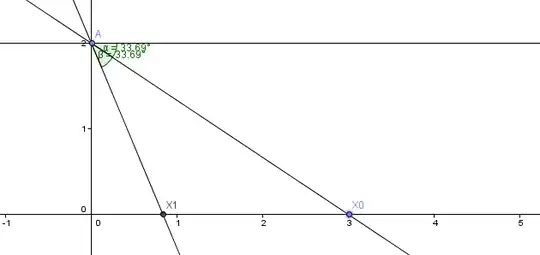
This also gives a geometrical interpretation of the recursion :