4

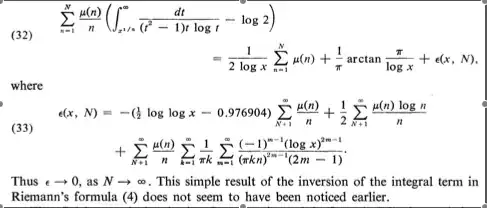
In their article "Calculations Related to Riemann's Prime Number Formula", Riesel and Gohl claim a simplification of Riemann's evaluation of the modified prime counting function \begin{align} \pi_{0}(x) & = \tfrac{1}{2} \lim_{\epsilon \to 0} \pi(x + \epsilon) + \pi(x - \epsilon) \\ & = \lim_{N \to \infty} R_{N}(x) - F_{N}(x) \end{align} where $F_{N}(x)$ is an infinite sum which depends only on the complex zeros of the zeta function in the critical strip and accounts for the discontinuities of $\pi_{0}$ at the primes, while \begin{align} R_{N}(x) = \sum_{n \geq 1} \frac{\mu(n)}{n} \mathsf{li}(\sqrt[n]{x}) + \frac{1}{2 \log x} \sum_{m = 1}^{N} \mu(n) + \frac{1}{\pi} \arctan \frac{\pi}{\log x} + \epsilon_{N}(x) \end{align} is a smooth function of $x$, and $\epsilon_{N} \to 0$ as $N \to \infty$. The first term is Riemann's well-known approximation to $\pi_{0}$, and the remaining terms depend only on the trivial zeros of the zeta function (at the negative even integers). One often finds the approximation, \begin{align} \pi_{0}(x) \approx \sum_{n \geq 1} \frac{\mu(n)}{n} \mathsf{li}(\sqrt[n]{x}) - \frac{1}{ \log x} + \frac{1}{\pi} \arctan \frac{\pi}{\log x} \end{align} usually attributed to them. What of the factor of $\frac{1}{2}$ and sum involving the Möbius function; doesn't this sum diverge?
enter image description here

azimut
  • 24,316
user02138
  • 17,314

2 Answers2

3

They used the classical formula $$\frac 1{\zeta(s)}=\sum_{n\ge1} \frac{\mu(n)}{n^s}$$ and applied it with different values of $s$ to get :

  1. $\sum_{n\ge1} \mu(n)=-2\ $ ($s=0$ and using $\zeta(0)=-\frac 12$) (warning : conjectured only!)
  2. $\sum_{n\ge1} \frac{\mu(n)}{n}=0\ $ ($s=1$ and since $\frac 1{\zeta(1)}=0$)
  3. $\sum_{n\ge1} \frac{\mu(n)\log(n)}{n}=-1\ $ (at $s=1$ with $\left(\frac 1{\zeta(s)}\right)'_{s=1}=1$ and $\left(\frac 1{n^s}\right)'_{s=1}=-\frac{\log(n)}n$)

    The transformation used was the first one in your case (with $+$ in front of the initial $\frac 1{\log(x)} \sum \mu(n)$ I think).

    But this doesn't seem satisfying for a proof since Hardy wrote about (2) that it was as "deep" as the prime number theorem (in "Ramanujan" page 24, I think that (2) was proved by Landau, for a recent review see Terence Tao's "A remark on partial sums involving the Möbius function").

    Concerning your first sum this wikipedia article about the Mertens function should be helpful.
    If we define the Mertens function as $M(n)= \sum_{k=1}^n \mu(k)$ then $M(n)=\operatorname{O}\left(n^{\frac 12+\epsilon}\right)$ for every $\epsilon >0$ is equivalent to the Riemann Hypothesis (Anderson 'On the Möbius function').

azimut
  • 24,316
  • Thank you for your answer. How is $1.$ conjectural? One can replace the summation with the inverse zeta function and evaluate it at $s = 0$. The estimate of Merten's function precludes the conjecture anyway, no? – user02138 May 29 '12 at 20:28
  • @user02138: Well if you look at the picture of the Mertens function you'll notice that the function is (randomly) oscillating with increasing amplitude so that it is very probably divergent (I am not saying that a kind of 'pseudo-limit' isn't $-2$ but a limit requires convergence that seems unlikely here...) – Raymond Manzoni May 29 '12 at 20:39
  • 1
    $(2)$ was first proved by von Mangoldt (1897). In 1899, Landau gave a much simpler proof in his dissertation. Also in 1899, de la Vallée Poussin gave a simpler proof than von Mangoldt's. Not as simple as Landau's, but de la Vallée Poussin proved more, $$\sum_{n \leqslant x} \frac{\mu(n)}{n} = O\biggl(\frac{1}{\log x}\biggr),.$$ – Daniel Fischer Sep 10 '20 at 16:15
  • @DanielFischer: Thanks for the correction and additional information! – Raymond Manzoni Sep 10 '20 at 19:25
2

This paper uses very unfortunate notations: most of the functions (Rₖ, Tₖ, etc.) have a hidden parameter N (which limits the summation in n). So even when you think that some terms do not depend on N, they do! In most of the places in this paper, N<∞, so the question of convergence in n does not arise…

One should keep in mind that the main purpose of all the formulas in this paper is to calculate with sufficient precision for the plots in the paper. As far as I can see it today, their strategy is:

  • Choose N so that the summation of (4) (saying π(x) = ∑ₙ μ(n) f(ⁿ√x)/n) is exact (due to f(x)=0 for x<2);
  • Use this N in the last summand ∑ₙ₌₁ᴺ μ(n)/n · li(ⁿ√x^ρ) of (19);
  • Show that the second summand of (19) has a limit (see (32),(33) above) when N → ∞;
  • Show that the first summand in (19) differs from ∑ₙ₌₁ᴺ μ(n) by a term converging when N → ∞.

So the calculations in the formulas (32) and (33) are only a glazing on the cake: the terms with a mysterious dependence on N (in the last summand of (19)) are completely ignored (analytically), and dealt with numerically.

(Additionally, they put an extra condition on N, that ∑ₙ₌₁ᴺ μ(n) = -2 (after (36)). Their rationale is completely unclear: why do they care about decay rate in log x if they have a precise formula?!)