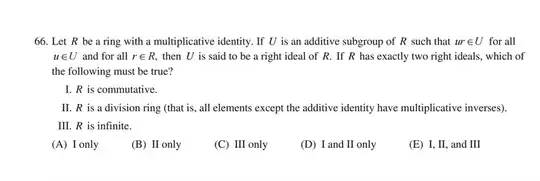
Can someone tell me how to analyze this question?
Can someone tell me how to analyze this question?

I'll write this out in real time to try to show my thought process.
We're given that some ring has exactly two right ideals. That seems like an odd condition - how do we count ideals, how does that relate to commutativity? Anyway let's try. First, are there any ideals that all rings have? There's the ideal containing 1. That ideal has to be all of R since ideals are closed under multiplication by $R$. There's also the ideal generated by 0 - the zero ideal. Great, we're already at two.
Now the problem becomes: what rings have no nontrivial right ideals? What does that mean? Among other things, it means that the right ideal generated by any element is the entire ring. Wait, not quite - any nonzero element.
Does this give us commutativity - not obviously. Does it make R a division ring? Given any nonzero element, the ideal it generates is all of $R$. So in particular it contains 1. Thus for any $u$ in $R$, we can find $r$ in $R$ such that $ur=1$. Exactly what we wanted. So II is true. Does R have to infinite? Fields are division rings, and finite fields exist, so no. But finite fields are commutative, so we still don't have a counter example for I. Lets go back to it.
In light of II, what's an example of an infinite division ring? The quaterions work. It's a division ring, so the conditions of the problem hold. Statement I is not necessarily true. The answer is B.
