I am having hard time with this question .I have not understood what is point and why is sequence $a_1 + 21$ , $a_2 + 21 $... has been taken in second picture .Please help me understand the question
Thanks
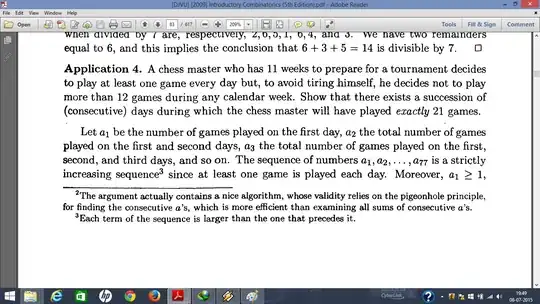
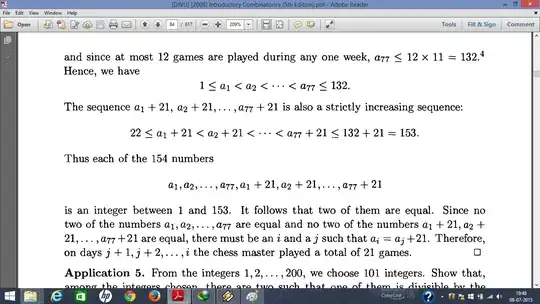
I am having hard time with this question .I have not understood what is point and why is sequence $a_1 + 21$ , $a_2 + 21 $... has been taken in second picture .Please help me understand the question
Thanks

This is an application of the Pigeonhole Principle. I'll try to explain the given answer in another way. Hopefully it will help your understanding of the solution.
We want to show that there is a consecutive sequence of days (we don't really know how many days) during which exactly 21 games are played. The strategy is to find two days ($1\leq j < i \leq 77$) such that $a_i = a_j + 21$; i.e. the total number of games played up to day $i$ is exactly 21 more than the total number of games played up to day $j$.
The first series of inequalities follows from the fact that at least 1 game is played per day, and the total number of games is limited by the number of weeks (11) and the maximum number of games per week (12). Thus, we can write:
$$1 \leq a_1 < a_2 < \cdots < a_{77} \leq 132$$
Now, if I interpret your question correctly, you are wondering why we have introduced the $a_i + 21$ terms. The reason for doing so is that we can apply the Pigeonhole Principle. Also, from the restatement of the question above, you can see that what we are after are two days $i$ and $j$ such that the total number of games played up to those points differ by exactly 21 (i.e. $a_j + 21 = a_i$). It's fairly easy to see (simply by adding 21 to the sequence of inequalities above), that:
$$22 \leq a_1 + 21 < a_2 + 21 < \cdots < a_{77} + 21 \leq 153$$
So, we know that all of the numbers
$$a_1, a_2, \cdots, a_{77}, a_1 + 21, a_2 + 21, \cdots , a_{77} + 21$$
are in between 1 and 153. We know that there are 154 items in the list, and only 153 possible values they can take, so we know that there must be two which are equal, by the pigeonhole principle.
Also, since the terms in each sequence are strictly increasing, we know that:
$$a_i \neq a_j \qquad \text{whenever $i \neq j$}$$
and also
$$a_i + 21 \neq a_j + 21 \qquad \text{whenever $i \neq j$}$$
Hence, the two which are equal must be from 'different' lists. That is, one is from the list $a_1, \cdots , a_{77}$, and the other is from the list $a_{1} + 21, \cdots, a_{77} + 21$.
Hence there exists a $j < i$ such that $a_j + 21 = a_i$, meaning that exactly 21 games were played during the days $j+1, j+2, \cdots, i - 1, i$.

Alternative solution (it proves a stronger result)
Here is a general theorem: Given a list of $n$ integers $a_1,a_2\dots a_n$ there is a list of consecutive integers that have a sum that is a multiple of $n$.
Proof:
Consider
$a_1$
$a_1+a_2$
$a_1+a_2+a_3$
$\dots$
$a_1+a_2+\dots+a_n$
If any of these sums is a multiple of $n$ we are done. Otherwise, each of them is congruent to one of the $n-1$ congruence classes $\bmod n$ that is not zero. So by the pigeonhole principle there is $j<k$ so that $a_1+a_2\dots a_j\equiv a_1+a_2+\dots a_k\bmod n$. Therefore $a_{j+1}+a_{j+2}+\dots a_k$ is a multiple of of $n$. This ends the proof.
We can use this theorem to solve your problem.
Consider the $21$ days $8,9,10,11\dots 28$, there is a sequence of consecutive days in which a multiple of $21$ games was played. This can be $21$ or $42$. If it is $42$ then that is because these $21$ days contain four weeks. two full weeks and two other weeks of which we have $7$ days in total. At least $42-24=18$ games were played in these $7$ days. Meaning, at least $7$ games were played in the other $7$ days of these two weeks. So at least $25$ games were played in these two weeks, this means at least $13$ games were played in one of these two weeks, a contradiction. So it is not $42$ and must therefore be $21$, so indeed there is a period of days in which $21$ games were played and we only needed days $1,2,3\dots 35$ to prove this.


The sequence was chosen that way because we were asked to prove there was a series of days on which he played $21$ games. If we were asked to prove there was a series of days on which he played $19$ games, we would have used $a_1+19, a_2+19 \dots $ and the same argument would have gone through.
