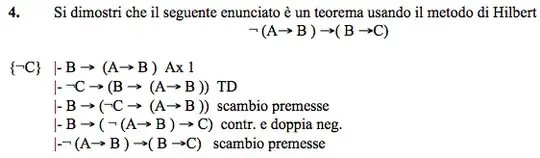
I figured out a way of doing these, from the bottom-up, starting from the statement provided without having to induce anything upfront. First off you should look into some algebra for this system (which is deduced from the main 3 axioms) here: https://it.wikibooks.org/wiki/Logica/Calcolo_delle_proposizioni/Sistema_di_Hilbert#Regole_derivate - it's in italian but what matters are the actual properties.
Now, let's say you're given a statement and you have to show it's a theorem in Hilbert's system. First thing is you write it down your page so you can write stuff on top of it:
Whenever you're confronted with something like $¬(A → B)$ - a NOT of two terms - you have to find a way to get rid of the NOT in front of it either by using the contrast property where $A → B$ is equal to $¬B → ¬A$, or by using the so called exchange of premises property where $A → (B → C)$ is equal to $B → (A → C)$. So from the above we go ahead and apply the exchange of premises property and exchange the $¬(A → B)$ with the $B$:
- $B → (¬(A → B) → C)$
- $¬(A → B) → (B → C)$
We moved it inside so we can get rid of the NOT, which as I said earlier, should be our main goal. In fact, now that $¬(A → B)$ is inside, we can apply the contrast property to help us negate it and therefore get rid of the NOT as such:
- $B → (¬C → (A → B))$
- $B → (¬(A → B) → C)$
- $¬(A → B) → (B → C)$
Great so remember that our goal is to continue this process until we find a statement which is an instance of one of the 3 axioms of Hilbert (linked in the question). It seems we're getting close to match Axiom P2 $A → (B → A)$, if we just move the B inside:
- $¬C → (B → (A → B))$
- $B → (¬C → (A → B))$
- $B → (¬(A → B) → C)$
- $¬(A → B) → (B → C)$
Now we simply need to move ¬C out and we matched our P2 Axiom and therefore showed that the initial statement was in fact a theorem.
- $¬C \vdash B → (A → B))$
- $¬C → (B → (A → B))$
- $B → (¬C → (A → B))$
- $B → (¬(A → B) → C)$
- $¬(A → B) → (B → C)$