I am studying the integral, given by a Laplace transform,
$$\int_0^\infty\!e^{-\alpha x}\sinh^{-2/3}x\left(1+\frac 12\sinh^2x\right)^{-1/6}\left(1-\beta\sinh^{4/3}x\right)^{1/2}\,\mathrm dx$$
From what I can tell there are three singularities: one at $x = 0$ (from the second term in the integrand) and two at $x = \pm\sin^{-1}\sqrt 2$ (from the third term). The only multi-valued term should be the third term since
$$\left(1+\frac 12 \sinh^2x\right)^{-1/6} = \left(x-\sin^{-1}\sqrt 2\right)^{-1/6}\left(x+\sin^{-1}\sqrt 2\right)^{-1/6}$$
and the hyperbolic functions are single-valued. This means I can set up my branch cut along the real axis in the range $x\in\left(-\sin^{-1}\sqrt 2,\sin^{-1}\sqrt 2\right)$, but this makes the choice of contour really confusing. This integral is not symmetric under the transformation $x\to -x$ or anything else as far as I can see.
Here's my question: What is a good choice for a contour for this integral? Would it even include any of the three poles if it does not go around the branch cut?
FIRST EDIT: From what I understand, when hyperbolic functions are involved it is good to use a rectangular contour and exploit symmetries. Here it would be $\sinh x = \sinh(x+2\pi i)$ and a good contour would be from $i\epsilon$ to $2\pi i$ to $R+2\pi i$ to $R+i\epsilon$ and back along the real axis, taking the limits as $\epsilon\to 0$ and $R\to\infty$.
Some new questions with respect to this revelation: do I pick up a quarter of the residue at the origin? And am I correct that the branch point at $\sin^{-1}\sqrt 2$ does not contribute any residue? How is the limit $\epsilon\to 0$ different along the branch cut vs past it?
SECOND EDIT: After further study (and the limited help of Mathematica) it turns out this integral is filled with branch points. See the picture below.
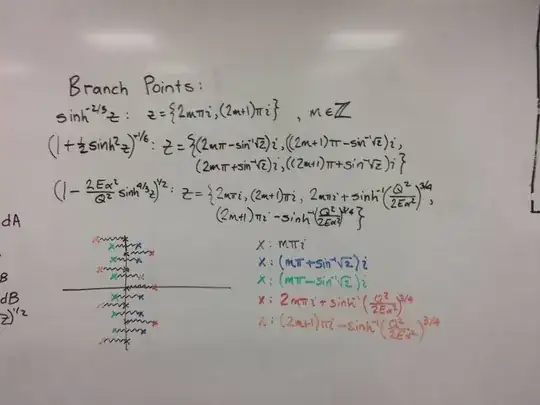
Notice how I've connected pairs to form short, finite-length branch cuts which can be integrated around. This now means there are no removable singularities where the residues may be picked up. Instead, the path I've previously described needs to be extremely deformed in order to close the contour. The main concept which confuses me now is how you would integrate over half a dumbbell/dogbone contour (see the branch cut along the portion of the real axis) when the contour continues further past it.
