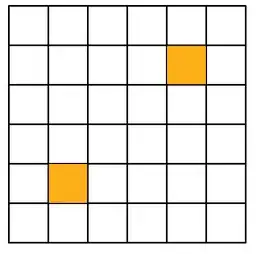
How many rectangles are there which do not include any yellow squares?
How many rectangles are there which do not include any yellow squares?


Here is a more combinatorial/algebraic approach:
Let the Horizontal lines from bottom to top be $h_{0}, h_{1}, ..., h_{6}$ and Vertical lines from left to right be $v_{0}, v_{1}, ..., v_{6}$
Total Rectangles $= {7 \choose 2} \times {7 \choose 2} = 441$
Rectangles that contain bottom left yellow square is all rectangles that can be formed by choosing one horizontal line from $\{h_{0}, h_{1}\}$, another horizontal line from $\{h_{2}, ..., h_{6}\}$ and one vertical line from $\{v_{0}, v_{1}\}$, another vertical line from $\{v_{2}, ..., v_{6}\}$.
Total number of rectangles that contain bottom left yellow square $=$ $\left({2 \choose 1} \times {5 \choose 1} \right) \times \left({2 \choose 1} \times {5 \choose 1}\right) = 100$
Similarly, total number of rectangles that contain top right yellow square $=$ $\left({2 \choose 1} \times {5 \choose 1} \right) \times \left({2 \choose 1} \times {5 \choose 1}\right) = 100$
Total number of rectangles that contain both the yellow squares are all the rectangles that can be formed by choosing one horizontal line from $\{h_{0}, h_{1}\}$, another horizontal line from $\{h_{5}, h_{6}\}$ and one vertical line from $\{v_{0}, v_{1}\}$, another vertical line from $\{v_{5}, v_{6}\}$.
Total number of rectangles that contain both the yellow squares $=$ $\left({2 \choose 1} \times {2 \choose 1} \right) \times \left({2 \choose 1} \times {2 \choose 1}\right) = 16$
From principle of inclusion-exclusion: Rectangles without any yellow squares $=$ $441 - (100+100-16) = 257$
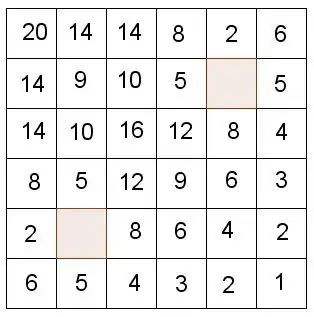
What I did is, in each square, count the number of rectangles that could be drawn having the same upper left corner as that square, which also do not include the shaded squares I also got 257. I hope someone will check my work. I have a bit of a dyslexia - type problem and it's really hard for me to do things like this without messing up.

Here is an illustration to Yagna Patel's solution:

Each possible rectangle is described by the choice of two horizontal and two vertical lines. This helps to emphasize the choice aspect. See e.g. the lower yellow rectangle $(h_1, h_2, v_1, v_2)$.
The lines can also be viewed as coordinate lines and we could say that rectangle has a lower left point $(1,1)$ and a higher right point $(2,2)$.
