25

Related to some other problems, I got interested in this function:

$$(x+1)^{x+1}-x^{x+2}$$

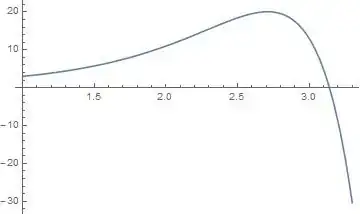
Its root is very close to $\pi$. This is Mathematica code that finds the root:

NSolve[Power[x + 1, x + 1] - Power[x, x + 2] == 0, x, Reals]

{{x -> 3.14104}}

($\pi \simeq 3.14159$)

Moreover, the location of its maximum is very close to $e$:

FindMaximum[Power[x + 1, x + 1] - Power[x, x + 2], {x, 2.65, 2.78}]

{20.0645, {x -> 2.70965}}

($e\simeq 2.71828$)

I find these facts almost disturbing.


Is there a deeper mathematical explanation for such "close but not quite" behavior?


I tried various ways of approximation of this function (similar to this), but don't have enough math knowledge and background to get any result that makes sense.

Here is the graph of the function:

enter image description here

VividD
  • 16,196
  • 1
    Disturbing, no but interesting, yes ! – Claude Leibovici Jul 11 '15 at 12:43
  • Interesting is that the integral from $0$ up to the root is $\approx \left(\pi -\frac{1}{3}\right)^{\pi }$ and $\approx \left(2+\sqrt{2}+\sqrt{e}\right)^2$ – Claude Leibovici Jul 30 '15 at 11:26
  • 1
    What in the world were you doing? People aren't supposed to do creepy math thingys that result in mindblowing stuff. Well, whatever you're doing, have fun! – Simply Beautiful Art Dec 07 '15 at 01:47
  • 2
    I believe this is just random. I'm sorry, but there's probably just luck going around in this. And why does the $y-intercept$ not match the expected value? It doesn't appear to be 1? – Simply Beautiful Art Dec 23 '15 at 00:56
  • The root of $\frac{x-3}{2}+(x+1)^{x+1}-x^{x+2}$ is even closer to $\pi$ than yours. One can find infinitely many such examples (and I would bet, getting closer and closer to $\pi$). So I'm not sure that it is of any particular significance. – barak manos Jan 04 '16 at 15:37
  • 1
    To understand the maximum at e, try thinking of your function as the ratio of selected terms from the power series for $e^{x+1}$ and $e^{x}$ so that the result of setting the first derivative to 0 is approximately e. – frogfanitw Feb 15 '16 at 06:10
  • We can rewrite equation for the root as: $$x=\left( 1+ \frac{1}{x} \right)^{x+1}$$ Thus, $x > e$ – Yuriy S Apr 05 '16 at 21:56
  • 2
    We can also expand the above expression for $x>1$: $$x=e+\frac{e}{2x}-\frac{e}{24x^2}+\frac{e}{48x^3}-\frac{73e}{5760x^4}+\dots$$ The first approximation for $x$ will be: $$x \approx \frac{e+\sqrt{e^2+2e}}{2}=3.14978$$ – Yuriy S Apr 05 '16 at 22:09
  • A closely related question http://math.stackexchange.com/questions/580480/prove-a-pi-inequality-left1-frac1-pi-right-pi1-pi/598394#598394 – Yuriy S Apr 06 '16 at 09:19
  • @SimpleArt , y-intercept is $3$, as it should be: $(1+1)^{1+1} - (1)^{1+2} = 3$ – VividD Apr 13 '16 at 19:07
  • @VividD Your supposed to plus in $x=0$ to find $y$-intercept. Which yields $y=1$, if done correctly. – Simply Beautiful Art Apr 14 '16 at 00:29
  • @SimpleArt But for the plot, y axis is x=1, and y has value 3 at inertcept, so everything is fine. – VividD Apr 14 '16 at 10:10
  • @VividD Oh, yes, but now that graph is bothering me. XD Statistics says that your graph is misleading... – Simply Beautiful Art Apr 14 '16 at 20:08

1 Answers1

2

This is not an answer, but too long for a comment.

The most interesting part is the root location, so I'm going to clarify my comment about the series expansion.

The equation for the root can be transformed to have the form:

$$x=\left(1+\frac{1}{x} \right)^{1+x}$$

Consider the function:

$$f(x)=\left(1+\frac{1}{x} \right)^{1+x}$$

Let's change the variable $1/x \to y$, and expand the resulting function around $y \to 0$ up to third order terms:

$$\left(1+y \right)^{1+\frac{1}{y}}=(1+y)\exp \left( \frac{1}{y} \ln (1+y)\right)=(1+y)\exp \left( 1-\frac{y}{2}+\frac{y^2}{3}-\frac{y^3}{4}+\dots\right) =$$

$$= e(1+y) \left(1+\left(-\frac{y}{2}+\frac{y^2}{3}-\frac{y^3}{4} \right)+\frac{1}{2} \left(-\frac{y}{2}+\frac{y^2}{3} \right)^2+\frac{1}{6} \left(-\frac{y}{2} \right)^3 \right)+O(y^4)=$$

$$=e \left(1+\frac{y}{2}-\frac{y^2}{24}+\frac{y^3}{48}\right)+O(y^4)$$

So finally we have an approximation:

$$x \approx e \left(1+\frac{1}{2x}-\frac{1}{24x^2}+\frac{1}{48x^3}\right)$$

Substituting $\pi$ on the right side we get:

$$x \approx e \left(1+\frac{1}{2\pi}-\frac{1}{24\pi^2}+\frac{1}{48\pi^3}\right)=3.14126\dots$$

I don't see any deeper reason for $\pi$ to be a good approximation for the root of this function. It seems to be a coincidence.


There should be nothing surprising about the maximum, because this function is closely related to $e$.

But it turns out to be tricky. Let's find the fist derivative of the function:

$$g(x)=(1+x)^{1+x}-x^{2+x}=e^{(1+x)\ln(1+x)}-e^{(2+x)\ln(x)}$$

$$g(x)'=(1+\ln(1+x))e^{(1+x)\ln(1+x)}-\left(1+\frac{2}{x}+\ln(x) \right) e^{(2+x)\ln(x)}$$

The equation for the extremum is:

$$g(x)'=0$$

Which can be transformed to:

$$\left(1+\frac{1}{x} \right)^{1+x}=\frac{2+x(1+\ln x)}{1+\ln(1+x)}$$

If we substitute $e$ on the right hand side, we get:

$$\frac{2+x(1+\ln x)}{1+\ln(1+x)}=\frac{2(1+e)}{1+\ln(1+e)}=3.215\dots$$

On the left hand side we get (note that for any $x$ we know that $\left(1+\frac{1}{x} \right)^{1+x}>e$):

$$\left(1+\frac{1}{x} \right)^{1+x}=\left(1+\frac{1}{e} \right)^{1+e}=3.205\dots$$

Again, I'm not sure if we can make any conclusions from the fact that the solution is close to $e$.


But I hope these calculations help the OP get a better understanding about this function.
Yuriy S
  • 32,728